Observing your trees – a problem with ash
Sherlock Holmes’ common criticism of his friend Dr Watson was: “You see but do not observe”. All of us are guilty. But once our attention has been drawn to a subject, we start seeing ‘everywhere’ what had before passed unremarked upon. And this is what I want to do with Ash trees.
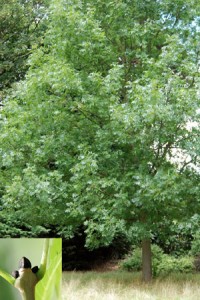
In May I began noticing that two Ash trees visible from the study window were behaving very differently. They were next to each other and both about 60 feet high. One flushed and developed normally, and was still in full leaf in mid-October, the other ‘struggled’ into leaf with a few leaves eaten, a few not appearing on shoots until August, and many shoots never flushing at all. Throughout the summer the crown was transparent with just a few, scattered leaves hanging on.
I started to observe Ash closely on my travels, which over the year have included East Anglia, West Scotland, South Wales, and southeast Ireland, as well as my home patch of central Southern England. Poorly crowned Ash were everywhere, with perhaps one tree in four looking well below par, and perhaps one in ten with much of the crown appearing dead. These are observations not measurements, but they indicate the extent of the problem.
 I began raising the matter with colleagues at forestry field meetings and with the research community at Alice Holt. Much of the early concern was put down to late flushing – odd after such a warm April – but the continued poor condition of many Ash crowns prompted closer examination of the problem. It appears that a nasty disease of Ash is affecting the species in eastern and central Europe, notably Denmark, Poland and Sweden, with wilting of shoots caused by the fungus Chalara fraxinea. The reports are alarming and described as serious, though unlikely to kill a whole stand of trees. The fungus has not been isolated yet in UK and, crucially, the symptom of wilting does not match what appears wrong with our Ash. However, samples of shoots showing the symptoms of (a) failed flushing, and (b) very delayed (August) flushing have been taken from 20 year old Ash in my own wood (where trees range from full health to very poorly foliaged crowns) for culturing for possible pathogens. Results are awaited as I write.
 Of course, Ash is prone to several threats – unseasonal frosts, the Ash bud moth, Ash bark beetles, Nectria canker and the Ash dieback problems found in the 1980s associated particularly with hedgerow and field trees appearing to suffer from intensified farming practices. But what has been happening to Ash in 2007 is peculiar. Only time will tell of a wider significance. In my own wood I’ve identified, described and marked pairs of healthy and unhealthy specimens and so next Spring is now awaited with extra interest!
If readers have observed these unusual conditions The Disease Diagnostic and Advisory Service (DDAS) of the Forestry Commission’s Forest Research at Alice Holt will be pleased to receive a report. Send to: [email protected] They would also like to hear from readers of reports of bleeding in oak trees especially Quercus robur.
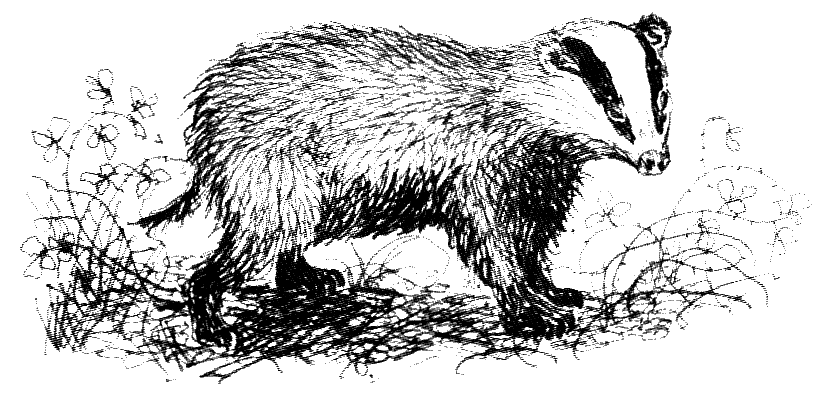
And finally, owing to demand and interest expressed to the writer in the past, readers of this regular piece may be interested to know that ‘Badgers, Beeches and Blisters – getting started in you own wood’ has been reprinted with minor revisions. It is available at the same price of £8.95 (post-free) from Patula Books, Box 6674, Basingstoke RG24 4DP or visit the website www.patulabooks.co.uk for more details.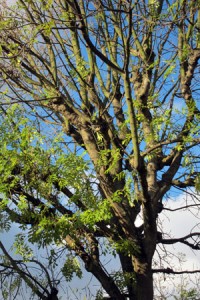
[This item by Professor Julian Evans first appeared in CONFOR’s December 2007 Forestry and Timber News and is reproduced by permission]
Addendum :
for advice on Ash Dieback - perhaps visit
https://www.trees.org.uk/Help-Advice/Public/Ash-Dieback-–-Practice-Guidance
https://www.rhs.org.uk/advice/profile?pid=779
https://www.forestresearch.gov.uk/research/archive-ash-dieback/
Comments are closed for this post.
Discussion
Please what can we do to save our very old wheeping ash tree it’s leaves have not yet appeared is there any thing I can do to help it live thanks
There is a very old Weeping Ash – the only one around here, that I can see through my window.
I’m wondering if a tree not in close proximity to other ash trees has a better chance of remaining healthy & not suffering from the list of diseases you mention?
I first noticed this problem in the Vosges mountains in France last September–wilting leaves at that time of early autumn . A stay in West Cork a couple of weeks later revealed the same problem, and back home in W.Cornwall it looked as though at least 50% of the ashes had the same symptoms. Some of them seem to have recovered, despite having dead keys from last year still on their branches. In my own garden , where I have over a dozen ashes over 50 years old, 2 in particular now look very unhealthy, with thinned foliage, and marked crown dieback. I have also had one ash that died quite suddenly over a year ago.It had a most magnificent ring of bracket fungus around its base–but I have not seen it on any of the other trees-so I don’t know if its part of the same problem. I’ve become obsessed with it–its almost a relief to find that others are equally concerned! But what to do?
We’ve just felled a 20-yr old Ash. The centre trunk was clearly dead, the bark peeling, the wood mildly spongy and any leaves crisp & dry.
Although other branches were flourishing with berries on, we elected to take it down now than risk it taking itself down. There is fungus growing in areas, but fungus grows on rotting wood anyway? I’m no gardener……
My other trees look fine.
I’m in Norfolk.
I came across this while searching for dying ash trees. We have several large ash trees growing opposite (c. 100 years old) and two to the side (both of which have just had to be felled as they were dead). The ones opposite have a few leaves coming out of some of their branches and look generally sickly with poor leaf cover, so basically a cluster of 6 or so trees that are all ill. We also have a c. 100 year old weeping ash in our garden that has never looked healthier, so it seems specific only to the non-weeping variety. I am going to speak to the neighbour who’s land they are on about cutting some of the Ivy off to try and help save them though I fear there maybe something else at foot and would be grateful of any information on trying to help save these beautiful trees.
In my case it turns out to have been a late and unprecedentedly late frost -4°C.
It took a month for the Ash to get back to where they had been and now almost two moths later other trees that took longer to show the effect, are now about back to where they were.
Yes I have started to notice ill and dying trees everywhere. Its almost one in two here in Meath, Ireland. If anyone wants to email me I would appreciate it as our own do not seem to notice or care,
John
I have half a dozen Ash and until a day or so ago they all seemed normal. Now all the leaves are shrivelled, hanging down and almost black.
Yes, I have noticed similar problems with a number of elderly 60ft tall ash trees in the small coppice at the bottom of my garden in East Kent, which has a mixture of mainly oak, ash and chestnut. Have also see gatherings of almost “luminous” small moth-like creatures hovering around the trees – could there be a connection, I wonder?
Last year they seemed reasonably healthy but I was advised to remove any ivy growing on them and other trees to prolong their life. Like H-P I have new ash saplings springing up everywhere that I don’t want them! However, I would hate to lose the ones in the little wood.
Probably best to consult a tree expert. My trees (although always quite spindly because closely packed together) have a preservation order on them so I have to consult the chap at the Council to get permission to cut any down. Will be doing that very soon and will post any further comments.
I have too have been aware of something very strang happening to ash trees as far afield as Wiltshire (from Cornwall) in all areaas that I have visited. Last year they seemed late to show spring growth and then have failed to drop their keys. I got close to an Ash in North Devon today and noticed die-back from the dead-appearing keys for at least nine inches. I also noted one or two starting to come into leaf. It would be good to know what is being done to protect these beautiful trees.
Hello, I stumbled on this article whilst searching the web for any evidence of Ash trees dying, I am not a tree expert, I’m just a maintainer of my garden and this month of April 2011 I had finally got around to sorting out the lawn, a chore made worse because I didn’t get around to clearing the leaves and millions of Ash tree seeds resulting from the Autumn fall. After my 4th day of raking up these deeply embedded devil seeds I noticed that there appeared to be a covering of new seeds on the areas of lawn I had raked. Amongst a variety of trees in my or neighbouring gardens there are four Ash trees, on the first glance the two in my garden appeared to be fine and were sporting new leafy buddy things, but the giant Ash two gardens to my right and the one two to my left and a further previously unnoticed one to the rear of my garden still all have clumps of dead looking seeds attached and no new growth at all, in fact they look positively dead to my untrained eye, and I suspect maybe for some time as they obviously did not drop their seeds when I think they should of done last Autumn, now looking back at my two trees I’m wondering whether the new buddy leafy things they are sporting are as lush as they should be. Before finding this UK article (I live in Essex) I read about the Emerald Ash boring beetle devastating Ash trees in the USA, and the theory that Wi-Fi is killing Ash trees in Holland. I have many expensive garden casualties resulting from the double snowy winter we had but surly not mature Ash trees. Can anybody tell me whether there are any known problems in the UK or indeed whether anybody is still reading this article posted in 2007, is there anybody out there? And if so, any thoughts?
H-P.
Have noticed a lot of similar symptoms in ash tress in Co Galway in Ireland. Have you any updates on this problem for ash trees?
I think a lot of ash is diseased. Try walnut , or rowan . We lost two mature beeches.
I have a very old weeping ash ,I mean probably 90 years old . I have noticed over the last few years , less and less leaves being produced and branches breaking off. Shoots coming through the bark , what is happening do yo know and what can I do please help .
Yvonne MChUGH
29 May, 2019