Native and non-native bluebells – an update
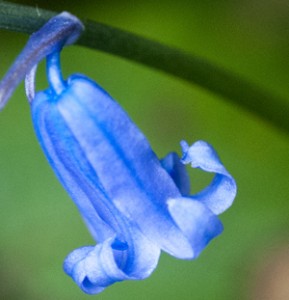
The onset of Spring brings a variety of blue flowered plants such a bluebells, hyacinths and squills in our gardens, parks and woodlands. The bluebell is ‘easily’ recognisable. However, there are two or three different types of bluebells. The bluebell that is native to the UK has the Latin or Linnaean name of Hyacinthoides non scripta.
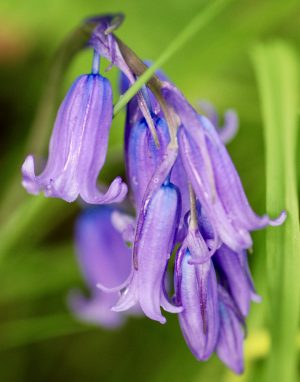
Its deep blue and scented flowers hang from an elegantly arching stem. It is found in abundance in many deciduous woodlands and hedgerows across the UK, though it is unusual or rare in parts of East Anglia and Scotland. The Spanish bluebell (H. hispanica) is also to be found.
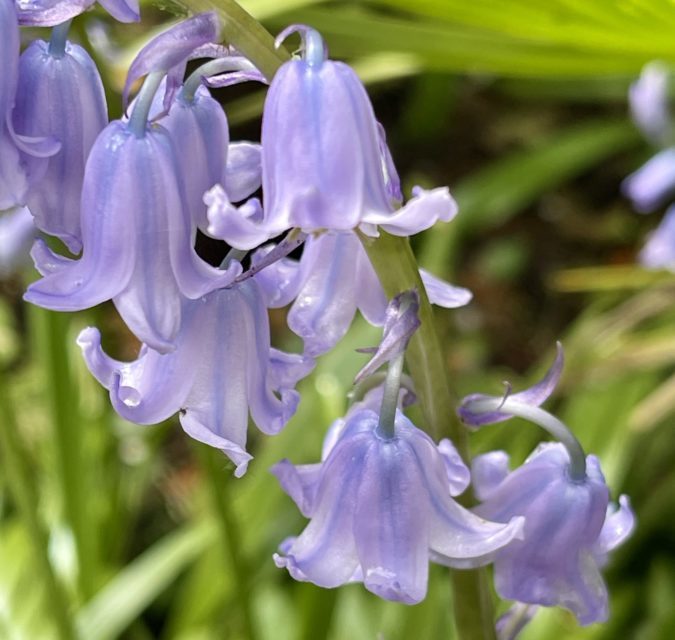
It is possible to distinguish between the two species – some of the differences are listed in the table below:
| Native Bluebell | Spanish Bluebell |
|---|---|
| Leaves are narrow by comparison to Spanish Bluebell, about half an inch or so wide | Leaves broader, often an inch or more wide |
| The flowers at the top of the stem droop to one side | The top of the stem is much more erect |
| The flowers hang from one side of the stem | The flowers are arranged around the stem |
| The flowers are deep violet blue | The flowers are a pale or mid blue, and white and pink ones are also found |
| The flowers have parallel or straight sides and have a narrow bell shape | The flowers are more ‘open’ with a cone shaped bell |
| The tips of the petals roll back somewhat as though they ‘want’ to touch the tube of the flower | Not such obvious curving |
| The pollen is a pale cream colour | Pollen is a blue colour |
| Flowers are scented | No scent detectable |
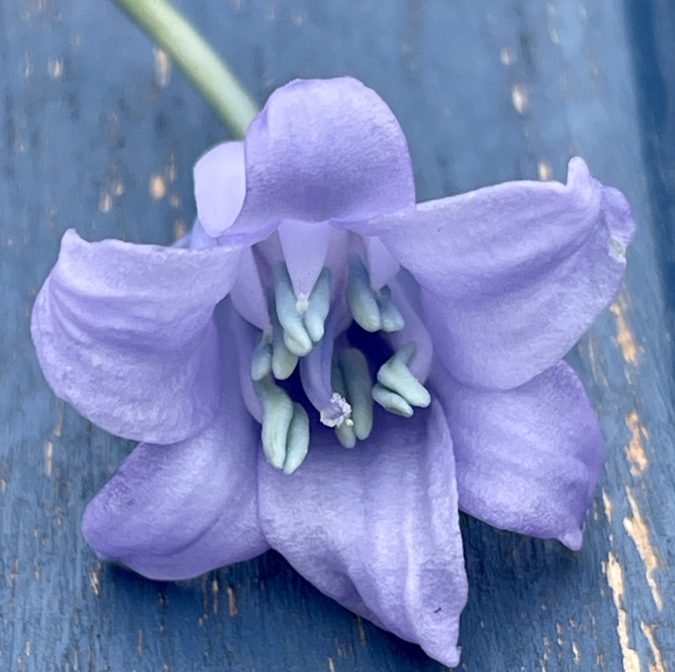
The spanish bluebell can hybridise with the native bluebell, giving rise to types that have a mixture of the above characteristics.
The Natural History Museum is trying to map the distribution of these different bluebells and it is asking people to complete an online questionnaire about the bluebells in their gardens, local parks, hedgerows and woodlands.
If you can help, go to: http://www.nhm.ac.uk/nature-online/british-natural-history/survey-bluebells/recording/index.html
Since this was first posted in 2006, there have been various updates, but the bluebell survey link does not seem to be active now.
See : https://www.nhm.ac.uk/take-part/citizen-science/bluebell-survey.html
Comments are closed for this post.
Discussion
Bluebells
Bluebells currently enjoy an advantage in that they start their growth and development in the chill of winter / early spring. This allows them to ‘enjoy’ the open canopy before the trees come into leaf. With climate change, this advantage may be lost – see
Sussex Wildlife Trust
http://www.sussexwt.org.uk/news/archive/page00052.htm
The NHM link has moved, here’s a new link. They’re still analysing 2006’s results, but will soon be starting 2007’s recording.
http://www.nhm.ac.uk/nature-online/british-natural-history/survey-bluebells/bluebells-exploring-british-wildlife.html
I have a rare white bluebell in my garden.
Emma
3 May, 2023