Wild Food Courses
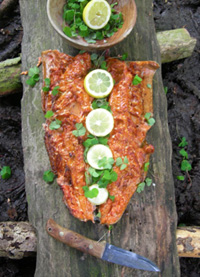
Have you ever wondered what salad plants you can pick and eat on your walks in the countryside? Have you ever prepared and tasted succulent rabbit-burgers grilled on a barbecue in the woods or smoked your own trout fillets in a back-woods smoker?
Dan Watson (North of England Agent), Rob Pickering and Liz Murphy ran three two-day courses in preparing and eating wild food at a Woodlands.co.uk wood at Wynyard in County Durham in May.
The course base camp was in the heart of a 500 acre ancient mixed broadleaved woodland with the working area in a beech and birch glade close to a stream.
The 22 course participants bared up well in the dreadful May weather and thoroughly enjoyed learning camp craft skills such as building different types of cooking fires, knife work, spoon carving and cord making as well as dealing with (and eating!) a wide range of wild and camp foods including:
- Bannocks & breads.
- Edible salads from the hedgerow.
- Trout, Salmon and Sea Bass preparation & cooking methods.
- Game preparation & cooking methods for Venison, Rabbit, Pigeon.
- Woodland quiche
- Backwoods oven & smoker
- Fruit syrups & crumble
- Building a Hangi oven (a hot rock cooking method) for a communal feast
Classic hedgerow beverages such as nettle beer, raspberry vodka and oak-leaf wine were also sampled to ensure that a thoroughly merry time was had by all!
If you fancy trying nettle beer (an excellent and refreshing summer drink ready in two to three weeks) this is a great recipe based on the Roger Philips Wild Food book which Rob has adapted slightly, but do heed the caution!
You will need:
- 1 full carrier bag of fresh young nettle tops
- 12 litres of water
- 3 lbs sugar
- 1 tbsp cream of tartar
- 1 tsp winemaking yeast
- Juice of one lemon (or orange)
- 16 beer bottles
- 16 bottle caps
- Bottle capper
To make the beer:
1. Wash nettles
2. Boil the nettles for 15 minutes, then turn off and allow infusing for a further 15 minutes.
3. Strain into fermentation bin through two pillowcases (or some muslin)
4. Once strained, return the liquid to the pot
5. Add the sugar and the juice of one lemon (or one orange)
6. Lightly heat and stir to dissolve the sugar
7. Pour back into the fermentation bin and add the cream of tartar
8. Leave to stand until tepid
9. Start the yeast by taking a cup of tepid brew
10. When the liquid is lukewarm, add the yeast
11. Loosely cover and leave for 2 – 4 days
12. Strain (as above) and leave for one more day
13. Strain again and allow to settle
14. Sterilise the bottles by placing in a cool oven and heating to 175 degrees C (Gas Mark 3)
15. Allow the bottles to cool until hand warm
16. Siphon the beer off into bottles and cap tightly (don’t use screw tops)
17. Leave for at least a week (or three, if you can wait that long)
Makes 14-16 bottles
Open with caution, as it can be highly explosive, and enjoy
Roger Philips suggests serving with a sprig of mint and an ice cube.
‘‘We gorged ourselves on this gourmet weekend, it was great to get in touch with real food I prepared from scratch and ate outdoors. I came away feeling inspired and confident to find and eat more wild food in the future’’
Robin Meetham. Course participant.
Comments are closed for this post.
Discussion
Are you running any courses in 2012? Please provide details if you are.
Thanks
Good Site], I [suggest
Hi Adam,
If you had a small group of say 6, we could consider coming to your local area?
Fraser
Are there any courses running in the west Midlands or Leicestershire areas?
thanks
Adam
Hi
We will be running foraging courses in Pembrokeshire very soon, I was demonstrating wild food cookery at the recent ‘Really wild festival’ in St.Davids. We will be working with local foraging experts an hope to run our already popular ‘Edible seashore’ course as well as wild woodland and meadow foraging courses. A week long camp including the many aspects of wild food/medicine and cookery will hopefully take place in the late spring. Details can be found on wild food courses at
http://www.wildforage.co.uk. Telephone 07702 104644
Kind regards
Fraser Christian
Are there any courses held in South Wales?
I know a great recipe for those nettle leaves.. It will make you want to make more than ta out of them! Stinging Nettle Gnocchi with Dolcelatte Sauce!
http://wildfoodmushroomsfishing.blogspot.com/2010/03/stinging-nettle-gnocchi-with-dolcelatte.html
Enjoy!
I would love to know are there any wild food courses planned for 2010 have to bere with me though as i am a complete novice and very new to it but it does Interest me greatly
This sounds like a damson to me, it is part of the prunus family the same as a sloe. Great for gin and jam.
Hi Rachel – yes, blackthorns produce sloes. See a recipe for sloe gin at http://www.woodlands.co.uk/blog/wild-food/sloe-gin/
We have what we think might a Blackthorn tree maybe about 20ft high in our garden. It has vicious thorns (some at least four inches long), small oval shaped leaves, and it has a few plum-like fruit, which are a purplish red colour. However the fruit are not sour tasting, acting quite bland. They are soft, so probably ripe. Is it a Blackthorn/Sloe? Does anyone know? I’d quite like to make sloe gin so am hopefull!
nigel & to who ever else may be interested, i use ferrets to catch rabbits & prepare them for the plate myself. I would be happy to show you any time e mail me at [email protected].
Try this wild food site http://www.naturessecretlarder.co.uk
http://www.bushcraftliving.com and Greenman Bushcraft http://www.greenmanbushcraft.co.uk
There has been quite a bit of interest in running the Wild Food course again this Autumn so if you (or anyone else) are interested please let me know your contact details and I’ll send you some more information as soon as it is available. You could also have a look at the website at http://www.dwwp.co.uk/courses.asp , many thanks for your enquiry…
I am a local community health officer working with community groups within the west midlands area and would like to attend some courses on wild hedgerow foods and harvesting food for free ! from the wild ie fish and meat and want to know if there is some one who could teach me the basics in this type of thing that I can then pass on to others to get folk more interested in the food around them !
We live in a town environment but are surrounded by countryside so……….any help you could give me or contacts would be great ! Nig
We are planning more courses in the woods this year, slightly different to last year’s courses to include a focus on skills but with a wild food element to all of them.
– Self Reliance in June
– Bow-making in September and
– Backwoods Crafts – date to be confirmed
E-mail me at [email protected] if you’re interested in more details.
With regard to the recipe book, Roger Philips Wild Food is a great one.
Is there another course this year? we would love to come and find out more – and we are also looking for a recipe book… maybe you guys could club together your recipes and write one!
Tracy
Nettle tea is somewhat faster and a nice spring-like taste: pick tiny nettles, wash soil and insects away, boil and pour through a sieve.
This tea has the magical ability to change colour from green to light red when you add a slice of lemon. (The acidity of the lemon makes the colour change.) Children love this effect!
The leftover boiled nettles can be used for cooking much like boiled spinach, or simply sprinkled with salt and eaten.

I am interested in organising a foraging course in south Wales but don’t know how to contact an expert forager to carry out the course. Can anyone point me in the right direction. My email address is [email protected]
Thanks in advance
Simone
23 June, 2012