You are here: Home > Blog > Flora & Fauna > Grow Your Own Truffles
Print this page

Grow Your Own Truffles ~ by catherine

Grow Your Own Truffles

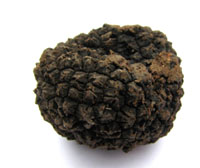
Usually one thinks of collecting truffles as a solitary activity carried out in secrecy at dead of night.  However it is now possible to buy trees already inoculated with truffle spores. 


Contrary to common belief commercial cultivation is nothing new.  Truffles have been cultivated since the 1800s and reached a peak in France in the late 19th century.  Large tracts of land were freed during this century by the spread of the fungus phylloxera which destroyed many vineyards.  Also, the French silk industry collapsed when disease killed the silk worms, making mulberry trees redundant. 

It was only with a shift of population from country to town, and the devastation of the First World War that cultivation on a mass scale declined.  In recent times, Australia and New Zealand have been successfully cultivating truffles.  It remains to be seen whether it takes off in this country.

Truffles are, of course, a fungus and “ectomycorrhizal”, that is they are found in association with plant roots, and have a symbiotic relationship with the trees they grow under.  The first cultivation of truffles was achieved in France by planting acorns from an oak that was known to have truffles growing at its roots.  Truffles prefer oaks, beech, hazels or poplars, and like sun and a moist, alkaline soil.  You will have to be patient though – it takes 5-8 years for them to start fruiting.

Although truffles are associated with France and Italy (Piedmont), there are many different varieties that grow all over the world.  They do grow wild in this country too, and the most common is the white, summer truffle (not to be confused, however, with the white Alba truffle from Italy which commands such high prices but cannot be grown here unfortunately!)

Despite its reputation as a luxury food, French and Italian peasants associated the truffle with famine.  As the food writer, Elizabeth Luard, explains in her book, truffles were a cash crop.  The peasants who collected them only ate them in times of war and hardship, when the market had collapsed.  They were used to flavour a pot of beans when no meat was available.

Having planted your inoculated tree and watched it grow, how do you find your truffle?  Trained dogs are preferred to pigs because they don’t root and are less likely to eat what they find!  Alternatively, some people say all you need is a stick to disturb the flies (there is a variety of fly which is particularly associated with truffles) and watch where they fly up.  A disturbance in the earth where they have swelled is another sign.  Good hunting!

Posted in: Flora & Fauna, Practical Guides ~ On: 4 April, 2008

60 comments so far

blogs at woodlands
23 September, 2011

cations = positively charged ions (sodium, potassium, calcium etc)

Guy Kiddle
23 September, 2011

The ratio of Calcium to Magnesium is particularly important. It is Magnesium that appears to regulate the symbiotic trigger in these fungi a requirement to establish the fruiting body; this has been known for some time.

http://totallytruffles.weebly.com/

There are however other mechanisms of this symbiotic relationship that are more poorly understood that limit the scope of the truffles growing in Southern Europe.

hakan konur
16 November, 2012

dear sir, we are a big truffles collectors in turkey.our truffles pure natural.we collect on mountains.we have willage personals all families can collect it. in 15 march then 15 may between we collect truffles. if you need it pleas send me meail.
hakan konur
mail: hacanoconner@hotmail.com
mob:00905462651185

French Marie
18 November, 2012

Please beware that there are 33 species of truffles, and I have collected 13 species in the UK. If you want to buy truffles to eat, that may be fine to buy from outside the country, but for using as inoculum, throwing the debris on any land, you risk damaging the environment, import damaging bacteria, insect larva, and fungi species, to the UK.

Northern Africa harvests mostly terfez, which are not truffles. They keep wanting to put them in the same categories but scientifically and culinarilly they are not. They are hypogeneous fungi (below soil level fungi) eaten like potatoes. I do not recognise these dates as dates for harvesting species of truffles.

See what has happened to the Dutch elm disease, oak die back disease ( rhododendrons), ash currently….what next?

Philip
25 December, 2012

I’ve always been interested in the woodlands and what we can take from our natural surrounds to be able to serve – so any additional information, I’m going to be so grateful to you, thanks.

Jamie
14 January, 2013

Philip…. Your take, do you give back ?

Peter Burton
18 March, 2013

Hi just to add to what French Marie said, I produce a liquid organic fertiliser which is also a great fungicide which I have offered the forestry commission and other organisations on a number of occasions but they dont seem to interested.

French Marie
19 March, 2013

Peter,

You have to be fully aware of what any introduced product does. There may be instances where you want to kill all fungi, but forests rely on fungi to access nutrients.
Fungi turn tough leaves and cellulose (wood) into readily available nutrients. Local fungi is best adapted to compete. If you kill all local fungi with a product, you have the potential for foreign fungi to get established…and kill the UK woodlands and forests, the food for plants, butterflies etc…..fungi is at the bottom of the food chain.

A lady had truffles and many species of mushrooms under a 250-300 yr old oak (many lovely in recipes!), some rare, others not and truffles….the state of her lawn bothered her so much that she hired a gardener to tidy her lawn, get rid of the moss, weeds…and I told her that she would get rid of her mushrooms too…and a season later…she admitted that I was right, nice grass but nothing else!

On the other hand many nurseries use mycelium from one or other fungi to grow plants (whips) faster…but then these tiny trees even if from local source or DNA, they are ruined for the local mycelium, and beautiful mushrooms…that is boletus, truffles etc. as their roots are already colonised with the introduced mycelium.

I am glad to see that The Forestry Commission which looks after many hectares of woodlands and forestry did not seem to be interested. It is reassuring….

Peter Burton
19 March, 2013

French Marie,
Please be assured that I have had alot of testing done on this which has cost me thousands and the product has been perfected. All im saying is if something needs to be done and it needs to be as organic and natural as possible. The reason more things are becoming curable is due to research which involves testing. If we just sat back and ignored things we would still be living in caves.

rob.
19 May, 2013

hello, im always looking for new things on our farm. we have a 5acre woodland north faceing on a slope.
The trees are 23years old and there are oak and some hazel etc. i would like to introduce truffles into it but i dont know were to start. CAN ANYONE HELP?

Leave a comment

© 2013 Woodland Investment Management Ltd | Disclaimer | Contact us | Blog powered by WordPress