Making a Bird Box
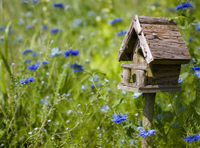
This is fun and useful – a nice project that can involve outdoor and indoor work. It combines interest in birds and with practical use of woodwork skills.
Which birds are your boxes for?
Think about which birds you are likely to attract and build your boxes accordingly. Different designs and strategies are likely to attract different birds – to take one example, a great spotted woodpecker will need a box with a 50mm hole, mounted in a secluded spot at least 3 metres above ground level but also stuffed with an old rotting piece of birch wood. Despite careful plans to attract particular birds, you may still be surprised by which birds actually use the boxes you have made.
Design
There are a number of possible designs such as the small box with a small hole often used for tits or sparrows, the box with the half-open front and the box with a hidden entrance at the top.
An entrance hole of 32mm will allow access to all common small birds but if you cut the size down to 25mm this will give access only to smaller tits and possibly tree sparrows. It doesn’t matter too much where the hole is as long as it is at least 120mm (5”) above the floor level of the box.
The size of the box should be about as big in cross-section as an adult human hand which suits most birds well and allows you space for cleaning out the box. Too large a space makes a lot of work for the nest-builders in filling it with twigs and moss.
A good design will create a dry box that is not draughty which also has good fixing points for fixing/attaching to a tree.
Depending on the design you may want a door on the side, front or top for inspection and cleaning out each season. This should be hinged. For this you can use either metal hinges or a flap of material such as a small section of damp-proof membrane which is very long lasting (rubber cut out from old inner tubes also works well). If there is an inspection door it should be fixed so that it doesn’t blow open and a good catch also helps resist predators. A catch made from wire works well and allows it to be tensioned to give the door a close fit.
I have seen boxes with small perches outside. The danger here is that they can encourage predators (mammals and other birds) and of course this is the reason for using small access holes.
Materials
You can use pieces of wood cut from the woodland, bought-in supplies or salvaged wood. The main thing is to use wood that will last several years and avoid wood that is treated with dangerous materials such as creosote. If you treat the box you should use water based preservatives and only treat the outside.
For fixing the pieces together you can use either nails or screws but obviously screws are stronger.
Siting – avoiding sun and predators
Clear flight path in
Facing away from sun
Drainage is needed to avoid a damp floor in the nestbox
Above the level of predators
You might want to be able to get a ladder near to it for inspections
Maintenance
You may want to clear out the nest at the end of the season which will remove pests and fleas that would be a nuisance to any new nesting birds. It is a good idea to wear gloves for this to avoid putting off future nestbox users – birds have a very good sense of smell.
Putting in bird boxes may seem like a hobby activity but it can also be part of your official woodland management strategy and form part of a woodland grant scheme application. In any event it is worth taking advice from the forestry commission or local county nature trust on the subject.
Two really useful books about nestbox making and installations are:
The BTO Nestbox Guide by Chris du Feu available from the British Trust for Ornithology (www.bto.org);
Bird Boxes and Feeders – 11 step by step woodworking projects – by Stephen Moss and Alan and Gill Bridgewater.
Comments are closed for this post.
Discussion
[…] of the number of nesting boxes put up for them. As Angus indicated in his recent blog on bird boxes, birds are very sensitive to the size of the hole in the box – this influences which birds might […]
hi angus,
im making a bird box at school to attract native
birds. cause they need a hollow tree but it takes 120 years
to form. i need some help on the design. could you tell
me some patterns that would help with it. its made
out of pinewood this would help
your sincerly,
taree
Recently a stray white Dove has started feeding from my bird table, it roosts behind my sky dish, i would like to make a Dove Cote but i can’t find any instructions, i found instructions to make a nesting box for a stock dove , the hole is at the top but Dove Cotes seem to have the entrance at the bottom, do you think it will be okay to use the stock dove nesting box measurements.
Hi Angus,
This year our family built a bird box out of odds and ends of recycled wood. We then manage to get a bird box camera and were able to enjoy the blue tits. I would fully recommend getting a camera as my children were glued to the wildlife rather than cartoons for a change. Thanks for a lovely Blog. Linda.
I have read that sprinkling feeder contents with hot spices will deter squirrels (apparently birds are not bothered by it) but, alas, I think our squirrel would happily eat a vindaloo and not flinch.
really helpful .
really helpfull
You can buy or make squirrel baffles, they used them on bbc autumn watch to prevent squirrels taking short cuts to the peanuts on their squirrel assault course. My sister has determined squirrels, though her ‘squirrel proof’ feeding tubes don’t live up to the marketing 100% it does seem to encourage them to raid less well protected peanut sources (other peoples gardens) instead.
Any thoughts on using boiled linseed oil as an alternative to water based preservative on the outside of bird or bat boxes?
If you’ve not used it before it’s a traditional wood treatment that dries to a semi gloss varnish like finish.
Very difficult. Squirrels are really determined thieves.
any helpful info on how to deter squirrels from raiding bird feeders would be greatly appreciated
I have made one but although blue tits come into my garden to feed they checked out my bird box the first year but declined to use it , I wondered if the size of the hole put them off. Will try again now you have given me correct instructions Thanks
i make bird boxes from my neighbours old furnishture ect
i think that there should be more info in this
When making a bat box, it is important to score the back board every inch or so using a saw, so the bats are able to grip. I hope this helps!
Thanks Angus
I am sure we will have a go at making these over the summer. fun!
Tracy
Tracy – I’ve never actually made a bat box but my researches suggest that bat box making is very similar except that the “doorway” is a slit at the bottom of the box and it is particularly important not to use wood that has been treated with chemical preservatives because it can kill the bats. Other pointers are: put them higher up on a tree than you might put bird boxes and it is useful to put up groups of bat boxes (3-4) spread around a tree as the bats like to stay in cooler spaces during the day – out of the sun. Also the wood you use needs to be rough-cut so that the bat can cling to it. I found some nice diagrams and guidelines at:
http://www.lincstrust.org.uk/factsheets/batbox/index.php
There is also some nice bat material at the Bat Conservation Trust site at:
http://www.bats.org.uk/
best wishes,
Angus
Hi Angus
Would a bat box be made in a similar way, if we want to attract bats?
Tracy
HOw do I fix my bird box to a tree without damaging the tree?
Linda
12 November, 2011