Woodland toilets

When we first had our wood, we didn’t worry about a toilet. “Go behind a tree” we told visitors. And the campers went off into the woods “prospecting” with a trusty spade. No problem.
But the years went by and we started to have visits from little girls, and older ladies, and we realised we were in trouble.
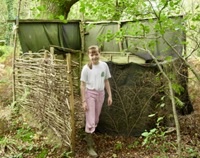
So we dug a hole. And over it we placed a large strong box, upside down, with a round hole in the top. And over the hole we fixed a toilet seat. On a post at the side, we hung a toilet roll. Simple, really.
The rhododendron bushes were pretty thick just there, but for added privacy we erected a screen of dark cloth from the market, supported by poles.
And since that day, I have been collecting ideas from other woodland owners on the best way to do it: to be hygienic, civilised, and environmentally friendly. The best advice I had was to buy from the Centre for Alternative Technology a wonderful book called “Sanitation without Water” by Uno Winblad and Wen Kilama. Tens of millions of people, to this very day, are surviving and flourishing, day in, day out, without toilets as we know them. And although none of us woodland owners expects to be in this sort of situation, the book has some very useful tips.
“People need to choose the latrine that is best for their area and for their traditional culture.” Hence the toilet seat, which transforms the very primitive arrangement of just squatting instantly into something fairly acceptable. Though, as a ten-year-old said to me the other day, “That’s the weirdest toilet I ever saw”.
The book recommends sprinkling dry ashes over excrement to prevent flies from getting to it, and this also much reduces the odour. We collect the old ashes before lighting the new fire, keep them dry in a big pot with a water-tight lid, and sprinkle them with a soup ladle.
Apparently, the mixing of urine with faeces inhibits the rotting which will naturally render the bacteria harmless. So we now follow the advice of the book, and spread a layer of vegetable waste, or just leaves, in our toilet each time we visit.
Of course, the hole gets filled up, and when it is near the top, we cover it with a good layer of earth, and dig another hole. Moving our screen is fairly easy. Other people have told me they use a pail inside their box: one of those straight -sided containers used in wine making. Then they empty it in a hole far from the clearing where they picnic or camp. They actually have walls and a roof on their toilet; when it rains we just hold up an umbrella!
Getting closer to the natural scheme of things, another owner showed us her “compost toilet” with logs arranged in walls round the four sides of the hole, and a nice smooth round one to the front for sitting on. She assures us it is very comfortable. Her screen is simply poles, tepee style, clad in branches.
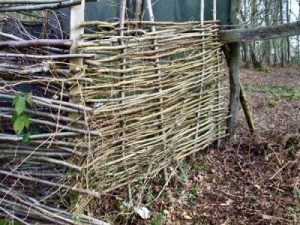
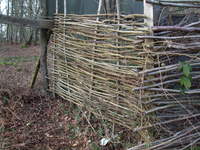
A friend who visits frequently is slowly replacing our dreadful curtains with fine traditional hurdles, made from our own hazel.
And for a lock, a simple branch on stilts across the track leading to the toilet will suffice – after all no toilet in our own culture is complete without a lock, however notional!
Leave a comment
Subscribe to our blog email updates
Managing Your Woodland for Wildlife
A new book on encouraging biodiversity in your woodland. Available free here »

29 comments so far
Dawn and Steve
16 April, 2007
Fantastic advice! We have been puzzling over this one and, as we are campers, were going to use a chem toilet and go to a tame campsite to empty it on the way home. We do wee behind bushes but the whole idea of the earth toilet really seems to be the way forward.
Has anyone else done this and if so can you tell us any (if you pardon the terrible pun) pitfalls?
Tracy Pepler
17 April, 2007
I am trying to convince my man that this is the way to go, but he wants to know how to later be able to access the compost without having to dig down a big hole……… and if we just use a big hole, how do we make sure that there is no underground leakage, as until the ‘stuff’ is composted it is not very nice!
thanks
Tracy
Chris Kendall
23 April, 2007
We would like to buy some woodland and put a summerhouse on the land to be able to visit weekends and summerholidays with the grand-children. I cannot find any information on putting a wood built building on the land and would like to know if you can advise me please
Chris
Catherine Davidson
25 April, 2007
Chris
If you were thinking of something you could live in, I’m afraid you would not get planning permission. However, shelters and stores for forestry purposes are permitted, and, on holdings over 5 acres, you are allowed a caravan for up to 28 days a year. Read the article by Lucy Nichol on Woodlands and Planning Legislation for the details.
Catherine
Craig
2 May, 2007
Hi all, we bought our wood last year and a toilet was our first priority. We visited the centre for alternative technology and did a lot of research. Eventually we came across the idea of a Treebog. It is essentially a composting toilet but the compost is used up by a screen of willow planted around the structure. We have been using it for around 9 months now and it doesn’t smell, we planted the willow in November and they are now getting leaves and growing up. The willow is a fast growing variety. The main adavantage of this is that you should not have to dig out the compost or move the toilet. The main disadvantage that I can see is that as the compost pile has to be on the ground the structure is quite big (loo seat about 7 feet high). We made a loo seat thats position can be moved across the cabin to prevent build up in one place. We will also have a harvestable willow crop. We will not know for a few years if the willow is all we need but thought it was worth a go. The Centre for alternative technology has a factsheet with dimensions and calculations for number of people etc. We put roof sheets on and harvest the water to a tap on the steps for handwashing, all very civilised really.
Craig
Pip
10 May, 2007
does anyone have any experience of tree houses on their woodland?we’re about to buy 30 acres and want to put a tree house up on one of the beautiful huge beeches in the wood, for animal observation and the occasional sleep over. any ideas? tips? re planning – there are countless fantastic tree house makers on the web but i’m worried we might get told to remove it by planners…
Sean
19 May, 2007
We’re just finishing the purchase of 10.5 acres of woodland and have also thought on the ‘eco’ toilet problem. My concern is not the actual digging of holes and rudimentry accomodation but that we are on a clay soil. Digging the hole doesn’t present a problem but as clay retains the water quite well will we have to empty to pit or can we just split the loo in two and have a solids and liquids dept’s? This would cut down on the amount of moisture in the solids but will the clay soil make the time scales too long. Having said this we don’t want our wood to become a minefield of old pits over the years either
Muria
29 May, 2007
I’m also interested in building a treehouse. Any information on this would be helpful, particularly with regards to planning permission.
HouseBuilder
26 June, 2007
You don’t really need planning permission for structures. The trick is to build your house in the middle of the wood where nobody can see it. If it is up for 5 years with no objection then you can keep it up forever. Result!
Craig Grady
12 September, 2007
I now have pictures of our toilet and treehouse as well as some of the other things in our wood on my blog which is viewable at http://boaowl332.blogspot.com/. Has anyone else got pictures of there woodland activities on line. All the wood used in the things I have built are milled from the timber in our wood.
Craig
sam
14 September, 2007
good advise! me and a bunch of mates from school have to make a toilett for a new study corse in school. ity is a corse that studys the land and enviroment around us. so we are required to make an earth toilett so we have less impact on the inviroment. i think your desighn is good and it may be used by us in the near future.
rosemary
10 November, 2007
Craig, you are an inspiration! Hopefully I will be purchasing a wood in the not too distant future
Tracy Pepler
3 December, 2007
There is a really good book on this topic – but sorry about the name!
It is called: How to sh**t in the woods! Although it is for hikers and mostly american, there are some interesting things to note…. especially being careful not to build your toilet anywhere near water courses, little streams et.
Tracy
Tracy Pepler
3 December, 2007
Hi Craig
Love it, I had a look at your blog.
Have you got planning permission for the yurt?
You can see our blog here
peplers.blog.co.uk
we have a lot to learn from you!
Tracy
Deb Millar
10 January, 2008
We are about to build our compost toilet and decided to have a chamber system plus urine diverter. We are buying 2 large dustbins (made from 100% recycled materials)and will simply swap them over when one’s full. Someone is making the urine diverter with an old cider bottle. I will put up photos when it’s done!
M Devonport
7 April, 2008
Tracy / Craig, would the yurt require planning permission if it was not used for more than 28 days?
Deb Millar
22 August, 2008
Our woodland toilet is now finished was designed and built by Martyn,our trusty spoon carver, bow maker and general wonder worker. As we run courses for children it was
essential to have something and we all hated the porta potti. The toilet is
now fully in use with a home made urine diverter and a large bin to collect
no 2s and paper waste. We keep a bin of sawdust to cover the waste and so
far it is fairly easy to keep clean. We have a spare bin so if it starts to
look full we will simply swap the bins over and put the lid on the full one.
According to our research, after a year it will have all broken down to an
innocuous material and will be suitable as a tree fertilizer. However it
should not be used for vegetables because of the danger of roundworm. We
also have a large pit filled with a straw bale as a male urinal and hope to
build a hurdle to screen it and put a roof on too. I would encourage people
to build their own- otherwise they could get a Thunderbox (just google it
in).
Richard
2 November, 2008
Has anyone got tips on what machinery would be required to upgrade a track of around 200 metres to enable us to drive over it? Could you do it yourself with hired equipment or would you need to get a contractor? If so what would you need to hire?
Many thanks
Richard
Stuart
8 February, 2009
Hi all. I’m thinking about buying a wood in scotland, but I want to use it as a small assult course for children and young people as nothing like this exists near me. I will not be useing the trees as part of the course (ie screwing wires or tieing ropes round them) it will be totaly stand alone and mainly ditches and water based challanges and a few of this kind of thing – (“http://www.outdoor-resources.co.uk/Ropes%20elements/5-assault.pdf”) I’m really just wondering if i “Wood” be alowed to do that?
Thank and sorry about the pun!
Stuart
catherine
13 February, 2009
Hi Stuart
Most planning restrictions are to do with establishing a permanent dwelling, so you should be ok. Of course, if you’re thinking of bringing groups of people into your woodland that has it’s own challenges – but you’re obviously thinking ahead, reading the toilets blog!
Martin
15 February, 2009
The woodland toilet issue I have mulled over for many years and I have found a supreme lavish design on the net with loads of techno detail about possible polution and such. try this link all good stuff
http://www.oasisdesign.net/compostingtoilets/earthtoilet/index.htm
Isla
19 July, 2009
Very interesting indeed. Thank you very much for the info.
Mike
1 February, 2010
Read the “Humanure Handbook” – It is available online in pdf form for free.
A great read and brilliant for any kind of composting toilet. The main idea is to use lots of sawdust, leaves or similar to prevent smell and encourage rapid composting.
I’ve used this style of toilet running camps for 50+ people for a week. No complaints over smell etc and they are jsut like using a normal loo. Only difference is you “flush” with sawdust!
walter
14 March, 2010
It is also worth to consider a Ventilated Improved latrine, an air tight box with a chimney attached which provides draft through the seat hole to avoid smell and flies etc. Commonly used and advised in the tropics, and schemes are available on the web.
'Chelle
24 October, 2010
Hi there just thought i would say hello. We are thinking of buying a wood in Wales, we live in Norfolk but can’t find a suitable wood here. So we plan on doing lots of camping and your advice on toilets etc is just what we need. Am hoping that when we do buy a wood (we off to wales this week to view six) we will be lucky enough to have neighbours that we can call on, help out, melt marshmellows round the camp fire ect. Will keep you posted.
ps Craig, i was devastated when i saw your pics, couldn’t get all of them so came across them
quite unexpectadley. Hope everything is going well now.
‘Chelle
Richard
25 October, 2010
We’ve kept our woodland toilet in Wales very simple and it works well. It wouldn’t stand continuous use -we probably camp around 3 weeks per year all in. Its basically a hole in the ground. On top when not in use, we cover with an old metal bin lid which keeps animals /flies out. When we’re there, I adapted an old camping bucket style toilet, and cut the bottom out. I then screwed this onto an old cupboard door as a platform, with a suitable hole cut out. This just provides a seat over the hole.
Obviously keep well away from water courses / supply etc as with any toilet. We keep a bucket of ash by the toilet, and sprinkle a trowel full every visit. Ash adds carbon and improves composting, also neutralises urine. Generally, best to wee behind bushes wherever possible, as urine prevents composting.
A spade sized hole (approx 18 inches square, by around 2 feet deep) had fully composted in around 9 months and could be dug out and reused.
Good luck!

J.Stone
11 February, 2011
Hello, just looked at Craigs blog, looks great. What about planning Permission for the structures in the woods, or does`nt it count if no-one lives there (but presume they are)… what about the five year thing applying for a live in structure? Lots to learn..maybe someone could answer…thanks.
Paul
22 March, 2011
What about water for hand-washing ?
I’m thinking of buying a plastic water butt (of the kind they sell in garden centres) and rigging a tarp to collect rainwater to fill it.
The intention is that this will be for washing (ourselves and our dishes) but not drinking. Does anybody have experience of using plastic barrels for this purpose ?
Does the water go manky after a while ? I have seen quite a few videos on YouTube (mainly American) about creating a rainwater filter using pea gravel and sand, to clean the water on its way through the barrel.
It’s in semi-rural Hampshire. The air quality is probably OK but there will be dead leaves, insects and bird droppings to contend with.
virginia
28 March, 2011
I recently bought 5 acres in Devon, and absolutely love it. Don’t regret a penny.
I have been digging a hole and placing a ‘thone’ above it: a large plastic plant pot, hole cut in the bottom and toilet seat mounted on it. At present it is shielded by a beach wind break, but I have plans for a tree-bog. What willow should I use?, there are so many of them.
My woodland came with a covenant that was VERY specific about what is permitted and what is not, and I don’t believe the 5 year rule would cut any ice if it was forbidden in the covenenant. I am permitted a ‘woodland store’ of a max size that must be a ‘temporary structure’ and not used as a dwelling. I have a tent for sl’eeping in through the summer, but it is fair to say once I have my woodland store’ (planned for easter), if it is absolutely tipping it down, I may be found huddled on the floor among my tools!
Good luck to you all in your projects.
Virginia