Woodlands.co.uk
Wetlands, woodlands and watery animals
“That’s the wettest woodland in the county” is a comment people often make about their local woodland. But this comment cannot be literally true for very many woods. It seems that people are often surprised by how wet woodlands can be and hence are often keen to drain them. However, wetlands are important habitats and can be home to unusual birds, invertebrates and mammals.
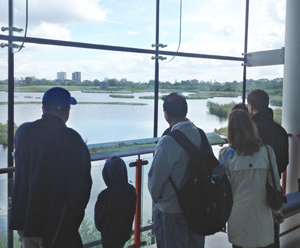
Visiting the London Wetlands Centre recently I discovered how a former sewage works has been transformed into a wildlife sanctuary over the last 20 years. Having become redundant as a sewage treatment plant, because of the creation of the Thames Water ring main, negotiations in the late 1980s led to part of it being developed for housing by Berkeley Homes (about 40 acres) and the remainder Read more…
Small Woods Association – a nunnery or a hothouse?
The Small Woods Association is a remarkable organisation with three unusual women at the core of it – Jude Walker, its CEO, Angle Pollard who runs their social forestry programme and Diane Wood – the SWA treasurer. For those who notice these things, it’s interesting that that their surnames are all related to woodlands and what they do – encouraging walking and pollarding in woods – an illustration of aptronyms perhaps (names which are very apt for the job they do). These women, along with Phil Tidey and their team at the Greenwood Centre, have built up the Small Woods Association into a very effective charity which has turnover of almost 3/4 million pounds and a clear objective of promoting sustainable conservation of small woodlands, but in recent years it has developed a particular emphasis on social forestry, meaning woodland projects with health and social objectives. Read more…
Climatic debt
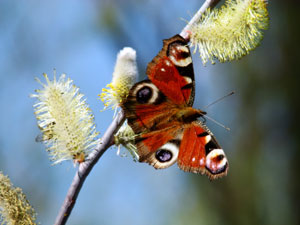
Butterfly Conservation UK and the Centre for Ecology and Hydrology have been involved in the monitoring the status of butterflies through various citizen science schemes*. UK butterflies (and indeed, birds) are probably the best-studied wildlife groups thanks to the dedication of an enormous workforce of highly skilled and committed volunteer recorders. Butterflies and birds have been observed and recorded in detail for many, many years and these detailed records and counts yield an invaluable resource of information for the analysis of population change(s).
A recent report indicates that some 70% or more of our butterfly species are in decline and that the geographical distribution of many has contracted. Read more…
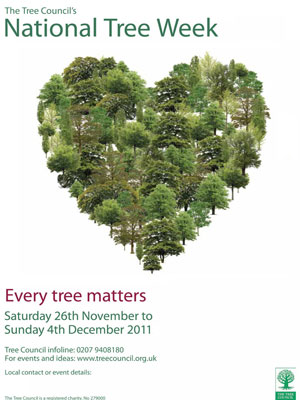
National Tree Week 2011 – 26th November to 4th December
The Tree Council’s annual tree weeks have been an undoubted success, emanating from the 1973 “Plant a tree in ’73” campaign (some rather cynical individuals chanted “cut it down in ’74”) and must have resulted in not only in promoting the whole idea of trees but in planting many thousands across the country in parks, gardens, roadsides, corners of farmland and development sites to name but a few. The Tree Coucil ( http://www.treecouncil.org.uk) is our foremost campaigner and umbrella body for UK organisations involved in tree planting, care and conservation.
Forestry and woodlands are a long-term business but those of us planting in ’73 can see the fruits of our labours: we stand back and look up at the hornbeam, hazel, hawthorn and fieldmaple spreading wide and high; the oak, ash, beech and birch are trees, a miraculous metamorphosis from those tiny whips planted during the cold winter months – it seems like yesterday. We plant for the next generation but once established trees grow quickly so we can all enjoy watching them develop. Read more…
BTCV – Conservation Volunteers
BTCV is a social enterprise group and charitable organisation that enables people to make a difference to their lives and to improve the places around them. They have the largest team of environmental volunteers in the country and have assisted at 50,000 sites across the UK. With 50 years worth of experience for engaging, reaching and inspiring volunteers and their communities, they are the confident pioneers of creating environmental capital. Read more…
Finding and encouraging reptiles in woodlands
Reptiles and woodland
The first time I came across a Grass Snake in our newly bought wood I almost trod on it, it was a real surprise and I was so lost in my own thoughts it really startled me. I had not thought the woodland provided a very suitable habitat for reptiles and in many respects, it didn’t. Read more…
Beewatch 2007 – Plight of the Bumblebee
The Bumblebee Conservation Trust, based at Stirling University, needs your help in recording sightings of bumblebees. They would like you to record what species you see, where and how many, and take pictures of any unusual specimens. Go to http://www.bumblebeeconservationtrust.co.uk/surveys.htm to find out how to take part.