Woodlands.co.uk

Blog - holly

Plants for Christmas.

Plants for Christmas.

by The blog at woodlands.co.uk, 23 December, 2025, 0 comments

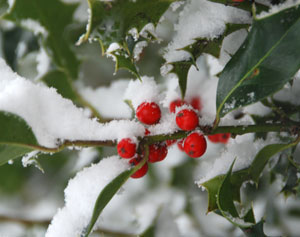
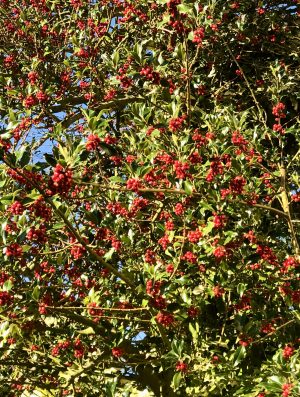
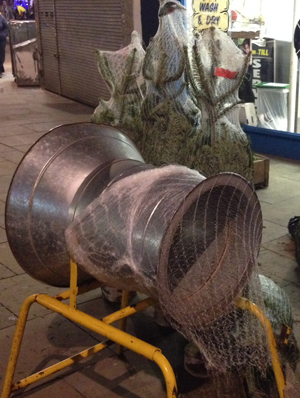
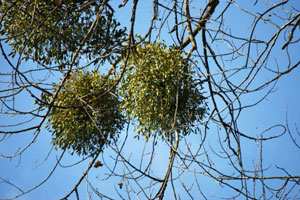
At this time of year, certain plants play an important  part in Christmas celebrations.  One is the Christmas Tree itself - which became established in Victorian times after Prince Albert introduced one in the Royal Household.  A Christmas tree is invariably a conifer but any of the following species may be used : Norway Spruce Picea abies Silver Fir Abies alba  Nordmann Fir Abies normanniana Scots Pine Pinus sylvestris and in North America Douglas Fir Pseudotuga menziesii  and Balsam Fir Abies balsamea. There is also the artificial Christmas tree. These originated in Germany in the late 1800s, and were typically made from dyed goose feathers attached to a central pole / wire frame.  Later in the 1930s, the Addis company used the machinery for making their toilet brushes to create ”trees’ .  Animal bristles, dyed green, were used to form the needles of the ‘trees’.  Nowadays, most of the artificial Christmas trees come from China. Apart from the Christmas tree, there is also Holly, Ivy and Mistletoe. All are evergreen plants.  Bringing greenery is an age old tradition associated with the coming of, or ‘rebirth’ of Spring.  The holly tree is either male or female, and also not a conifer. The leaves have spines and a thick, protective and waxy cuticle. Its leaves (as a garland around the door) were thought provide protection for the home, warding off evil spirits.  It was also used in the ancient Celtic Festival of Beltane to welcome in summer. It is certainly the case that in the past, the distribution of holly was far more widespread. The Needwood Forest in Staffordshire was a significant and ancient midlands forest but after the Enclosure Act of 1803, large numbers of its trees were felled.  In his ‘Plant Book’, Professor David Mabberley notes that some 150,000 holly trees were taken from this forest to provide bobbins for the cotton mills of Lancashire.  Bagot’s Wood is said to be the largest existing piece of this ancient woodland). Holly was also an important species in hunting estates and deer parks. Sometimes it was planted around saplings of other more valuable trees to deter browsing by deer. The  leaves of Holly are palatable to livestock, despite their spines.  It is the only evergreen tree (found in deciduous forest or woodland) that does not contain chemicals that are toxic to sheep or cattle. For many centuries, it was common practice to provide holly as fodder for livestock, during the winter months when other foodstuff such as hay or grains were in short supply.  Without the provision of the holly, livestock might have to be slaughtered.  The practice of using holly as fodder was more common in areas like Cumbria, the Welsh Borders and the Pennines*. Again in the past, Holly was also for hedging as it was virtually impenetrable, though the downside of using holly was its relatively slow growth. The berries of holly are attractive food to some birds, especially redwings and fieldfares. Holly and Ivy are often used to make festive wreaths and garlands. Common ivy (Hedera helix) may be found growing in woodlands, hedgerows or on walls. Sometimes it is a climber; sometimes it forms a layer at ground level.  It is a woody, evergreen perennial that is distributed throughout much of the British Isles, and many parts of Europe. It can grow in a variety of soil types, and when mature is resistant to many harsh conditions, being particularly tolerant of shade. Last of the Christmas plants is the mistletoe. Mistletoe is well known for the custom of “kissing underneath the mistletoe”. It is an unusual plant in that it is a hemiparasite that grows on trees such as apple, lime, poplar and hawthorn.  It forms large balls that are suspended  from the branches and and more obvious in the winter months (see featured image), when the host has lost its leaves.  Whilst it can make sugars and other complex organic compounds, it relies on its host plant for water and mineral salts.  It does this by forming ‘clamp-like’ connections (known as haustoria) with the water conduction tissue (xylem tissue) of the host plant.Mistletoe is an important species on woodlands. Some species are directly dependent upon it, or example the mistletoe marble moth and the 'kiss me slow weevil', and the berries provide food for number of different birds.    When mistletoe is removed from woodlands,  the number of woodland birds tends to decline as does biodiversity.  
woodlands web updates : 29

woodlands web updates : 29

by The blog at woodlands.co.uk, 10 December, 2023, 0 comments

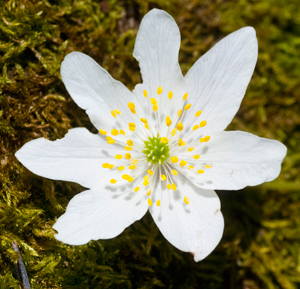
Flowers of the woodland floor. Some woodland flowers enjoy the dappled light of the woodland floor beneath the canopy.  They grow in relatively shady, cool and damp conditions in the humus-rich soils.  Polish scientists at the Nicolaus Copernicus University have been studying four species that often grow together in European woodlands - namely Wood anemone Yellow anemone Lily of the valley Common may lily These are perennial plants that ‘come to life’ in Spring, producing a carpet  of flowers across the woodland floor.  However, as much as they share a liking for the shady, cool and moist conditions found there, they differ in their sensitivity / tolerance to rainfall / moisture levels in the summer months: which may change their distribution as summers become warmer and longer.  The team modelled various warming scenarios which suggested that the ranges of these species may change / contract with hotter and drier summers.  The common may lily is one that may be particularly affected and no longer share the same range or woodlands as the others studied.  If climate change takes a hold, it may be that ‘assisted migration’ may be needed to help such plants to find suitable ‘climatic refugia’. more on plant migration ...... With climate change, both plants and animals need to adapt.  With increasing warmth, many species may ‘need’ to move towards cooler latitudes.  Whilst many animals are mobile, they may be able [over time] to access new suitable areas, plants on the other hand are dependent on the dispersal of their fruits / seeds.  Fruit and seed dispersal may involve various animals, including birds.  If the birds are resident or non-migrating species, then it is probable that they will only disperse seeds over relatively short distances.   Migratory birds however travel great distances but often in the wrong direction.  Many birds that migrate at the end of the summer, travel south to warmer climes.  Work at the University of Exeter has studied a number of woodlands across Europe and bird species that feed on the fruits of 81 plants species (and help disperse their seeds).  They found that only about a third of the plants had fruits (seeds) that might be dispersed northwards by birds.  To benefit from this northward dispersal, the plants needed to either have a very long fruiting period (eg.holly, juniper) or a very late fruiting period (eg. Ivy). Full details of this study here Food production and food waste. As Sir David Attenborough has pointed out in a recent episode of Planet Earth III, producing food to feed the world comes at significant environmental cost.  Natural ecosystems are often burned (forests) or drained (peatlands) and then turned over to agriculture to produce crops or farm animals. The forests of the Amazon have been significantly affected by burning and logging,  with the concomitant loss of biodiversity.  But they are not alone. In Mexico, forests are being lost as the land is being turned over to avocado production.  Mexico’s neighbour, the USA has a voracious appetite for this fruit.  The forests are being turned into ‘avocado orchards’.  Avocado trees are ‘thirsty’, they need a generous supply of water.  They consume much more water than the natural species [eg. oyamel), so that natural aquifers are being depleted.  This affects local farmers growing crops such as tomatoes and corn. One particularly sad aspect of food production is that much of the food is wasted. Some is lost between harvest and reaching the retail sector, and then more is ‘lost’ in the home. Food may not be used, or not used in time so it starts to rot, become rancid etc.  A lot of food goes to land fill, where it may generate methane - a potent greenhouse gas. Sprouting sequoias. In recent times, there have been many images of the fires ravaging the forests of the west coast of the States.  Many thousands of hectares and millions of trees have been lost, including many of the giant redwoods.  However, recent studies have found that some of the burned Sequoias are producing new growth.  They are sprouting from roots and trunks, from dormant buds that have lain hidden under the thick bark for decades, this despite the loss of the canopies of the trees.  To fuel this growth, the trees are using reserve materials that have been stored for 50+ years.

Next Page »