Woodlands.co.uk

Blog - red list

capercaillie

woodlands web updates : 28

by The blog at woodlands.co.uk, 30 November, 2023, 0 comments

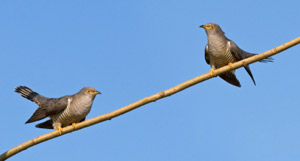
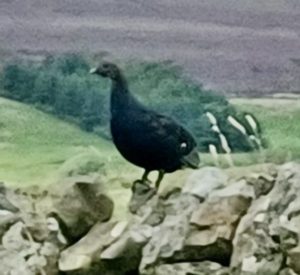
On the Red List! The capercaillie is threatened.  Its numbers in Scotland have roughly halved (between 2010 and 2020).  It was once widespread, but now it is found in the pine forests of the Highlands - notably the Cairngorms National Park.  It is a red listed species. The decline in numbers is associated with poor breeding success, poor weather in early summer when the chicks are developing, another problem is predation by species such as the pine marten, foxes and crows.  The Game and Wildlife Conservation Centre (GWCT) has identified another issue that these birds face - namely collisions with deer fences.     These fences are created to keep deer out of particular areas.  However, when the capercaillie (and black grouse) impact on these fences, they are injured or killed.  Marking these fences, reduces the number of collisions but does not stop them.  Unmarked fences are still killing adult birds.  Marking of these fences or their removal would help with the survival of the capercaillie, though removal would  mean trees and shrubs would be unprotected from deer. Mosquitoes! There are some 36 different species of mosquitoes to be found in the UK, which  are generally harmless (though they bite).  But that may change.  With longer and warmer summers, the UK may become a venue for other species such as the tiger mosquito.   This insect has been found in ‘traps’ (monitored by the UK Health Security Agency) at ports and rail terminals.  This insect is known to transmit various diseases, such as dengue fever.  The mosquito was found in Italy in 1990 and it is spreading on the continent. A species of Culex has also been found in some areas of the Thames estuary - which can spread the West Nile Virus. This virus can result in flu-like symptoms.  Outbreaks have been been mainly in the warmer areas of the Mediterranean, but with climate change and the potential for very hot summers here - vigilance will be needed. Floral defences. Many flowers release a distinctive scent.  The scent serves to attract pollinators like bees and butterflies, or  it may ward off pests that would feed upon the plant.. Many of the chemicals that contribute to scents are terpenes.  Recent research has investigated how these chemicals can affect the growth and development of butterflies - using painted lady butterflies.  These butterflies feed on a wide range of plants and hence are exposed to a variety of scents / terpenes. For these experiments, the researcher (at the University of Centra Florida) used four common floral terpenes  Limonene :  which has a fresh, citrus like smell Linalool. : has a floral scent, reminiscent of lavender Cineole : has a camphor-like smell, slightly medicinal contributes to eucalyptus oil. β caryophyllene : this has a spicy / woody fragrance. Different amounts of these terpenes were fed to caterpillars of the painted lady butterfly, and the subsequent development of the caterpillars was monitored and the size of the adults recorded.  The experiment was also conducted at different temperatures.  Temperature affects scent release by flowers. Higher levels of terpenes has significant affects on the survival of the caterpillars, especially when combined with the higher temperatures.  The caterpillars took longer to enter into pupation when given high levels of terpenes, though the size of the adults that emerged from pupation was unaffected.  If longer and warmer summers become more common, the combined effects of terpenes and heat could become important determinants of development. `
The ragwort.

The ragwort.

by The blog at woodlands.co.uk, 12 September, 2022, 4 comments

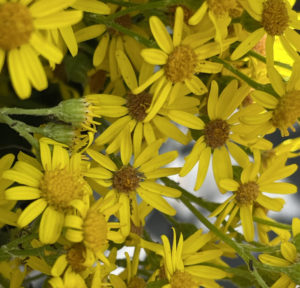
Ragwort is a common wild flower.  Its common names include, common ragwort, stinking willie and tansy ragwort (though its resemblance to true tansy is rather superficial).  It is not particularly a woodland plant, it is found in dry, open places - on waste land, waysides and (grazing) pastures.  It is not a plant favoured by land owners because it has toxic effects on cattle and horses.  It is generally considered to be a biennial, but can persist for some years. The stems are erect, straight, basically hairless.  The actual plant may grow to a height of two metres.  The leaves are lobed in a ‘pinnate’ fashion and have a distinctive smell that has lead to some of its common names - such as stinking willie.   The ragwort is a member of the daisy family (Compositae, now the Asteraceae), and its flowers are massed together into dense, flat topped clusters.  Each ‘flower’ is made up of many small, individual florets.  In the centre are the disc florets whilst around the edge are the ray florets.  The latter have a large lip or flap, which serves to increase the visibility of the plant to pollinators.  During the flowering season, a plant may produce many thousands of seeds.  The seeds have hairs attached to them, which help in dispersal. Ragwort is a plant that is much loved by pollinators - bees, flies, moths and butterflies.  It is generous in its nectar production, and has been placed in the top ten of nectar producers by one survey.   The plant also provides home and / or a food source for many invertebrate species, some of which feed on ragwort exclusively*, including some species on the IUCN RED LIST.  One species that is reliant of this plant is the cinnabar moth, whose status is described as ‘common and widespread, but rapidly declining”.  Interestingly, the cinnabar moth feeds on the plant absorbing the alkaloids and these make it distasteful to its predators . However, important as the plant is in ecological terms, it is toxic as it contains a number of alkaloids.  These are poisonous to various animals, such as horses and cattle.  The bitter taste is a ‘disincentive’ to much of the plant being eaten.  However, because of the alkaloids, it is one of the five plants (in the UK) named as ‘an injurious weed’ [as defined by the Weeds Act of 1959].  Some people may suffer an allergic reaction after handling the plant, experiencing a form of dermatitis. [caption id="attachment_38929" align="aligncenter" width="675"] Cinnabar moth, image courtesy of mcbeaner on Pixabay.[/caption] Further information on the Ragwortis available on WoodlandsTV, see below [embed]https://youtu.be/esfLW0nIvNo?si=DQ2Uokq7U1pAJYMZ[/embed] [caption id="attachment_38599" align="alignleft" width="300"] Cinnabar caterpillar[/caption] [caption id="attachment_38566" align="alignright" width="300"] Leaves of Ragwort[/caption]  
Next Page »