Woodlands.co.uk
2012 – a rather wet year.
It has been a rather strange year. After another dry winter – March arrived and was one of the warmest and driest on record; consequently, many of us were threatened with restrictions (on hosepipes etc) as a severe drought threatened – many reservoirs were very low on water.
But then came April, which was one of the wettest recorded in the UK. Some 121.8 mm of rain fell, beating the previous record of 120.3 mm -which was set in 2000; some parts of the U.K. had three times the ‘normal’ amount of rainfall. June was also very wet and set a record. There then followed the wettest summer as a whole since 1912. The final rainfall figures for the year have been released and the total rainfall for the UK during 2012 was 1,330.7 mm (52.4in), just 6.6mm short of the record set in 2000.
The big winners in these wet conditions were slugs – including the giant Spanish super slug, or Spanish stealth slug that was reported to be invading gardens. These have an ‘enhanced’ breeding cycle producing many more eggs Read more…
Back to bees, again
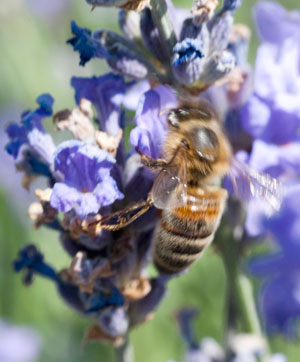
Further to the woodlands post about ‘bees and weather’, the British Beekeepers Association has announced that honey yields from hives are substantially down. The average annual yield per hive is about 13.6 Kg but this year the figure is averaging 3.6 Kg per hive – down by over 70%. The worst results were for the London hives, where the figure was down to 2.5 Kg / hive.
Most beekeepers have attributed this fall to the (wet) weather. Bees had a poor start to the year as the poor weather this Spring (April onwards) limited the bees foraging – for early crops, such as oil seed rape. The rain was also a feature of early summer – June and July, for much of the country. Read more…
Open day at Butterbeare Wood
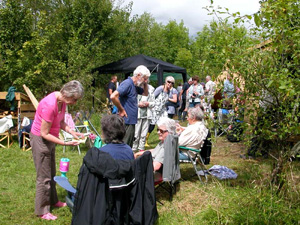
When I told family and friends that I had bought 4.5 acres of woodland in North Devon many of them expressed an interest is seeing it. In August, I therefore arranged an ‘open day’. I also invited along the owners of neighbouring areas of woodland.
Guests were encouraged to bring along something to sit on and their own picnics to supplement the barbecue and drinks which I had organised. Shelter was provided by my shed, a couple of gazebos and a tipi. And that other essential, a toilet tent, contained an earth closet. Read more…
Butterflies and winter temperatures
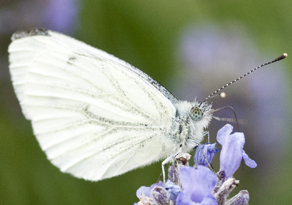
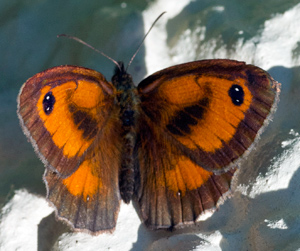
Most species of butterfly produce one batch of eggs each year – like the gatekeeper butterfly. However, some species can produce two sets of eggs a year. Whether or not two sets of eggs are produced seems to be connected to or dependent upon the late winter / early spring mean (average) temperature.
If it is ‘warm’ then some species of butterfly can start flying and reproducing earlier in the year. The earlier production of the first brood of eggs makes the production of a second brood more likely. Work on this has been conducted by Angus Westgarth Smith at Brunel University (using data from the Butterfly Monitoring Scheme – co-ordinated from CEH). Read more…
Spruce – an ice age survivor ?
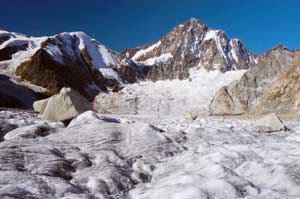
There have been many ice ages in the history of the Earth; but the last, which covered vast tracks of the Northern Hemisphere, came to an end some nine to ten thousand years ago – when the temperature (and sea level) rose. It has always been assumed that no trees survived in the regions covered by the thick ice sheet, and that trees (like other plants) have returned to areas like Scandinavia by the gradual northern migration of species that had taken ‘sanctuary’ in warmer latitudes.
However, recently work has been undertaken by Read more…
Unseasonal weather
We have experienced an extended and warm autumn, and now true to Pliny's words -
“A fair and dry autumn brings in always a windy winter” - winter weather has now firmly settled upon us. The temperature is down to “more representative” seasonal values for December, and cold, high winds have recently lashed Scotland and other parts of the U.K.
The warmest Autumn (for some 300 + years) was in 2006, when the temperature was some 2.4 / 3 oC above the seasonal average ; places like Kinlochewe recording a daytime temperature of 22.5 oC. The recent mild weather * was due to an unusual pattern of high altitude winds over the Continent. The course of the jet stream meant that there were southerly winds and relatively settled conditions over the United Kingdom.
Holly – a really useful tree
In various older texts on botany and gardening, it is said that ‘ … in Germany, Holly abounds in many forests… In France, it is abundant, more particularly in Brittany. The tree appears to attain a larger size in England than in other parts of Europe“ Certainly, in the past there were large areas where Holly was abundant. For example, Needwood Forest in Staffordshire. This was a significant and ancient Midlands forest. However, the Enclosure Act of 1803 allowed for the felling of large numbers of trees; this took some time to complete. In his ‘Plant Book’, Professor David Mabberley notes that some 150,000 holly trees were taken from Needwood about this time, to provide bobbins for the cotton mills of Lancashire. (Bagot’s Wood is said to be the largest existing piece of this ancient wood). Read more…
What do woodland owners do about sheds for storage ?
Some people who manage their own woodlands feel it would be easier if they had a shed or building to store things and to shelter when it rains. In principle, local authorities are positive about this as they want to see woodlands managed but in practice planning officers often fear that sheds are the thin end of a wedge that will end up with a residential development which doesn’t fit within the local development plan. Read more…