Making Hurdles
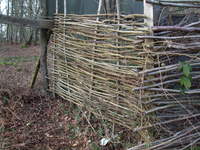
The reason I made the hurdles at first was to hide an unsightly rubbish tip. I decided they’d look a lot nicer than a garden-style fence.
The wood I used was hazel as it’s easy to bend around the uprights. Length is determined by the area to be hidden and available wood. Fairly straight lengths are needed for the uprights, less so for the weaving. I put the uprights in the earth and hammered them home with a mallet. The lower ends were pointed to make the going easier! They’re about 2 feet apart, the number used varies with the length I need to cover.
The weave sticks were around half an inch in diameter. Most reached from end to end, but here and there two lengths were used. Once complete they were cut to size using croppers. In the hurdles I’ve done so far I’ve not run a length of wood along the top of the uprights. I suspect this might make the structure rather stronger.
I can’t do this at the bottom though as they’re buried to give the required rigidity.
When I hid the tip behind the hurdle there were small trees in the way, some of which I used as uprights for the hurdle, giving a somewhat “rustic” appearance to the finished product! After the rubbish tip, I moved on to making screens for the toilet. Uprights about 7 feet tall were used to give the degree of privacy required for the users. As time has gone on I feel the hurdles are better, they now look rather neater. They’re too transparent for the loo enclosure for my liking, so I’ve used rot-proof black material inside the enclosure, so it looks natural from the outside but is private inside.
I only needed gloves, a saw, croppers, and a length of rope to bind all the thin stuff I’d gathered to make it easier to haul it back to the working area. Thus far I think I’ve only done four hurdles. Getting the wood is time-consuming. Anyone got any suggestions for speeding up this part of the process?
Comments are closed for this post.
Discussion
Here is a very short but useful time-lapse film showing the making of a hurdle:
https://www.instagram.com/p/Bx9v8TagO2K/?utm_source=ig_web_button_share_sheet
I have made my first hazel hurdle today after having watched several YouTube ‘how to’ videos. It has been quite successful, but the key thing is I have learnt by doing, making mistakes and correcting them. I would like to share what I learnt. Rather than drill holes in a railway sleeper or equivalent, I noticed that the rungs on my aluminium ladder were hollow and open each end. They were perfectly spaced to put the ‘sales’ in to keep them upright, probably better even than holes in a length of wood. I turned the ladder on it’s edge and inserted the sales (uprights) in the hollow rungs. I leant the whole lot against a bench (although a wall would equally suffice). At the start, the uprights are a bit wobbly, but that is good if you want to use last year’s hazel canes. I did use last year’s wood for the first half of the hurdle, but I used this year’s wood, straight from the tree as I needed it to do the ties at eavery 6 inches. I had to give up on the old wood later as the uprights had become taught and I used new hazel from then on. I discovered though that I didn’t need to worry too much if the canes snapped because the whole structure is very forgiving and the odd bit of snapped wood adds to the authenticity and rustic look. When I had finished, I eased the structure gently out of the ladder rungs and it is very sturdy, ‘tight’ and looks pretty good for a first attempt. Because I used quite a bit of old hazel, I’ll have enough old and new to make a couple more…or a wigwam or house for the grandkids. I hope this helps someone. I took me just 3 hour’s to make my first hurdle…which was a hurdle overcome in itself.
I would also like to understand this “holes drilled in a curve” in the mould. Please explain whether it is a simple shallow arc, or an S-shape or ?? Why not just weave with a straight line? I saw the comment saying that the curved holes help the hurdle “straighten out on its own” but this is confusing to me. Is there a clear photo or diagram somewhere showing the degree of curve needed? Also, why 9 holes?
Hi I want to make my own hazel hurdles – have just got old railway sleeper but do not know how to drill the holes – do they need to go all the way through and what size / sort of drill bit should I use? Any ideas? Thanks
[…] – read more here on how to make […]
I want to try to make a hazel hurdle to screen a water butt in my garden.
Can you tell me where I can legally cut and collect hazel sticks in order to do this?
Do I have to seek permission from landowners before gathering sticks?
Dear Barry
Thankyou very much for your response. That is really helpful.
hi katharine….it may be possible to use last years cut,providing they are not to brittle.if they are still a bit bendy then i suggest you soak them for three days to one week….dig a long pit in the ground,line it with polythene,then fill with water.immerse the withies and put some stones or bricks on them to keep them below the surface….take a couple out after a few days and test them for flex,when ready start weaving….best of luck!!!!p.s.when storing withies keep them out of the sun in a darkish place,and lightly cover them to prevent the wind from drying them out
Hi
I make hazel hurdles after coppicing, but had a request to make one now using last season’s coppiced hazel. Is it still okay to use the rods even though they are no longer green?
Thanks
Allan is, of course, absolutely correct! The mould has a series of (usually) nine holes drilled in a curve so that when the hurdle is removed it will straighten out on it’s own.
If you’re going to try making standalone hurdles, you’ll also need to learn how to complete the bottom and top weaves properly as these keep the whole hurdle together.
There’s no doubt that it’s hard on the hands, but it is hugely satisfying to make one.
The other book by Raymond Tabor is “Traditional Woodland Crafts”, ISBN-10: 0 7134 7500 5 and is an excellent read. Another option is the BTCV book “Woodlands: A Practical Guide” , ISBN 0 946752 33 8.
If you’re near to Winchester, Hampshire then Sparsholt College will be running a five day hurdle-making course in September 2009. I should in the interests of fairness that I do work for the college! We also run a 2 day hurdle making course as well. If you’re not near Winchester, then look on the ‘net for local colleges, or local makers who may run courses near you.
David.
Thanks for that Allan i will look out for the book.
Hi to all of you, I am a bit new to this blogging, but not new to Hazel Wattle Hurdle making.
Hurdle Makers cut & make in the coppice they are working, on a mould, (railway sleeper can used or simular) nine holes drilled in a curve, for the uprights (Sales or Zales) some of these maybe cleft.
Long cleft rods are woven in between the zales, bending them at the ends to continue with the rods until you have reached the finished required height. Some made up to 6 foot high. I would recommend a book “The Encyclopedia of Green Woodworking by Ray Tabor. This book really tells you everything, but it is still best to go on a course, for that contact http://www.coppice.org.uk the Wessex Coppice Group, who I believe still run Wattle Hurdle Making Competition near Wincester in Hampshire, in I think September each year, you also need good quality Hazel Coppice, which is becoming rare. I hope this helps.
Hi River, Nice to find some people out there who like the old things in life.I have about 3 acres of mixed woodland that i look after and i have recently tried my hand at hurdles.I have used hazel but i have not had much sucsess with splitting it.I did make a gate with hazel but i used a 4×2 frame and an air nailer to fix hazel horizontally.The effect was ok and we use the gate every day.Any ideas on splitting it?
Making hurdles can also be a good workout. The traditional way of making them involves using long hazel poles horizontally and bending them round at the end of the hurdle. This involves bending and twisiting the hazel rod at the same time to get it to bend 180 degrees without breaking. This is incredibly hard work. A friend of mine did this for a living, when he took it up full time he lost 2 stone in 2 months… Using croppers is a lot easier and fine for most purposes. Trad hurdles had to be more robust as they were constantly being moved around from field to field. Alex still makes woodland products but not so many hurdles these days:
http://www.cleftwood.com/
Adam.
Thanks for your reply River.
Yes the area is quite a jungle. Rabbits love it. Mostly I enjoy watching the birds. We have a brown owl circulating – not sure if its after the birds eggs or the rabbits, gladly the owl doesn’t stand a chance with all the branches in its way.The cuckoo is doing my head in with the noise but it is enjoying other birds nests.. A lonely high naked branch from an old fir provides a good perch for a sea eagle., so I won’t be chopping it down.
Thinking I might have to make a deer fence/hurdle,as I spotted a young deer over the wall today – would it be interested in eating the sawn off branches? or should I have Venison for tea?
Hello Mary,
You should be okay with thin willow-it’s quite bendy!Sounds as if you’ve quite a jungle to
deal with!
oops! Sorry Andrew, meant my last comment for River
Hi Andrew
I live in the Western Isles in an old farm house 100 years approx with extensive garden ground. At the foot of the walled garden there are numerous trees. Hawthorn, Pines and Willow Trees, Fuscia, wild roses and Rhododendrums in abundance. It has been allowed to grow pretty wild and I have sawn back a number of shrubs and trees resulting in new growth. With the broken branches etc I am hoping to make a hurdle to hide the cuttings with some willow shoots. Perhaps some old branches from the pine may fill in some gaps as well. I am thinking of using the willow to weave – will it work?
Hello Andrew,
Sorry not to have replied earlier,my infernal computer’s been rather sick and has been in
intensive care as it were.
You’re obviously much more experienced than I,thankyou for your advice.Will definately try
these ideas out!
Many thanks,River.
Hello Barry,
Alas I don’t have the room in my smallish walled garden to grow much in the way of trees-
just wish I did!Might plant some at the wood to make the campsite a little more private
though,so your message wasn’t in vain,thanks.
Best wishes,River.
HI RIVER
if you have a bit of room in your garden why not grow the hazel from cuttings or seed.my neighbour feeds a family of squirrels who bury peanuts & hazel/cobnuts all over the place,the former never make it but free trees,yes!this year i plan to transplant all into beds.so within a couple of years the saplings should be large enough to use, well fed with tree mould & comfrey juice.alternatively,try your local parks dept,i use ash for the weavers on some fixed hurdles, i have plenty all around my patch.they last a few years or so,free to me the only cost is cutting time,use & adapt what you can find around you.my three tortured hazel shrubs constantly sprout straight growth from their rootstocks, whitch can be used for cuttings as well….hope this info is of use to you….barry
Hello Tracy,
Sorry to be abit slow,the number and spacing of the upstakes varies with
the thickness of the wood you’ll use to weave the hurdle.The thicker or
stiffer this is,the farther apart your upstakes will need to be.
I have a few pictures of what’s been done thus far,but sending them’s
another matter!
Regards,
River.
As far as the posts in the ground go itis better to use lengthsof split chestnut or oak, weave the lower few weaves of the hazel , say 8”, then drop in hazel verticals, called sales or zales, into the weave beside each piece of chestnut then continue the weave up these. Oak and chestnut are fence post material. The hurdle does not last long anyway but at least theuse of these durable woods adds years. For learning hurdle making see http://www.hewittmobilesaw.co.uk
Do you have any photos of what you have made, sounds great!
I hadn’t thought of banging the uprights into the ground and making the hurdles on site, thanks for that.
Do you find that there is a minimum number of upstakes needed to keep it strong?
Thanks!
Tracy


hi Everyone
I made my first hurdle this weekend. I used my own hazel and combined with coppicing, something I have never done before either. However, I put it in situation and just hammered the uprights into quite soft ground, having used the bill hook to whittle the ends to a point. So no sleepers required. Maybe I have made a terrible mistake but I felt very pleased with what I produced
Jan Walmsley
1 October, 2019