Woodlands.co.uk

Blog - January 2026

Invaders - wallabies!

Invaders – wallabies!

by The blog at woodlands.co.uk, 24 January, 2026, 0 comments

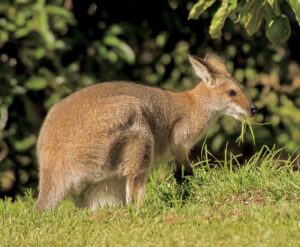
The nineteenth century saw the introduction of many ‘exotic’ or non native species.  Some of these introductions have proved to be invasive, for example the Himalayan balsam.  Invasions have also included animals. For example, muntjac, parakeets and grey squirrels.  More recently, there have been many sightings of wallabies. Their presence is thought to be due to escapees from wildlife parks, zoos and possibly private collections. It has been suggested that some were released during the WW2 as people were unable to look after them.  On the Isle of Man, there is a thriving population of red necked wallabies, which dates back to the 1960’s.  A recent survey (2023 & 2024) using thermal imaging and drones estimates the population to be around one thousand animals, possibly more.  The grassy and woodland habitats are not dissimilar to those in Tasmania, though the climate in the Isle of Man is somewhat cooler and wetter.  Here, there are no predators and they seem to have adapted well to the somewhat cooler conditions. They feed on heather, bracken, bilberries and grasses.  The local wildlife trust is concerned that the animals may be having a detrimental effect not only on the native vegetation but also the local fauna - such as ground nesting birds.  On the plus side, there are those who think their presence helps to support the local tourism industry. Beyond the Isle of Man, there have been many sightings of wallabies across the U.K, ranging from Cornwall to Scotland.  Sightings are more common in the South.  In some areas sightings of wallabies are no longer reported as the animals are ‘common place’. The Chilterns being a possible hot spot for sightings.  However, at present it seems that there is little evidence for self sustaining populations though this might change as our climate becomes milder.  There was a small population in the Peak District but it has since died out, possibly due to a harsh winter in 2010.  This population arose from the introduction of five wallabies by a local landowner, Henry Brocklehurst,  the  wallabies formed part of his private zoo at Swythamley. Featured image : thanks to Sandid on PIxabay  
Death on the moor

Death on the moor

by The blog at woodlands.co.uk, 21 January, 2026, 0 comments

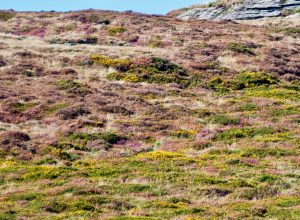
Dartmoor is famous for is diverse landscapes, many of which which sit on top of one of the largest granite areas in the country.   There are wet heaths, dry heaths, oak woodlands and blanket bogs.  The oak woodlands contribute massively to biological diversity of the area as the trees are covered with rich flora of mosses, liverworts and lichens. The SW area often experiences strong winds and has acidic soils.  The biodiversity of the area explains why it has been designated as a Special Area of Conservation.  It is one of our National Parks, which attracts many thousands of visitors.  A ‘normal‘ feature of heath and moorland is swathes of heather.   Due to its tolerance of acidic conditions and relative infertility, heather is generally a prominent member of the local flora.  This was once true of the moorland communities on Dartmoor, but the situation is changing. The change is due to a grass - known as purple moor grass (Molinia caerulea). Molinia is native to the UK but is also found in Europe, Asia and parts of Africa. It grows well on acid soils with a pH between 3.5 and 5, and it too can tolerate poor soils. During of the last 50 years,  Molinia has spread extensively in Dartmoor, Exmoor, the Pennines, the Peak District, the Yorkshire Dales and  parts of Wales.  Sadly, areas of purple moor grass support little in terms of insect or indeed bird life.  Herbivores like sheep and cattle tend to avoid it preferring other sources of vegetation, such as heather.  Indeed its nutritional value is not great and actually falls as summer progresses.  The grass is relatively unaffected by fungal / bacterial disease.  It forms deep roots and tussocks, which help protect its buds. The cover of heather on Dartmoor has fallen substantially in recent times, and in places has been replaced by an expanse of purple moor grass.  The features that made Dartmoor special are being lost. Possible factors contributing to changes on the moor: The practice of burning the moorland to encourage fresh shoots for sheep, cows, livestock.  Fires destroys many species but the young shoots of Molinia are ‘protected’ to a degree within the tussocks, and the deep roots also help ensure survival. Nitrogen deposition may be another factor.   A range of nitrogen compounds from farming (fertilisers, animal waste), traffic emissions and industry are released into the atmosphere and are deposited in significant amounts (circa 29 kg per hectare / year). Changes to moorland drainage.  As peat dries, the purple moor grass seems to thrive. There are limited funds available to the National Park for maintenance / repair. The subsidies (termed Headage payments) paid to farmers for the number of animals that graze on the moor. The combined effect of the above means that the moorland ecosystem is struggling, losing its integrity and climate changes (e.g. hotter, drier summers) do not help.   Essentially, the moorland is dying. There are places where the natural vegetation / flora of heather, bilberry and mountain ash are to be found, which suggests that restoration might be possible. What can be done? Create dams and embankments to retain water so that areas become wetter, and plant clumps of the moss - Sphagnum, which is vital for peat formation.  The water / wetness would also help reduce the risk of fire. Plant trees, like those found in woodland areas of the moor, which once established would tend to shade out the purple moor grass. Reducing the grazing pressure on the moorlands. Further reading https://www.theguardian.com/environment/2025/jul/16/dartmoor-is-dying-how-the-uks-national-parks-turned-into-biodiversity-deserts https://www.theguardian.com/commentisfree/2025/jul/15/sheep-destroying-british-habitats-taxpayers-dartmoor-farming https://dartmoorpreservation.co.uk/is-dartmoor-dying/
Changing times?

Changing times?

by The blog at woodlands.co.uk, 15 January, 2026, 0 comments

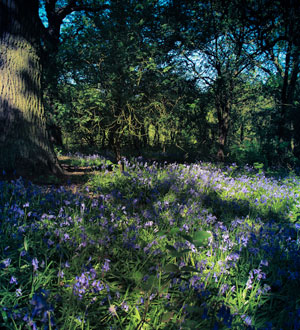
Researchers from the Open University have studied how ancient woodland habitats have changed in recent times.  Of the 43 woodlands studied; some were near to urban areas, whereas others were sited in rural locations.  The change in the nature of these woodlands was ‘measured’ by comparing historical records, herbarium specimens and surveys of the woodlands with present day surveys and analysis.   The study was particularly interested in ‘indicator species’ (eg bluebells, yellow archangel) associated with ancient woodland. Ancient woodland indicators are generally slow to colonise, but may be ‘stress tolerant’ and can persist after woodland disturbance or indeed, tree removal.  The study looked at how they fared with the spread of non-native species, such as the Spanish Bluebell, Rhododendron ponticum, swamp stonecrop (Crassula helmsii), Buddleja davidii, and Japanese knotweed (Fallopia japonica). These can outcompete native species, leading to local extinctions.  Woodlands near urban areas might be expected to be affected by the spread of such plants from gardens, parks etc. Pollution, which degrades air quality and also affects nutrient availability.  This may be due to fertiliser run-off from agricultural land or particulates and heavy metals from roads / industry.  Rural woodlands are perhaps more likely to experience fertiliser run-off than urban ones, this can increase nitrate and phosphate levels in the soil.  However, the drainage of particulates and various pollutants from roads and motorways has recently been recognised as problematic. The research indicated that the presence of native species in both urban and rural areas was relatively unaffected over the last thirty years.  However, the number of non-native or alien species in urban woodlands has risen significantly, affecting their species make-up. Thus, the study identified a large number of alien species recorded in ancient woodlands near to urban settings but these are largely absent from rural sites.   Biotic homogenisation can occur as non-woodland and alien species start to move into our ancient woodlands, leading to changes in the native plant communities.  A significant  proportion of ancient woodland in England is near to urban sites.  Clearly, there is a need for improved and careful monitoring of ancient woodlands near urban areas. 
Elm Trees: disease-resistant elm trees now available

Elm Trees: disease-resistant elm trees now available

by Angus, 6 January, 2026, 4 comments

I was excited to hear from a close relative that there has now been progress on developing elm tree saplings which could be resistant to Dutch Elm disease. As one who grew up in the 1970s I remember their loss over a few years as a result of the disease. For others they will be familiar from old photographs, poems, and paintings, yet they are strangely absent from today’s countryside. Dutch elm disease [DED] reshaped the nation’s woodlands and hedgerows, killing an estimated 25 million mature trees and altering landscapes that had developed over centuries. But the story isn’t over. A new generation of disease-resistant elm cultivars is beginning to change what’s possible for UK woodlands, conservation projects, and even urban tree-planting schemes. These elms are not the fragile giants of mid-century memory; they are carefully developed hybrids bred for resilience, longevity and ecological value. Their return opens up exciting potential for forestry, the countryside, wildlife recovery and long-term legacy forestry planning. What resistant elms could do for UK forestry [caption id="attachment_18575" align="alignleft" width="254"] Leaf of Elm[/caption] The forestry sector in the UK is under pressure to diversify tree species, increase resilience to climate change and pests, and expand woodland cover at scale. Disease-resistant elms present a genuine opportunity to contribute to those objectives. Elm is a fast-growing hardwood, historically valued for its tough, interlocking grain and durability when wet. While its traditional uses in wheel hubs, shipbuilding, coffins and farm structures may no longer drive demand, elm still has a place in modern forestry. The new resistant cultivars grow straight, tolerate a range of soils and are adaptable to urban, lowland and upland conditions. From a silvicultural perspective, introducing resilient elm back into mixed woodlands broadens the species portfolio at a time when ash dieback, Phytophthora strains and climate stresses are reducing the reliability of formerly dominant species. A more diverse woodland structure is a more resilient one — less vulnerable to the next big pathogen or extreme weather event. Elm trees also provide excellent early canopy cover and can integrate well into long rotation plans. For foresters thinking 50 to 100 years ahead, resistant elms offer the possibility of establishing stands that can thrive well into the next century. How reintroducing elms could transform the UK landscape The cultural loss of the elm is written into the character of the British landscape. Country lanes once lined with towering cathedral-like trunks became visually bare within a generation. Many regions saw hedgerows thinned and their organic shapes lost. Even in towns and cities, the elm had been a dependable street tree until Dutch Elm Disease [DED] stripped avenues of their distinctive silhouettes. [caption id="attachment_18572" align="alignleft" width="225"] Young Elm[/caption] Restoring resistant elms has the potential to bring back this visual richness. Their broad crowns, sculptural forms and strong architectural presence offer something different from oaks, beeches, horse chestnuts and maples. Landscapes shaped by elms have a softness and particular grace — an interplay of height and curve that many native-focused designers have long missed. Imagine the patchwork of English lowlands stitched again with lines of elms along watercourses. Picture Scottish or Welsh farmland bordered by hedgerows reinstated with elm that can survive more than a decade or two. The return of elms isn’t just ecological; it’s aesthetic, historical and emotional. It reconnects the modern countryside with an older Britain — restoring depth to the rural identity we sometimes forget is still evolving. Even urban design also stands to benefit. Many of the resistant cultivars withstand pollution, road salt, and compacted soils, making them excellent candidates for street avenues, civic squares and parks. A walkable city framed by elms once again feels completely plausible. Why disease-resistant elms might be good news for wildlife Elms have always been wildlife trees. Their leaves, seeds and bark host a wide range of invertebrates, which in turn support birds and small mammals. But perhaps the most striking ecological story is the elm’s role as a critical food plant for the White-letter Hairstreak butterfly.  This butterfly suffered a devastating decline as DED wiped out its primary larval host. Now, with resistant elms returning to woodlands, parks and village greens, conservationists have begun to integrate these cultivars directly into habitat recovery plans. Early evidence suggests that several resistant elm varieties are fully acceptable host plants, capable of sustaining healthy White-letter Hairstreak populations. Bird species also benefit. Elms provide dense cover and good nesting structure, and their early leaf flush is valuable for spring caterpillar availability — an important food source for breeding birds. In broader woodland planning, elm reintroduction helps to restore vertical layering and structural complexity, both essential for biodiversity. Combined with native shrubs and other hardwood species, resistant elms can contribute to dynamic ecosystems rather than monocultures. UK suppliers offering disease-resistant elms If you’re interested in planting some yourself — whether for a large woodland project or a small-scale tree-planting scheme — there are now some UK suppliers currently offering disease-resistant elm cultivars. One of them is Hillier Nurseries (Hampshire), one of the main UK distributors of the Resista® range, including Ulmus ‘New Horizon’ and Ulmus ‘Rebona’. These cultivars are widely used in both landscape and urban environments. Their website is at www.hillier.co.uk I plan to plant a few in the Spring and see how they get on.