Woodlands.co.uk

Blog - hedgerows

Watching insects on the move

Watching insects on the move

by The blog at woodlands.co.uk, 5 December, 2025, 0 comments

Scientists from the Meteorological Office use radar data to track approaching storms and changing weather patterns.   The radar works by sending out pulses of microwaves, these bounce off rain drops and other particles in the air.  The time that it takes for this signal to return, plus its intensity gives information about the approaching weather. Early radar [during the Second World War] also picked the movement of ‘angels’. These ‘angels’ were later recognised as the movement of birds, bats and insects.  Scientists then had to develop techniques to remove this ‘biological scatter / material’, so that they could accurately predict storms etc. By removing this ‘biological component’ of the signal, a lot of biological information about the movement of birds, bats and insects was being ‘discarded’.   Now, scientists from the University of Leeds have ‘repurposed’ the radar data (from many radar stations, which scan the skies many times each day & night) but this time they remove the data relating to the weather.  This leaves information about the insects moving at a height of some 500 / 700 metres above the ground.  The results showed that some 11.2 trillion insects are moving during the day, and that this reduces to some five trillion at night.   Some of these insects are actively flying, but some are being carried by the wind  / thermals.  Furthermore, there were more insects above areas such as woodlands, grasslands and even urban areas.  However, the numbers were lower over intensively farmed areas, where plant biodiversity was reduced as compared to woodland or natural grassland.  The numbers were also lower where artificial lighting was high.   Other work by the CEH, Newcastle University and Butterfly Conservation, has involved surveys of grassland and hedgerows in southern England (Thames Valley) some of which were lit by streetlamp, others were unlit. The areas that were exposed to night time lights had roughly half the number of caterpillars as compared to the unlit areas.   In another study, LED lighting was set up in fields, and caterpillars' numbers in these illuminated fields were reduced.  The lighting may :- [caption id="attachment_40185" align="alignleft" width="300"] Cinnabar moth caterpillar.[/caption]   Deter nocturnal moths from egg laying. Make the night flying moths ‘easier targets’ for predators (such as bats). Affect the feeding habits of moth caterpillars. Whilst it would seem that night time light affects insects and the feeding behaviour of caterpillars,  quite how and why is yet to be determined.
Revisiting hedgerows.

Revisiting hedgerows.

by The blog at woodlands.co.uk, 12 April, 2023, 0 comments

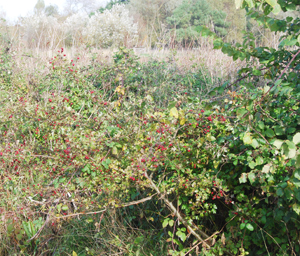
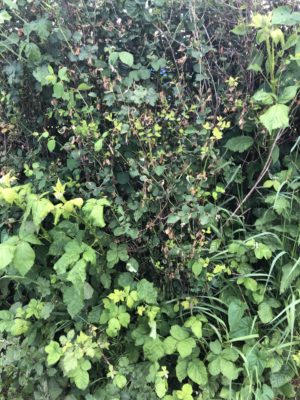
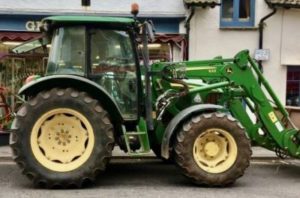
Some years back, the Woodlands blog posted various articles about hedgerows,  noting the loss of many - due to the increased mechanisation of farming in the mid C20th.  Now, there is greater recognition of the importance of hedgerows, and there are initiatives to promote the maintenance and expansion of hedgerows. But what is a hedgerow? Natural England offers a definition as follows : A hedgerow is defined as any boundary line of trees or shrubs over 20m long and less than 5m wide, and where any gaps between the trees or shrub species are less that 20m wide (Bickmore, 2002). Any bank, wall, ditch or tree within 2m of the centre of the hedgerow is considered to be part of the hedgerow habitat, as is the herbaceous vegetation within 2m of the centre of the hedgerow.  This differs from the definition in the  Biodiversity Action Plan, which included references to ancient hedges / species-rich hedges.  The definition now includes all hedgerows consisting of at least one native woody species of tree or shrub (mainly), but it does exclude bramble and honeysuckle as ‘woody species’.  According to one source, there are some 550,000km of hedgerow in England, with over 400,000 km being actively managed.  Hedgerows are an important semi-natural habitat in what is otherwise a managed agricultural landscape. They are found across the country but there are more in lowland regions. Hedgerows in the south east are associated with large fields and fewer trees, the proportion of trees in hedgerows increases as one goes north and west.   The nature of hedgerows varies across the country but all are important as : They provide a habitat, shelter (micro-climate provision) and resources for many different species (from plants to insects, birds and mammals). Hedgerows are particularly important as nesting sites for birds. They support animals that have key roles within the broader ecosystem, for example pollinators and predators of pests. They offer an important source of nectar that helps support wild bees - adjacent farmland can be a poor source of nectar Hedgerows are known to support threatened (red listed) species Hedgerows capture and store carbon (above and below ground) Hedgerows offer ecosystem services eg. mitigation of water flux and availability, landscape connectivity, soil conservation / stabilisation. A number of studies indicate that increasing the number of hedgerows would help with landscape connectivity (for example, for hedgehogs) and that planting of blackthorn and hawthorn in association with later flowering species would help support a number of wild bee species.  Expanding the number of hedgerows could have some negative effects as they might offer a home to invasive species and / or pathogens; but one study has indicated that ash trees in hedgerows suffer less impact from ash dieback than trees in forests.  To date there does not appear to be any detailed research on whether increasing hedgerow coverage would have any impact on tree disease / pathogen spread. Hedgerows, like woodlands themselves, face a number of challenges due to climate change.  Warmer winters may mean that the ‘winter chill’ requirements of some shrubs / trees will not be met; this may mean flowers and fruits fail to form properly which in turn means less food for birds, small mammals etc.  Drier summers may stress some species, trees like Beech are susceptible to drought.  Extreme weather events (like Storm Arwen) can inflict damage on hedgerow trees.  If a hedgerow is next to farmland, then it may experience drift from pesticide and / or herbicide spraying  nutrient enrichment (eutrophication) due to the use of fertilisers. Hedgerows with a diverse structure, with plants, shrubs and trees of varying ages and heights provide the widest range of niches / microhabitats for wildlife.  The inclusion of dead / decaying wood offers opportunities for various fungi, saproxylic beetles, woodlice etc.  Some hedgerows are managed / reduced with a mechanical flail (see above !!!). If this is done annually, it can result in a loss of biodiversity. Trimming should be done on a 2 or 3 year cycle; and some sections of the hedge might be left for longer " see (https://www.hedgelink.org.uk/cms/cms_content/files/76_ne_hedgecutting.pdf).  Thousands of tree and hedgerow plants are being planted to create a flood defence project at Castlehill, East Hull.   The plan is to create some seven hectares of woodland and over five kilometres of new hedgerow, as part of a flood defence project (to store floodwater east of the city).  Trees such as field maple, downy birch, English oak, and black alder are being planted along with species of willow, dog rose, guelder rose and blackthorn and hawthorn to create hedgerows and scrubland.  Other species will be allowed to naturally develop in the area and the habitat is expected to reach ‘maturity in some fifteen to twenty years. There is a citizen science project that involves surveying hedgerows.  It is organised by the People’s Trust for Endangered Species [PTES].  The Great British Hedgerow Survey guidelines can be found here : https://hedgerowsurvey.ptes.org/survey-guidelines Some times hedges offer a home to other things         
woodlands web update - 22

woodlands web update – 22

by The blog at woodlands.co.uk, 11 February, 2023, 0 comments

Back to one’s roots? Some of the effects of agriculture are very obvious, such as the vast areas of land now covered by monocultures of wheat or oil seed rape.  The expansion of mechanised agriculture has resulted in significant reductions in biodiversity, for example, through the loss of hedgerows and ponds (see the post on ghost ponds in Norfolk).  However, agriculture has others effects that are not quite so obvious.   Soils are ‘filled’ with roots, and roots help engineer landscapes.  They help: break up bedrock, improve permeability of the soil to water  stabilise the soil,  store carbon transport water and minerals to the plants.   They have been doing this for millions of years since the colonisation of land by plants. Now, research by scientists in the United States, has shown that the roots of agricultural crops are significantly less deep than those of  the  natural vegetation in an area.  Indeed, the root depth may be shallower by some 60 cm, compared to the natural root systems of an area.  If the soil is less root material then there is  decreased carbon storage,  reduced nutrient recycling and  possibly reduced soil stability.   Whilst there are some areas where “woody encroachment” is occurring (for example, shrubland taking over in some grasslands and forest advance into regions of tundra so root depth is increasing) -  the onward march of agriculture is dominant. Full details of this analysis / research : https://agupubs.onlinelibrary.wiley.com/doi/10.1029/2022EF002897 Shrinking in winter Recent research has shown that some small mammals (like moles and shrews) shrink in size during periods of cold temperature.   This shrinking is thought to be a response to cold temperature rather than lack of resources.   This change in form has been known for some 70 years and is referred to as Dehnel’s phenomenon.  Professor Dehnel observed this change in form in shrews [in Poland in 1949].  However, shrews have a short lifespan so an extended studied of this phenomenon with these animals was not / is not possible.   Recent studies by German researchers have focused on moles, who can survive harsh winters by becoming  smaller.  It is thought that this reduction in size enables energy savings.  According to Dr Dina Dechmann this reduction in size comes at a cost, as the animals’ cognitive behaviour is affected. Further information here : https://royalsocietypublishing.org/doi/10.1098/rsos.220652 Farming and sustainability With the expansion of farming, less and less of the land is available for our native plants and animals,  Hedgerows and ponds have been lost / removed, natural habitats have been reduced. The government has produced new guidance on environmental land management schemes (ELMs).  That is subsidies that will be paid to farmers if they help promote and protect nature and improve the environment (e.g. using less insecticide and reducing pollution). There would be payment /subsidies for some 280 measures, for example : Creating fenland from lowland peat Maintaining sphagnum moss Creating land that could produce organic fruit Establishing a skylark plot Adding organic matter to the soil Creating green cover over winter (on 70% of the land) Welcome as these measures might be, there is criticism that they favour big arable farmers and do not really help those working on more marginal land (such as upland and moorland regions). Further information available here. Trees - From Root to Leaf For those who like their trees, here is a new book about them.  Written by Paul Smith -who was head of the Millennium Seed Bank of the Royal Botanic Garden, Kew.  Not read or seen a copy but the Sunday Times comment "'Stunningly illustrated and detailed ... a celebration of all things arboreal, from the seeds, leaves, flowers and fruit to the diversity of trees and how they have influenced art, culture and science' suggests that it might interest.  See "https://press.uchicago.edu/ucp/books/book/chicago/T/bo186012850.html"  
Light in the darkness

Light in the darkness

by The blog at woodlands.co.uk, 8 February, 2022, 0 comments

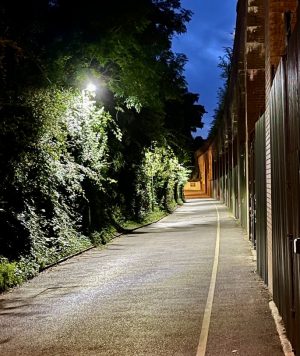
Compared to past centuries, we live in a bright, highly illuminated world where even our nights are bright.  Apart from the lights in our homes and offices, there are thousands of street lights. In many places, the natural 'night time' environment is no more.  This 'artificial light' pollution  has increased significantly in recent times (as indicated by research led by the University of Exeter).    Street lights, especially the newer LED ones, may be affecting various night flying insects.   It is a fact that insect populations in general are under threat from  The loss of woodlands, forests, heathlands and meadows (often to agriculture) The intensive use of pesticides Climate change / extreme weather events Pollution of rivers / lakes (eg. Nitrate / phosphate pollution leading to eutrophication). Now the intensive use of artificial light is thought to be affecting night flying insects, such as moths. Moth populations are in decline, for example, the Buff Arches population, has declined in number by 62% since the 1970s. However, the effects are not limited to moths but also birds, bats and wildlife that feed upon them (or their caterpillars). The UK Centre for Ecology and Hydrology suggests that streets bathed in light may:- Deter nocturnal moths from egg laying. Make the night flying moths ‘easier targets’ for predators (such as bats). Affect the feeding habits of moth caterpillars. A number of investigations have been initiated by CEH, Newcastle University and Butterfly Conservation. The work involved surveys of grassland and hedgerows in southern England (Thames Valley) some lit by streetlamp, others unlit.  The areas that were exposed to night time lights had roughly half the number of caterpillars as compared to the unlit areas; (the hedgerows reduction was 47%, and 33% in grass margins).  In another investigation, LED lighting was set up in fields, caterpillars numbers in such fields were reduced.  It would seem that night time light affects the feeding behaviour of caterpillars. Quite how and why is to be determined. LED lights are being using more and more, as they are brighter, cheaper to run and more energy efficient. LEDs emit more blue light than older forms of lighting. It is likely that the impacts of light pollution on night flying insects will increase. This, in turn, will effect of other species, such as hedgehogs which need many, many caterpillars to feed themselves and their young.  The loss of insects, such as bees, ants and beetles is occurring at a worrying rate, indeed faster than the loss of mammalian, avian or reptilian species.  The loss of insects has far reaching consequences for ecosystems - as they provide food for many vertebrate species and they acts as pollinating agents for many flowers and crops.   https://youtu.be/Rnsz7JtBmJw

Next Page »