Woodlands.co.uk

Blog - oak

Britain’s Ancient Wildwood

Britain’s Ancient Wildwood

by Anton, 1 May, 2026, 0 comments

How Trees Reclaimed a Frozen Land The British landscape we know today, its rolling hills, hedgerows and scattered woodlands, is the product of thousands of years of change. But rewind far enough and none of it existed. After the last Ice Age, Britain was a treeless, frozen expanse. What followed was one of the most remarkable transformations in the natural history of these islands: the slow, steady return of the forests. A land emerging from ice About fifteen thousand years ago, the climate began to warm and the ice sheets that had smothered much of Britain started retreating northward. The southern parts of the country may have supported a sparse arctic grassland, but trees were entirely absent.  Sea levels remained low, vast quantities of water were still locked up in ice, so Britain was physically connected to mainland Europe. A broad plain of meandering rivers linked present-day East Anglia with the Netherlands and northern Germany, across a region now submerged beneath the North Sea and often referred to as Doggerland. This land bridge allowed plants, animals, and eventually human settlers to make their way into Britain from the continent, setting in motion changes that would reshape the landscape dramatically. The pioneer trees arrive Trees gradually colonised the bare ground. The first wooded areas were likely dominated by birch — species such as Betula nana and B. pubescens that tolerate extreme cold. Although the climate was warming, conditions were still too harsh for many pollinating insects. Birch is wind-pollinated, making it an ideal pioneer species: one that can establish itself on immature or disturbed soils in challenging environments. In doing so, pioneer species modify their surroundings and 'open the door' for others to follow, a process known as succession. Over time, pine, aspen and hazel arrived and took hold, followed later by elm, oak and small-leaved lime. Forests spread across Britain, covering the land except for the highest, wettest and coldest areas. Reading the past through pollen How do we know what grew where, and when? Pollen analysis of peat bogs and other sedimentary deposits can reveal which species were present over different periods. The outer wall of a pollen grain — the exine — is extraordinarily resistant to decay, so its distinctive structure remains intact for millennia, allowing researchers to identify species long after the trees themselves have vanished. The wildwood takes shape By around six thousand years ago, forest covered most of the British countryside. This great expanse of woodland is often called the “wildwood”, a term popularised by Oliver Rackham in Trees and Woodlands in the British Landscape. The wildwood was at its most abundant during this period: a complex, tangled mosaic of trees, many of them dead or dying from the effects of wind, fire sparked by lightning, and flooding. It would have offered a rich variety of habitats and niches for plants, insects and mammals alike. Not as dense as you might think Recent research and pollen analysis published in the Journal of Ecology suggests that Europe’s post-glacial wildwoods were rich in hazel, oak and yew; species that tend to flourish in more open woodland where light reaches the ground, rather than in dense, closed-canopy forest. Hazel produces more pollen and flowers freely in sunlit conditions. Yew, while sensitive to fire, is shade-tolerant and needs some space and light to avoid being outcompeted by taller trees. Its leaves are toxic to most mammals (including humans), which protects it from grazing. The persistence of yew in ancient woodlands, along with its sensitivity to fire, points to a relatively open woodland structure; one maintained, it is thought, by the grazing activity of large herbivores. Oak, too, is a light-demanding species whose seeds germinate best on disturbed ground. Large herbivores consume huge quantities of vegetation, altering plant biomass and community composition. They also cause physical damage through trampling and bark-stripping. These processes can help create clearings and maintain open areas within the woodland. The resulting light reaching the forest floor would have encouraged a rich ground flora to flourish beneath the canopy. A living legacy Britain’s wildwood may be largely gone, but its legacy runs through the landscape. The oaks, hazels and yews that define many of our oldest woodlands are living links to those post-glacial forests. Understanding how they established themselves and how grazing, fire and climate shaped the woodland around them isn’t just a matter of historical curiosity. It offers practical insight for anyone involved in woodland conservation and restoration today. The wildwood reminds us that British forests were never static or uniform; they were dynamic, open and shaped  by many animals,  and the elements. 
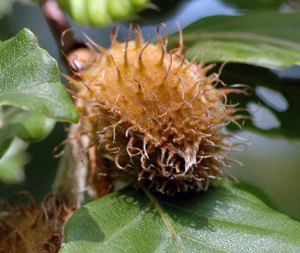
beech nut

Mists, Mast and mellow fruitfulness

by The blog at woodlands.co.uk, 26 September, 2025, 0 comments

Autumn is here, whether you follow the definition of meteorological autumn, which starts on the first of September or the astronomical autumn which starts at the autumn equinox.  The equinox is when day and night length are equal, after that time the days get shorter. Or it might be that you are noting the signs of the seasons changing.  The BBC, the Woodland Trust and Nature’s Calendar chart the advance of autumn by recording events in the life of key species, for example blackberry, hawthorn, swifts, conkers, ivy and oak.  The information collected helps build a picture of how climate change is affecting the time of flowering, fruiting  etc. of many species. The blog has already commented on the early flowering of the blackberries but now woodlands are starting to transform into a mosaic of reds, yellows, and oranges as the leaves prepare to be shed and the woodland floor becomes a fungal jungle, (as Jasper has described). Hawthorn, Blackthorn and other bushes are laden with berries, conkers and acorns will be strewn across woodland floors. Squirrels eat hazelnuts (and hide some of them as a winter food store).  This banquet of fruits and seeds may be a response to the long, hot and very dry summer we have just experienced.  Trees and shrubs have been stressed by the heat and drought. Some have responded by mobilising their reserves / efforts into producing more fruits and seeds, to ensure that they pass on their genes to the next generation.   [caption id="attachment_24651" align="aligncenter" width="600"] Sloes on Blackthorn[/caption] If it seems like you have been noticing more acorns on the trees than normal that could be down to a "mast year”. Mast years occur roughly every five to ten years and refer to years when certain species of trees Like oak & beech) and shrubs produce a larger than normal crop of berries, nuts and fruit.  This boost in production means far more is produced than can be eaten  by the usual herbivores, squirrels, dormice etc, thus ensuring at least some of the mast goes on to grow new plants.  However, this ‘over-production’ can come at a cost to the tree, using vital resources so that growth in the subsequent year may be reduced.  Quite what causes trees and shrubs to ‘go mad’ and overproduce is not known but some theories are explored in a previous blog, though the weather in Spring is an important factor. [caption id="attachment_42689" align="aligncenter" width="675"] Collecting acorns.[/caption]
How many trees are there in the UK?

How many trees are there in the UK?

by Angus, 1 June, 2025, 0 comments

About 3.5 billion or about 50 for each person. Yes, there’s some guesstimating but it can’t be far out.  Of course you can argue the toss about what counts as a tree and if you count tiny saplings you might get it up to 5 billion. Here’s the basis for this number - the UK is just over 60 million acres, of which about 14% is woodland.  That’s a big increase from 1900 when it was only about 5% and it’s far less than Europe where the average is almost 40%.  Anyway, suppose there are another 50% of trees outside woodlands - such as those in parks, field edges, urban trees, and on moorlands. That would be the equivalent of 12 million acres with tree cover.  How many trees per acre is a big question because large majestic trees can be so large that there can be only about 20 on each acre whereas for young saplings the number can be as high as 2,000. Conifers can be as many as 1,000 per acre but, as the tree crop is thinned, that reduces to the low hundreds. So a figure of just under 300 trees per acre looks typical and on 12 million acres that would give about 3.5 billion trees. They are not evenly distributed between different parts of the UK - for example Scotland has almost 20% tree cover and about 20M acres so of the UK’s trees, almost a third are in Scotland. That brings us onto what species these trees are. It turns out that in woodlands a quarter of the trees are Sitka spruce and half as much again are Scots pine.  Other conifers (Douglas fir, Norway spruce and Lodgepole pine) make up another 15% so over half our trees are conifers.  Of the deciduous trees English oak and Silver birch each make up another 10% or so with Beech and Hazel together making 15% of our trees. It’s a concentrated picture, with 87% of our trees being made up of the top 10 species. Whereas the British population is around a hundredth of the world’s population (1%) we are far less significant in tree terms. There are probably around 3 trillion trees worldwide so the UK has nearer to a thousandth of the trees in the world.  At least the UK is going in the right direction - whilst the world’s tree cover is reducing due to deforestation from fires, drought and agricultural expansion, the UK’s has been increasing, albeit gradually.  Since the start of the millennium we have probably increased tree cover by around 1%. [caption id="attachment_30295" align="aligncenter" width="650"] Chestnut coppice[/caption]
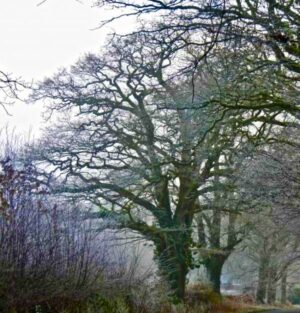
oak tree in winter

Planting Oak for the future ?

by The blog at woodlands.co.uk, 9 May, 2024, 1 comments

At present, our forests and many across much of Europe have a medley of different species, and this has been the case for many hundreds of years.  They have survived minor fluctuations in climate and weather.  However, now climate and weather are changing in significant ways.  There are more extreme weather events, ranging from unprecedented rainfall to drought and periods of very high temperatures.  Winters seem to be be warmer and wetter, summers hotter and drier. Consequently, there is concern that many tree species being planted today will not be able to survive in the conditions that they are likely to experience in 50 or a 100 years time.  Species like the European Beech (Fagus sylvatica) are likely to struggle (like many did in the heat wave of 1976).  The root system of the beech is shallow, and though it has large roots spreading out in many directions, it cannot access water that may be present at deeper levels in the soil.   Though it is not known how native trees might adapt or be able to respond to a changing climate, it is possible that the number of tree species per km2 able to survive through to the next century may well fall by a third to a half in a warmer climate (depending on how quickly the warming occurs). Examination of some 60 plus European trees species at University of Vienna by Johannes Wessely et al suggested that the English or Pedunculate Oak (Quercus robur) may be a species that could cope with changing climatic conditions. It seems that native UK Oaks are genetically diverse, and this gives rise to variation and the potential to adapt to changing conditions.  Oak is wind pollinated and its light pollen can be dispersed over long distances, which promotes outbreeding and genetic diversity. Whilst the oak has always been valuable as a species for :- Timber production : it is used in furniture making and in the past thousands of oaks were used in the building of ships such as the Mary Rose. Carbon sequestration / storage - it is long lived and has a large above ground biomass Biodiversity : it provides a ‘home’ for many species of animals, plants and fungi. It offers food and shelter for many invertebrate species, numerous insects and spiders); its leaves often show the ‘scars’ of their feeding activities. Its bark is an ideal substrate for many lichen and bryophyte species (epiphytes). The roots of the trees establish mycorrhizal associations with various fungi. Now, the Oak may prove to be valuable in a warmer world as a species for timber production and reforestation projects.  The Oak’s ability to support other plant, animal and fungal species would also be important in terms of biodiversity and resilience..   Forests with a smaller number of tree species are thought to be less resilient to climate change and less biodiverse.   [caption id="attachment_41217" align="aligncenter" width="675"] A solitary oak[/caption]
On buying a woodland

On buying a woodland

by David Harwood, 15 February, 2022, 0 comments

Recently, woodlands.co.uk asked me some questions about ‘buying a woodland’.  So here goes : How did you find your woodland? As a local, I found the woodland by walking with my partner and our dog. My partner’s family lived in the village for a number of years. Were there surprises you found in the first few weeks of owning your wood? The biggest surprise for me in the early weeks was the expansiveness of my woodland, every time I would visit I would find something different. This could be a different tree species,a path or a bird. Did you set up a campsite and how did that go?   One of my goals was to camp at least once a month, starting with my first month of ownership in January! Camping has given me the opportunity to spend more time in the woods, not just mornings /  afternoons and appreciate the peace and quietness. How have you managed the woodland?  Management so far has been cutting overstood hazel coupes for regeneration and collecting good firewood for home. Rotten or poor-quality wood has been collected and stacked for wildlife habitats, especially oak! The hazel rods have been for craft activities ,with the brush piles being left for insects. What are your future plans for the woodland?  Future plan for the woodland is to introduce different native species of tree. I have around 20 saplings I have potted on at home, that will eventually be moved into the wood. With the regeneration of hazel, the crop I intend to use to create deadwood hedges for protecting young trees from deer. How have various members of the family got involved in the woodland?  All of my family have visited the woods and helped in some way. Whether it be firewood, coppicing or bringing food to have with a hot drink!   What practical projects have you done or planned for your woodland?  How did you do these?  My partner and I both enjoy wood craft such as pyrography and woodturning. A lot of oak limbs that have come down during storms have been used to make presents for friends and family, and decorations for our home. What advice would you give to someone buying a small woodland?  My best bit of advice would be to wait for the woodland that has what you want. Woodlands come in all shapes and sizes; and getting the right patch can make your experience a lot more enjoyable. In terms of flora, what have you learnt in the woodland? I have learnt that woodlands like mine (broadleaf) provides a home for hundreds of plants, flowers and insects. The humid conditions in oak woodlands provides ideal conditions for rare / hard to find flowers such as orchids and so many types of fungi and lichens. David 
beech nut

Masting

by The blog at woodlands.co.uk, 10 December, 2021, 0 comments

‘The Fall’ in the eastern United States has been colourful and plentiful this year.  There have been bumper crops of acorns, maple seeds and pine cones.  It is a Mast Year.  The trees have produced enormous numbers of potential offspring. These seeds and fruits will have significant 'knock on effects' in the ecosystems for some years.   Beeches and oaks can release so many seeds that they significantly increase the organic content of the soil and its nutrient value.  This fuels fungal and microbial growth. Small mammals feast on the acorns / mast and their numbers increase.  They, in turn, are food for foxes, owls and other predators *.   Quite what drives a mast year has long been a cause of speculation.  Ideas have included  masting evolved to overwhelm seed predators (mice, squirrels etc.) and thus ensure that at least some seeds survive to germinate and grow on.  fluctuations in nutrient availability affect the trees and flower / fruit production environmental prediction - that masting occurs in those years when seeds are likely to have good weather for sprouting in the following Spring.   even sunspot activity has been invoked Recently, a database [MASTREE] was created of mast years (for Beech and Norway Spruce) that extends back centuries.  This has enabled scientists to explore the environmental prediction idea, that is, whether masting is correlated with climatic events and occurs when seeds are likely to have favourable weather for germination and growth in the Spring after their production. On comparing the data with climate records, they found masting events [in beeches] correlated with climate patterns associated with the NAO - North Atlantic Oscillation, i.e. changes in air pressure between Iceland (low) and the Azores (high).  A “positive” NAO phase favours both masting and subsequent seedling growth; that is warm wet winters promote seed production and dry springs favour seedling growth.  Quite how the trees turn such climatic events into ‘signals’ for masting is another matter. Not all are convinced however. Some argue that the resources used up in producing so many seeds / fruits mean that the trees are exhausted and it takes time for these resources to be replaced and for the tree to flower and fruit fully again.   Professor David Kelly has a somewhat different hypothesis related to weather .  He suggests greater warmth in the previous growing season(s) may be the trigger.  Quite how the trees ‘remember’ the warmth that they have experienced is not known; but one thought is that it is due to what is termed ‘epigenetic marking’.  It is possible that the DNA of the genes that affect flowering is changed by the warm temperatures.   The activation of particular genes can be altered by their DNA undergoing methylation - a process where methyl (-CH3) groups are added (or removed) from the DNA.  Further information on masting and climatic effects on trees - visit science.org * [Sadly, a Swiss study found good masting years were later associated with a rise in tick-borne disease.]  

Next Page »