Restoring forests and woodlands.
by The blog at woodlands.co.uk, 29 June, 2025, 0 comments
Trees are remarkably resilient. In various forms they have been arounds for millions of years. They have survived asteroid impact (66 million years ago), and a series of successive ice ages. However, in more recent times they have faced a new challenge, the relentless march of humankind. Early societies felled trees for timber for dwellings, boats*, wood for fire, making tools, as part of ‘flash and burn’ agriculture to create a ‘swidden’ to grow food. The material felled to create a swidden was allowed to dry and then burnt, the ash released mineral nutrients into the soil for the crops.
As more complex civilisations / societies evolved, there were attempts to restore degraded forests / bare land, and to protect forests. The Zhou (Chou) dynasty established a ‘forestry service’ over two thousand years ago, and in India the emperor Ashoka (268 -232 BCE) ordered wide scale reforestation. Much later in the Middles Ages there were efforts to restore degraded areas, for example, around Nuremberg in the C12th. Most of these early efforts were concerned with increasing timber production or the mitigation of natural disasters. In the last two centuries, significant areas of natural forest and woodland have been lost, increasing the risk of soil erosion, flooding and disease (as animals are displaced).
In the last century, the percentage cover by forest / woodland in some countries (for example, the UK) was low so vast areas were planted with a single species. Fast growing species (conifers such as pines, spruce and larch) were often grown on what was regarded as marginal land, creating plantations. In some parts of the Mediterranean, Eucalyptus was planted. These were species that could cope with the challenging nature of the soil and / or the topography. Many of the European initiatives met with some success in terms of timber production and / or the stabilisation of degraded areas (for example, reducing erosion). Such schemes also created jobs, contributing to the local economy. But when grassland or heathland were used to create single species plantations, this was often accompanied by a loss in biodiversity. In places, the introduction of non-native species has been challenging as they have become invasive, for example, black cherry.
The success of any scheme is dependent on
Sound planting techniques and aftercare
Selection of the right species for the area
The co-operation / involvement of local peoples.
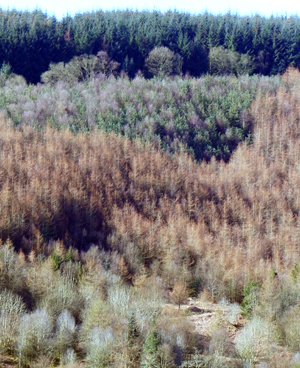
Mass planting of a single species can also contribute to the rapid spread of disease / pests (e.g.bark beetles, pine procesionary moth). Vast swathes of coniferous forest were affected by acid rain (associated with sulphur dioxide from the burning of fossil fuels) in the last century. This was termed Waldsterben [Wald=forest + sterben=to die].
Problems such as these, coupled with increasing environmental awareness contributed to a rethink of the aims and objectives of forest management / renewal / restoration. However, there were examples where ecological recovery was good, for example, some spruce and black pine ‘monocultures’ were diversified through the planting of a understorey of broadleaved trees, as in Slovenia.
In recent times, timber production, control of erosion and reduction of disaster risk remain relevant still, but the importance of biodiversity, resilience and ecosystem services are now uppermost. There is a move from ‘quantity to quality’ of forest and woodland. In many countries, a growing interest in recreation and tourism (recognising the importance of green space for mental and physical well being), coupled with growing environmental concerns and recognition of climate change has emerged.
Forest and woodlands across the world, from the boreal regions to the Equator are under threat. Many have been lost or badly degraded, and are in desperate need of restoration. Forests are no longer regarded as sources of timber, but are important providers of ecosystem services, such as the mitigation of flooding.
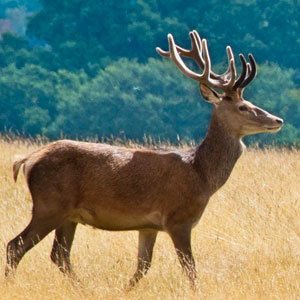
So, in more recent times they have been efforts to restore and repair forests and woodlands. Homogenous and dense plantations / forests in boreal regions had clearings created to allow light demanding species to establish. Limitations have been placed on clear cutting, and the use of fencing, tree protectors have
[caption id="attachment_41889" align="alignleft" width="300"] squirrel[/caption]
helped to reduce browsing pressure (by deer / squirrels etc). One means of promoting biodiversity is ensuring that the woodland / forests offer deadwood. This provides a ‘home’ to species as varied as woodpeckers to saproxylic beetles. These beetles help break down wood so that it can be further broken down by fungi and bacteria, returning nutrients to the soil. Tree girdling was a technique used in Finland to create deadwood, it severs the conducting tissue (phloem) so that the supply of sugars is interrupted. Thought is now given to the selection and introduction of tree species that are adapted and resilient to anticipated climate change impacts.
Though countries have adopted a variety of techniques in recent times, the extent of forest and woodland restoration has been largely limited by the funding available. Restoration does not come cheap, funding over significant period of time is needed, and time itself for the effects of the measures to become apparent.
For detailed information on forest restoration see - https://link.springer.com/article/10.1007/s40725-024-00235-3
Intereesting facts :
Henry V111’s flag ship, the Mary Rose , was built using oak and elm. It was the first big ship of the Tudor naval fleet and it is estimated that over 600 trees were needed for its construction,. That is equivalent to about 16 hectares of forest / woodland. And
Cver 370 species are supported in the territories of the Karen swidden farmers in northern Thailand.