My Life Measured in Tree Diseases
by Angus, 2 May, 2025, 0 comments
I was born in the 1950s, a time when black smudges began to appear mysteriously on the trunks of sycamores in Britain. The culprit: sooty bark disease, a fungal infection caused by Cryptostroma corticale. Back then, I had no idea my life would unfold alongside a slow but steady parade of arboreal afflictions. But looking back now, I can measure the years not just in milestones and birthdays—but in the trees we lost along the way.
Sooty bark disease doesn’t get the headlines these days, but it was a grim marker of post-war environmental change. Sycamores, long naturalised in Britain, would suddenly wilt and die, the bark flaking away to reveal a sinister black fungus. We didn’t yet understand how much stress—particularly from the hot, dry summers of the 1950s—played into its spread. It was an early sign: a warning that trees are far more vulnerable than they seem.
Then came the true giant of tree diseases: Dutch elm disease. It began making headlines in Britain in the late 1960s and ravaged the landscape through the 1970s and '80s. Caused by a fungus (Ophiostoma novo-ulmi) spread by elm bark beetles, this pandemic decimated the native elm population. It’s estimated that over 25 million elms were killed in the UK alone.
I remember the shift in the landscape. Once-common elm-lined avenues and hedgerows simply disappeared. As a child, I’d climbed elms in the park; as a young adult, I watched them vanish almost overnight. Dutch elm disease wasn’t just a biological tragedy—it was a cultural one. It marked a turning point, an awakening to the vulnerability of our treescapes.
The decades ticked by. Chestnut trees became a familiar sight in my children’s drawings. But by the 2000s, I noticed the conkers looked smaller, sadder. Bleeding canker of horse chestnut, caused by Pseudomonas syringae pv. aesculi, began spreading rapidly across the UK. It causes a sticky, rust-coloured ooze from the bark and often leads to dieback and death. The disease didn't just affect the health of the trees; it diminished a cultural icon—conker tournaments and autumn walks lost something in its slow assault.
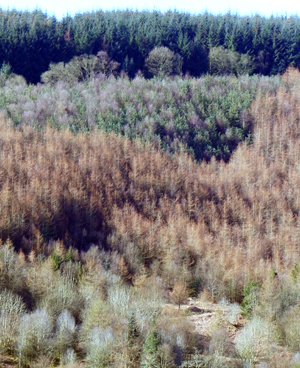
Around the same time, sudden oak death (Phytophthora ramorum) emerged, though it affects more than just oaks. First identified in the US in the 1990s, it reached the UK in the early 2000s, causing widespread concern in woodlands and nurseries. It targets a range of species including rhododendrons, larches, and beech. The name alone—sudden oak death—carried a dramatic finality.
Then came perhaps the most alarming of all in my later years: ash dieback, or Hymenoscyphus fraxineus. First identified in Poland in the 1990s, it reached the UK in 2012. It’s a true scourge, expected to kill up to 80% of the UK’s ash trees. These aren’t just forest trees—they line our roads, dominate hedgerows, shade our back gardens. Their decline feels intimate.
Walking in ash woodland today is like passing through a ghost forest. The signs are unmistakable: leaf loss, crown dieback, diamond-shaped lesions. I’ve watched entire copses hollow out over just a few seasons. The cost is measured not only in timber or beauty, but in ecological networks—over 1,000 species depend on ash.
And let’s not forget the oak processionary moth, which first arrived in the UK via imported oak trees in 2005. While not a disease in the fungal sense, it’s a threat nonetheless. Its caterpillars strip leaves and their tiny hairs can trigger allergic reactions in humans and animals. Forestry teams now issue warnings during their seasonal outbreaks. Oaks have stood proud for centuries, but even they are not safe anymore.
There are others: sweet chestnut blight, plane wilt, the pine processionary moth, and new strains of Phytophthora that attack multiple species. The list gets longer, not shorter.
So what’s going on?
Part of the answer is globalisation. Trees, soil, and ornamental plants now travel easily between continents, bringing pathogens with them. Climate change plays its role too—stressed trees are more vulnerable, and warmer conditions allow pests and diseases to thrive. And while tree diseases aren’t new, our ecosystems today are more fragmented and less resilient.
[caption id="attachment_8120" align="alignleft" width="400"] Leaf miner in Horse Chestnut[/caption]
What strikes me most, looking back, is how predictable this pattern has become. Every decade or so, a new name enters our vocabulary. Each time, we scramble to learn its symptoms, its vectors, its likely victims. And each time, the outcome is similar: loss, adaptation, then a wary lull before the next wave.
Measuring my life in tree diseases might sound grim—but it’s also grounding. Trees are long-lived beings; their suffering unfolds slowly, deliberately. Watching them struggle is a reminder that the natural world is neither invincible nor immune to human action.
The next great tree crisis is likely already on its way. But perhaps with better biosecurity, international cooperation, and public awareness, we can at least slow the tide. For me, though, the trees I’ve known—and the diseases that marked their passing—will always be a living calendar. A record of change, and of resilience.