You are here: Home > Blog > Flora & Fauna > Coppicing: An Introduction
Print this page

Coppicing: An Introduction ~ by bill

Coppicing: An Introduction

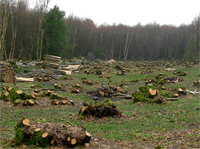
Coppicing is a woodland management method in which the wood from a tree is harvested by cutting a suitable tree near ground level.  It subsequently regrows over a period of years without needing to be replanted. This technique is different from pollarding, in which branches are cut at, or above, head height, leaving the possibility of grazing underneath the growing branches.

Coppicing is done on rotation: small areas of a woodland are cut each year in sequence leaving the areas not being cut to grow on for between 15 and 20 years for chestnut, and about 7 years for hazel. When an area of coppice is cut, it is all cut down, and creates a clearing. This periodic coppicing encourages the individual trees to live for up to hundreds of years. If the coppice cycle is managed correctly it can increase biodiversity in the woodland because of the beneficial effects of varying light levels reaching the woodland floor, and the range of different aged trees and stools in the woodland.

The best time to coppice chestnut is well after the autumn leaf fall when the sap has gone down, and certainly well before the sap rises in the spring.
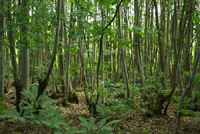
The basic procedure for coppicing chestnut is as follows:

  • Clear out all leaves and other debris around the base of the stool.
  • Cut and clear away any dead or dying stems.
  • Progressively cut each stem starting with the most accessible sections and working in to the centre of the stool. Ideally one cut should be made about 1-2 inches above where the branch grows out of the stool. That cut should be angled some 15 to 20 degrees from horizontal with the lowest point facing outwards from the centre of the stool.
  • In some cases it maybe necessary to make a first cut higher and then trim back as above.

Remember to:

  • Fell away from the wind and fell all the poles in one direction.
  • Make sure you are working upwind of any campfire
  • Always leave a fire in a safe condition when leaving the woodland.
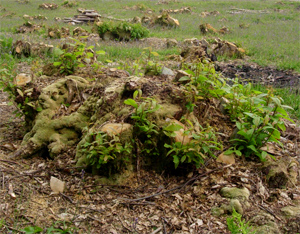
A coppiced stool showing some regrowthOnce cut, the poles produced are usually processed to some extent in the woodland: they are often cut to length, and perhaps de-barked. In many cases the coppicer will process further and create spiles (stakes or strong fencing posts), or will split the chestnut into various sizes for fencing. Some even make hurdles for keeping sheep in pens.

An approximate guide the diameter of felled coppice for further processing is:

  • Lathes: 1” to 1½”
  • Tree stakes: 1½” to 2”
  • Fencing Stakes: 2” to 3”
  • Straining posts: 4” to 5”
  • Post and Rails for cleaving: 6” to 8”

In the UK the main trees that are coppiced are sweet chestnut, hazel and hornbeam. Chestnut has traditionally been used for fencing whereas hazel is more likely to have been used for thatching, hedge-laying spars and hurdle making. Hornbeam was used for charcoal making.

Historically chestnut coppice growing has been strongest in the south East of England, especially Kent and East Sussex. Although it is said that the Romans introduced it, there is some evidence that coppicing was practised in England in Neolithic times. There are many areas of the UK where hazel and hornbeam have been grown, but the Midlands and Devon still have much hazel woodland useful for the remaining thatchers.

Posted in: Flora & Fauna, Practical Guides ~ On: 22 May, 2007

48 comments so far

Tracy Pepler
23 May, 2007

Thanks! a nice little introduction!

Paul Dennett
23 May, 2007

Thanks! I would love to get involved in that sort of thing

Richard
24 May, 2007

Of course it goes without saying that coppice trees are planted as such and one would not try coppicing mature trees which would probably die – depending on species! Beech has been traditionally coppiced, as on Cornish “hedges” ( http://handbooks.btcv.org.uk/handbooks/content/section/1627 ) but some of these have not been coppiced for many years and are probably too large to bring back into coppice now although very desirable as the beech will get too big for the “hedge”. Where these are situated by roadside and overmature beech cannot be tolerated then the sooner an attempt at re-establishing a coppicing regime the better. Different cultivars may respond differently but probably best to start with say cutting three widely separated stools and see if they survive after two seasons (may shoot in first season and die second!). The whole process could take 10 years for one unit! Has anyone had experience of doing this?

Tracy Pepler
19 July, 2007

Is anyone able to give some advice on where we could get chainsaw training in East Sussex – near Rye?

Green woodwork courses | The Woodlands.co.uk Blog
30 August, 2007

[...] do in your own or a friend’s woodland. Timber used is usually a by-product of woodland management. Coppiced timber in its green state is easier to cut, shape and turn than is seasoned [...]

Tracy Pepler
10 December, 2007

We are beginning to coppice our woodland this year (it has been unmanaged for a while) and I am able to find a market for most of the wood. I would just like to encourage people to look around to see what you can sell, its amazing how many people are wiling to buy some!

Tracy

Mike Pepler
25 January, 2008

There’s pictures of us coppicing our wood on our blog:
http://peplers.blogspot.com/2008/01/biggest-chestnut.html

Mike

john lyttle
25 January, 2008

Can anyone advise me on how many acres of wood land I need to produce 15 cubic meters of split logs on a yearly basis. The main tree being coppiced chestnut

thanks

Phil Cryer
1 April, 2008

At what age and where on the tree would I make the first cuts after planting ASH? I understand the the normal cutting height is about 1 metre for established stools.

What Is Ancient Woodland? | The Woodlands.co.uk Blog
27 June, 2008

[...] of the ancient woodland in the UK has been managed by coppicing (see http://www.woodlands.co.uk/blog/conservation/coppicing-an-introduction/ ) and some by pollarding. What tips would you give for identifying ancient woodland?  Please use [...]

Dale Henehan
17 July, 2008

Cheers for the intro. I really needed something like this for a science project I’m doing.

David Glover
4 November, 2008

Having just read the delightful book “Wildwood” by Roger Deakin, I now know what ‘coppicing’ means (how ignorant can one be?). This story of trees is one of the most splendid books I have ever read in my 80+ years. So, thank you for your explanations.

Neil
26 January, 2009

Nice article.

Would it be possible to add a full list of native hardwoods that are suitable for coppicing, plus their uses? Ash,cherry, willow and alder spring to mind – the first two for firewood, the second two are marvellous for kindling when cut at 1 or two years. Also ash and, surprisingly, willow for tool handles.

Tracy
28 January, 2009

Hi Phil

BTCV wrote a great book on coppicing, available on line, hopefully you will find what you need to there. I know that for chestnut, we cut as low as we can, otherwise after a few years the stool becomes very high!

http://handbooks.btcv.org.uk/handbooks/content/chapter/690
Tracy

Tracy
28 January, 2009

Hi John

According to my other half:

4 tons of wood per hectare- a ton is more than a cubic metre.
But this varies accoring to the climate and health of the trees

Tracy

Tracy Pepler
29 January, 2009

Neil, I just came across a list of trees that coppice in Woodlands by Rackham, and we got a book called Trees in Britain and their timbers by A L Howard, which is really good. Its an old one ;-)
Tracy

Phil Hopkinson
1 February, 2009

Hi Phil,
I would recommend cutting Ash for the first tierm at 20 yeaRS.
I would make the cut within 6″ of the ground. I always slope the cut so that the rain rund off it.
Phil

Jan Hawkins
6 February, 2009

Hi out there

I am trying to find a supply of coppiced chestnut in 2 metre lengths, with a top diameter of no more than 2″. Anybody have a contacts or supplies which I can buy.

Jan

Carole
30 April, 2009

Hello everybody,

My husband and I have just purchased a piece of woodland in Wiltshire. Unfortunately a lot of the trees were cut down prior to the sale. We would like to replace some trees but do not know where the best place is to buy them. Can anybody help with a bit of advise please.

Carole

catherine
1 May, 2009

Hi Carole

Try the suppliers directory in the site – http://www.woodlands.co.uk/owning-a-wood/suppliers-directory/tree-nurseries/. It’s under the “Owning a Wood” tab & there’s a sub-section for tree nurseries. There’s lots of really useful information in the “Owning a Wood” section and it’s well worth a look for general advice, tree id, suppliers, contractors and training providers.

good luck with your new woodland!

Catherine

Andrew McManus
9 May, 2009

“chainsaw training in East Sussex – near Rye?”
Is Plumpton college anywhere near?

“a lot of the trees were cut down prior to the sale.”
Sounds like a felling license would have been needed which would usually include a requirement to replant (grants available) and other official complications. You should have details on your sale documents or contact your Forestry Commission local office.

Angela Blackmore
23 May, 2009

Hello All

What a super website! I have just planted some Field Maple and a Beech as part of a mixed hedgerow, it’s very young, about 3′ high and only one thin main stem on each plant. Can anyone please advise me how long I need to wait before cutting, at what time of the year, and to how low down to cut? My aim is to eventually have a dense hedge of about 4 1/2′ high.

Also, this is my first, short run of hedge but I do want to plant a fair bit more. In addition to the Field Maple & Beech I’ve used a few mixed hollies, can anyone suggest other species to add in the next run? I live in the South East (Essex).

Thanks so much, Angela

Daniel Hawins
25 May, 2009

Hello to all,

I am a local coppice worker based in kent and i am looking for chestnut to coppice this winter. Preferebly 20+ years old for post and rail fencing.
I am also looking for standing firewood
I work all over Kent and Sussex and will pay good money for standing timber
I have a list of references
15 years experience
Please call 07774080914 or email me danhawkins@btinternet.com

Many thanks

Dan Hawkins

Tracy Pepler
1 June, 2009

There is a new website with a discussion forum dedicated to coppice.
http://www.coppice.co.uk

Catherine
15 October, 2009

For anyone looking for a coppicing course, Phil Hopkinson is running some in October & November:
2 days (24-25 October 2009 and 14th -15th November 2009 at Ravenshill woodland reserve, Alfrick, Worcs.

The course is an introduction to coppicing for people who have no experience at all or volunteer’s who have a little experience but would like to gain more knowledge.

The course will include tree identification, the benefits of coppicing, a walk through the wood looking at the differences in habitat between native woodland and conifer plantations.
Coppicing, coppice restoration, working methods, material selection and processing and material storage and building work breaks.

All tools will be provided. The course will be conducted outdoors so please bring suitable clothing for weather conditions. Hot drinks will be provided.
For more information about my courses visit http://www.malverncoppicing.co.uk

Cost: £95 for 2 days

To reserve a place on this course please send a deposit of £20 to:

Phil Hopkinson
159 Pickersleigh Rd
Malvern
Worcestershire WR14 2SH.

E_mail pahoppy@btinternet.com.
http://www.malverncoppicing.co.uk

Bob Lomas
21 February, 2010

As a retired coppicer and hedgelayer I would strongly recommend coppicing as a pass time. Coppicing is one of most historical pursuits and I would recommend anyone taking it up to engage in all its history and traditions. Never mind today’s politically imposed foreign measurements introduced to help destroy our national identity. Our customs and measurements go back to up to two thousand years. Our wood is cut in cord lengths of four feet. A stacked cord of wood is 4 feet x 4 feet by 8 feet. 128 cubic feet. This can be measured by one’s feet and hands, no tape measure needed. Hazel wands for beansticks and hedging binders are bound in bundles of 25.

Joe
18 March, 2010

Could someone please clarify…

I’ve recently moved to a property that has row of very large (15-20ft) multi stem Hazels. From the looks of things they have never been coppiced before. Last years harvest produced a lot of good hazel nuts!

I would like to coppice them. Being this large and this old, can I still do that? I keep reading articles with negative snippets on coppicing old trees?

Bob Lomas
19 March, 2010

Hazel can be coppiced and brought back into rotation at any age. I have successfully coppiced many acres that were last cut in the 1930s. Old hazel makes excellent firewood.

stuart.
21 April, 2010

Hi. i live in Brittany France. The previous owner of my house started planting a coppice of willow about 6mnths ago, and had intended to plant ash this year, a total area of 5 acres. I have no knowledge of managing a coppice, so i would appreciate a few pointers.
(1) what type of ash would I need and where do i buy them (about 600,I think I need),
(2) have read that willow is not the best type of tree for firewood, so do i dig them up or leave them, seems a shame to dig them up as they seem to be thriving.
All your input would be gratefully received. best regards.
Stuart.

BOB LOMAS
22 April, 2010

Burning up whilst coppicing has been mentioned on this page. For those still to do this herewith a few tips.
1. Visit the coppice in the summer before cutting and work out and mark where you intend to have your fires. This will ensure you don’t destroy any rare plants such as orchids.
2. Dry kindling for starting your fire can be found standing, those small shoots on the stools that never made it and died. A small piece of inner tube will get the fire started well. Make sure you have a small but well established fire going before building it with the material you will be cutting and burning.
3. Important, always lay the cut material on the fire aligned the same way, otherwise a wigwam will form and the fire can burn out underneath.
Should you be using a chain saw a reluctant fire can be encouraged by using the chainsaw as a blower.

4. You don’t want to carry your cut material for burning more than ten paces, so your fires need to be twenty paces or a chain apart, (four rods).

Tracy
22 April, 2010

Hi Stuart

Take a look at http://www.coppice.co.uk
you might find some help there. Willow would be ok for firewood, just make sure you dry it well. It is great for wildlife. Might be worth talking to local people to see what trees would grow well nearby.

Bob – great advice – and I guess even better if we can save the brash to do dead hedging etc -much nicer than burning. We only burn when we have no space for brash, but where we have done hedging we see loads of happy birds using it!

BOB LOMAS
25 April, 2010

The term ‘ancient woodland’ can be misleading. It depends on what is meant by ‘ancient’; no doubt some people see me as being ancient, a matter of relativity. It also depends on the continuity of the woodland. 17th and 18th century maps of Sussex and Kent, the two most heavily wooded counties in the country, show very little woodland, they having been clear felled to provide wood for ship building and in particular for charcoal to service the vast iron industries of that period. The loss of the southern iron industries and the use of steel for ship building allowed the woodlands to recover to some extent, but the first and second world wars placed great demands on wood. The slump in agriculture in the 1920s helped as many less fertile fields were allowed to be grown over with scrub and eventually trees.

Following WW II there were government grants to reclaim many such fields and much woodland was lost. After joining the EU in 1972, and the planned demise of our agriculture, government grants were awarded to replant many of these fields with trees which are now doing well. There are still many areas to be found in the south that have always been woodland, a reasonable indicator of their age is to be found in the ground flora, in particular yellow archangel and butterfly orchids as both take a very long time to establish. Both these species are now recovering from the devastation caused in the 1950s and 60s when many woods were utilised for for pig rearing.

Our old and ancient woodlands have always bee under the threat of political whim, now it is for roads and housing so it is essential that more woodland is created; but will our new woodlands ever become ancient?

stuart.
25 April, 2010

Hi. thanks for all your comments, i only want to harvest the trees for firewood,so as willow is already planted i shall leave them and maybe plant european ash. and a few hazel and chesnut. kindest regards. stuart.

COLIN HARDEMAN
1 May, 2010

Message for BOB LOMAS, Hello Bob, I too live in Kent and I make walking sticks for a hobby. Can you please advise me of any HAZEL SHANK suppliers in the Kent area.
Kind regards. Colin

BOB LOMAS
2 May, 2010

Sorry Colin, I live in West Sussex, but no doubt a Kentish Man or Man of Kent will respond to your request. Many hazel shanks suitable for walking stick shanks go on the fire because they are too short for hedging heathers or binders of for bean poles if they are not needed for hurdles.

Gone are the days when everything cut was used as faggots and bavins are no longer required for the bakers ovens, which is why the taste of bread is is no longer what it was.

I note on these exchanges that no one has mentioned the coppicer’s barrow, a very useful tool which years ago was so commonly seen in woodlands.

Marco Snyders
28 July, 2010

Good day,

We are looking to buy Coppice, Kindling, Logs, Sawdust/wood shavings, Wood Chip or any other waste wood or forestry material from February 2011 onwards.
We are a new company based in Suffolk- UK, manufacturing biomass wood pellets and are looking to meet or get in contact with potential suppliers now.
(contracts are also available )

We also buy Mischanthus, Corn husk, Peanut and Sunflower Husk and Olive residue…

If you are interested,then please email me at; peltrade@europe.com

Regards

Marco Snyders

James
10 August, 2010

Hi. I have a lake surrounded by Alders that I want to systematically coppice. The only time I can do the work is in August. Will this be effective or could I kill the trees?
James

Quora
15 January, 2011

How do I best coppice trees ?…

Coppicing is a method of managing a tree so that you can harvest sticks from the tree on a regular basis. Willow and hazel are particularly suitable for coppicing. Coppicing is best done on trees that are planted with that purpose in mind. Coppicing a …

Karin Craddock
7 February, 2011

Message for Colin Hardeman and any other walking stick makers near Rolvenden Kent.
We have one year air seasoned hazel and cobnut staves for making walking sticks for sale. 10 staves £20.
For an appointment to view and make your selection please email info@farnellfarm.co.uk

Tony Wright
20 May, 2011

I have some woodland here in France that is two thirds oak and one third sweet chestnut. Although the chestnut is multi trunked and was probably coppiced about 35 years ago, the oaks are single trunked. As all the trees are 40 to 50 feet tall and little light reaches the floor, I am considering coppicing, but my question is whether these oaks would survive coppicing now.

Phil Hopkinson
24 May, 2011

Hi Tony,
With regads to your Oak it depends on the diameter of the tree and their age. I have felled some Oak about 50 foot tall and between 8″ and 10″
diameter and they are regenerating nicely. Why not coppice the Sweet Chestnut and then thin out the Oak leaving about 33% canopy, that should allow enough light in for the Sweet Chestnut to regenerate.

Tony Wright
31 May, 2011

Hi Phil, Thank you for your suggestion which does make sense to me. The oaks are about the diameter you mention, and if any of the cut oaks survive as well as the standing trees, I still have the option to coppice more of them next year to get the balance right. At present I am also very concerned about the drought we are experiencing and hoping the water table recovers enough in the autumn to promote regrowth; otherwise I may have to wait another year. Thanks again.

Ian Baldwin
13 September, 2011

Has the law been repealed that requires you to keep ’12 standils to the acre’? (i.e. 12 trees that will grow to maturity). This would maintain a more aesthetic lanscape as well as providing wood when required for building ships for Her Magesty’s navy!

Ian Baldwin
13 September, 2011

Whoops, sorry Your Majesty (must not mis-spell her title, this could be treasonable!)

Linda D
16 September, 2011

I am familiar with hornbeam coppice (used for london fuel, ironwork charcoal respectively) from Coldfall Wood Haringey, and now from woods near Bethersden, Kent.
Both woods have amcient ditch and bank system with very old Hornbeam pollards and lapsed hornbeam coppice, where some of the stools are obviously old.
Question :
Is there any way (without counting rings obviously- which is difficult with the growth habit of hornbeam anyway) to estimate the rough age of Hornbeam coppice and pollard stools?

Antonia R
23 September, 2011

Does anybody have experience of an old beech being coppiced successfully? We have a lovely tree, very large, but has been attacked by a fungus and is dying from the top down. We have had this confirmed by several tree surgeons and the local tree officer. I was on this site looking for information about coppicing an ash tree that we have, and saw that beech is suitable for coppicing. I know that it’s not ideal to coppice an old tree (this may be up to 300 years old — apparently Alan Titchmarsh came to see it a few years ago and estimated the age around 300) — but as things stand it needs to be felled. Would attempting to coppice it just finish it off, or is there a chance that it might pick up and get a second lease of life? It’s a beautiful tree, it seems a shame to just chop it down if there is any other option. Any thoughts / suggestions gratefully received.

Hayley D
5 December, 2011

Does anyone know how much hazel sells for at the moment. We have a potential project in a small area of woodland – hazel coppice. Its a great site and we would be doing all the work; coppicing the hazel with community groups and potentially moving it from the site. It would be brilliant if we could make this into a continuous project; with the hazel being sold onto local people if they want it. I am just not sure how much you can sell hazel for?
Any thoughts would be brilliant. Thanks, Ranger Hayley
PS: The site is nr Winscombe, Somerset.

Phil Hopkinson
5 December, 2011

Hi Hayley,
Below is a lnk to my website with all my prices for products listed.
The secret is to add value. For example putting a point on a hedgeing stake adds 10p to the price.
The tops fo Hazel make great pea sticks which can be sold very easily to local gardeners.
http://www.malverncoppicing.co.uk/woodland_products.html

Leave a comment

© 2012 Woodland Investment Management Ltd | Disclaimer | Contact us | Blog powered by WordPress