Red Band Needle Blight
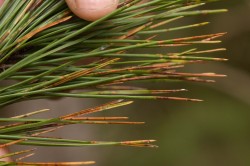
This is an interesting and dramatic condition that affects various pines, especially Corsican Pine. Thetford Forest in East Anglia has been severely affected by it. Of the 25,000 hectares of that forest, about 13,000 ha are Corsican Pine. They are all affected by this disease, which was first identified in the 1990s. It leads to defoliation (the needles drop off), a loss of yield (the trees grow more slowly) and in some cases the trees die. The most vulnerable age is 16 to 30 years when the blight is most likely to kill the trees
Neil Kellett (Operations Manager of Thetford Forest) says that the Forestry Commission has stopped planting Corsican pine; the last planting was in 2006. The FC has decided that diversity is the best approach - so they now plant Scots Pine, Douglas Fir and Larch. As well as these major alternatives they have also planted Western Red Cedar and short rotation crops such as Eucalyptus and Italian Alder. They have even started planting birch which is slightly ironic as for so long it has been carefully weeded out of the Forestry Commission's commercial crops.
However, with such a large stock of affected trees they have developed ways of reducing the impact of Red Band Needle Blight through thinning earlier and where infection is high thinning more heavily. The Corsican pines do much better when there is a good flow of air through them and seem to suffer when the air is more static.
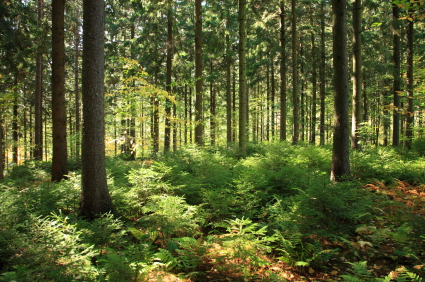 From the point of view of an owner of a small woodland the best approach is to manage for a diversity of tree species. Where there is an area of Corsican Pine, the owner should look out for the characteristic dieback associated with the blight. If your trees are affected you should get specialist advice but it is likely that you will want to thin earlier to let the air get in.
Comments are closed for this post.
Discussion
There is a detailed ‘question and answer’ page on needle blight here :-
http://www.forestry.gov.uk/forestry/INFD-7L6E57
above link refreshed 10/4/2014
Please advise – whilst driving home from Bigbury beach, South Devon, to Ivybridge, also South Devon, we were struck by what looked like a red disease affecting only conifers of various types. It looked as though the sea facing sides were primarily affected, but the disease seemed to have spread to all visible evergreens, diminishing as the miles sped by. Some trees looked like they were mostly dead, others half. When I then looked at our tree in the front garden it too has brown/reddish tinges on the outer needles.
Please could you advise us as to what has happened and if they are going to recover.
Many thanks.
nicola
10 April, 2014