Woodlands.co.uk
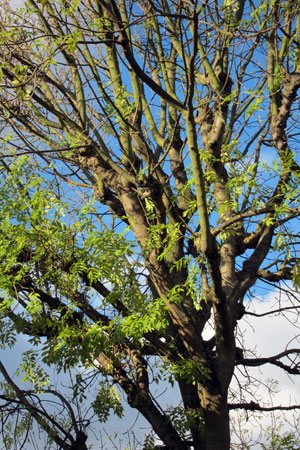
Ash dieback – what to do? Pre-empt, plant, persevere, keep calm and carry on.
The last ice age endured for about 100,000 yrs. Some 18,000 yrs ago, mammoths, sabre-toothed tiger and woolly rhino (preyed on by prehistoric man) roamed our land. Thick ice sheets lay to the North, whilst to the South was tundra – much like that now seen in Northern Siberia. Then 10,000 years later, the ice sheets started to melt and the tundra receded; sea levels rose and low lying areas were flooded. The North Sea and English Channel formed, cutting us off from mainland Europe. This was a gradual process (in our terms) and as Europe warmed, trees migrated northwards – some reaching the UK before we were cut off from the rest of Europe. Most plant colonisation was by seed and spores, animals followed bringing with them other taxa. Read more…
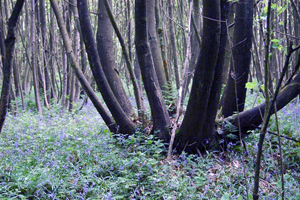
Bluebells and boars
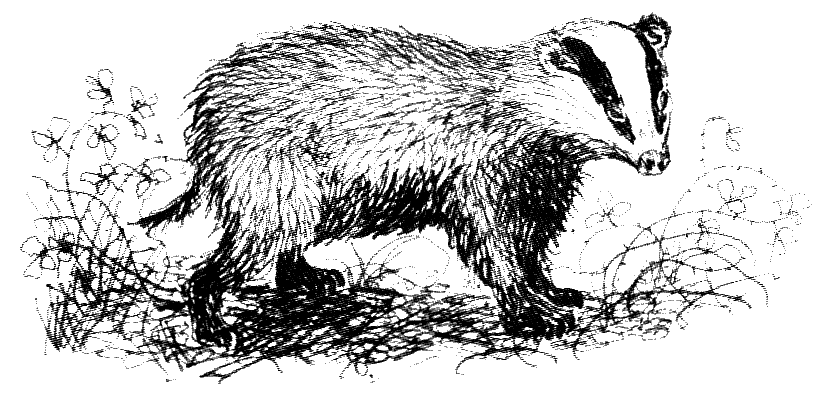
Wild boar became extinct in the U.K. in the thirteenth century –so we have been ‘boar free’ for circa 700 years. However, towards the end of the last century commercial pig farming developed; seemingly some escaped and have established free living and breeding populations.
Attitudes to these pigs / boars fall into two broad categories :
- those who welcome the return / reintroduction of a missing species and its ecological impact
- those who have a more negative perception of the boar – in that, they do damage, have the potential to harbour disease and can cause direct damage to people. Read more…
Forestry Commission accounts – a forest of facts
The Forestry Commission (FC) owns and manges over a million hectares of land and so must know a thing or two about UK forestry, and much is revealed in the Forestry Commission's formal accounts. This is a long document, at over 150 pages, but rather than pay £23.50 for it you can get the accounts online for free. Even though it's free many people would consider a set of Forestry Commission accounts to be a tedious read so we've been through them and dug out some interesting material. For example the key figure that the FC expect to pay for woodland management each year is about £72 per hectare or about £29 per acre per year, after taking account of income generated. Our surveys of owners of small woodlands show that they typically spend more than this on a per acre basis, so it is surprising that the report, rather dismissively, refers to strong demand for “hobby woodlands” and environmental ownership” Read more…
Phytoliths, metals and phytoremediation.
Plants take up essential nutrients (nitrates, phosphates, potassium, magnesium etc) through their roots, but some also take up other, more unusual substances – such as silicon, nickel, cadmium, copper, cobalt.
Grasses, in particular, are known to take up silicon and then deposit it in their leaves. The silicon that they absorb is converted into tiny granules called phytoliths, which are often located under the waxy cuticle. Read more…
Invasive species – Rats.
Rats (brown and black) have been ‘camp followers’ of humans ever since we adopted a ‘settled’ existence. In modern cities, it is often said that one is never more than 20 yards from a rat. Whether this is true or not, rats have been a pest throughout the millennia, most notably associated with the spread of disease such a bubonic plague but also Weils Disease (Leptospirosis). Read more…
Horse chestnut leaf miner moth
The ‘progress’ of the horse chestnut leaf miner (Cameraria ohridella) has been reported in the blog from summer 2006 to more recently, when a national survey was under way. This small, but highly efficient parasitic moth was first ‘discovered’ in trees bordering Lake Ohrid in Macedonia in the mid-Eighties. It was later described as species new to Europe, and since that time has managed to spread through almost all of Europe.
Annuals rings, climate and history
Dendrochronology seeks to gather information on tree rings, dated to their year of formation, and to use this information to established the age of artefacts (like the timbers of a boat or remains of house) or determine the nature of the climate in times past.
Annual rings form in temperate trees because the xylem vessels or early wood formed in late spring and early summer (when lots of growth occurs) are wider and lighter than those formed in late summer & early autumn, which are narrower and darker (sometimes called the late wood). A light and dark ring together constitute one year’s growth. In winter, there is no growth.
The various branches of dendrochronology (dendroarchaeology, dendroclimatology) are based on the uniformitarian principle. This says that the various factors that currently influence tree growth and hence tree ring development will have operated in the past. Through knowledge of these factors (physical and biological) that have influenced current and recent tree ring growth, it is possible when looking at tree ring samples from old wood artefacts / timbers to ‘reconstruct’ the climate of the past.
Phytophthora ramorum – a parasitic fungus to look out for
Recently I wanted to find out more about Phytophthora ramorum so I went to a seminar that was organised by Natur (The Welsh Institute for Countryside and Conservation Management) held in north Wales.
Seminar on Phytophthora ramorum
The seminar was specifically relevant for woodland owners, contractors and countryside workers. These groups are most likely to come into contact with this disease and therefore be well placed to identify it before it becomes established in a new location. There is also the danger that these groups could become vectors spreading the disease between sites. Read more…