Woodlands.co.uk - Practical Guides
Roadkill : rabbits, hedgehogs, foxes……
In this country, like others dependent on the internal combustion engine, many animals are killed or wounded on our roads. One of the first people to comment on the significance of roadkill was the American naturalist Joseph Grinnell; he estimated the mortality count in California (back in 1920 !!) ran into the hundreds if not thousands of animals every day. Read more…
Woody tissues : bark
Wood is such a familiar material that we tend to take it for granted. In general, it is a long lasting, fibrous material that is found within the roots, stems and branches of trees and shrubs. It is mainly composed of xylem – a tissue that brings water and minerals up from the roots and distributes the minerals and water to the leaves and growing tissues of the stem.
The National Forest
The Countryside Commission had the idea of creating a new ‘National Forest’ in 1987 – to give a tangible expression of the benefits of trees and woodlands. It also has a practical role in terms of demonstrating the importance of carbon fixation (through photosynthesis) and the importance of this in the amelioration of climate change.
The National Forest was and is a bold project, focusing on some 200 square miles of central England (parts of Derbyshire, Leicestershire and Staffordshire). The area includes farmland and the relics of coalfields & mineral workings, with some pockets of ancient woodland – for example, Charnwood Forest to the east and Needwood Forest to the west. A map of the area of the National Forest can be seen here . Read more…
Woodland burials on a grand scale
In the UK, we tend to think of woodland burials as a very informal and personal thing. On a recent trip to Sweden, I visited a woodland graveyard at the other end of the scale.
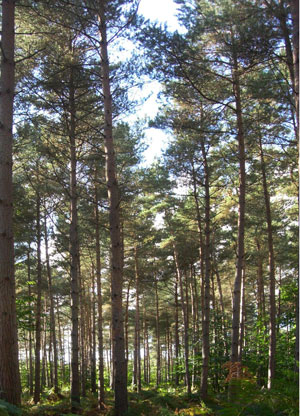
Skogskyrkogården on the outskirts of Stockholm is vast; you have to be there to truly appreciate the sheer size of the place. Established in the early 1900s it is completely unlike any other cemetery before it. So much so, that it is considered one of the most important creations of modern architecture – and as such was added to UNESCO’s World Heritage list in 1994. The graves are for the most part low and simple; the natural surroundings – typical Nordic forest of mainly conifers and birch – are the centrepiece, not the monuments.
Woodland Shelter Build.
A priority when staying out in the woods is a good water and wind proof shelter
The following photos show the construction of a hazel wood shelter to sleep 2-3 people.
We are out a lot, so we built it to last.
The photographs in the ‘strip’ below show the various stages in the construction of the shelter. Read more…
The Centre for Alternative Technology – Practical woodland courses
The “piss and wind centre” is what local people used to call CAT in mid Wales because of its commitment to waste recycling and windpower, but it is committed to a lot more than that – perhaps its main mission is training. Oxfam regularly send people to learn about water and sanitation and visitors even have a choice of using a standard toilet or a composting one. Read more…
Biochar at the Centre for Alternative Technology: business opportunity for small woodland owners or climate change solution
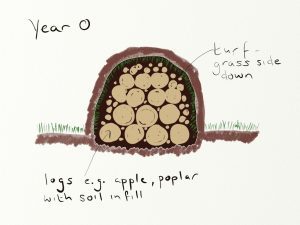
Biochar may be used to mitigate climate change brought on by global warming, by removing carbon dioxide from the atmosphere and locking the carbon into the soil, if James Lovelock (originator of the seductive Gaia hypothesis) is to be believed. Others say the numbers just don’t work. Biochar is also put forward as a very effective soil improver, which can reduce fertiliser use, reduce pollution, increase crop yields, and as an approach to agriculture may be traced back to the terras preta (black soils) of the Amazonian rainforest. Read more…
Fungi, mycorrhizae, truffles
The Fungi are a very diverse group of organisms, ranging from the true fungi (Mycota), which includes the mushrooms and toadstools, and the Oomycota (which includes the potato blight fungus). Unlike green plants, fungi do not have any chlorophyll so cannot make sugars and other compounds by photosynthesis. They get their sugars / carbohydrates through being saprobes (saprophytes), parasites, or sometimes symbionts. Read more…