Grow Your Own Truffles
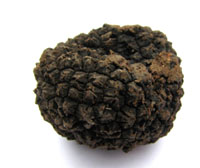
Usually one thinks of collecting truffles as a solitary activity carried out in secrecy at dead of night. However it is now possible to buy trees already inoculated with truffle spores.
Contrary to common belief commercial cultivation is nothing new. Truffles have been cultivated since the 1800s and reached a peak in France in the late 19th century. Large tracts of land were freed during this century by the spread of the fungus phylloxera which destroyed many vineyards. Also, the French silk industry collapsed when disease killed the silk worms, making mulberry trees redundant.
It was only with a shift of population from country to town, and the devastation of the First World War that cultivation on a mass scale declined. In recent times, Australia and New Zealand have been successfully cultivating truffles. It remains to be seen whether it takes off in this country.
Truffles are, of course, a fungus and “ectomycorrhizal”, that is they are found in association with plant roots, and have a symbiotic relationship with the trees they grow under. The first cultivation of truffles was achieved in France by planting acorns from an oak that was known to have truffles growing at its roots. Truffles prefer oaks, beech, hazels or poplars, and like sun and a moist, alkaline soil. You will have to be patient though – it takes 5-8 years for them to start fruiting.
Although truffles are associated with France and Italy (Piedmont), there are many different varieties that grow all over the world. They do grow wild in this country too, and the most common is the white, summer truffle (not to be confused, however, with the white Alba truffle from Italy which commands such high prices but cannot be grown here unfortunately!)
Despite its reputation as a luxury food, French and Italian peasants associated the truffle with famine. As the food writer, Elizabeth Luard, explains in her book, truffles were a cash crop. The peasants who collected them only ate them in times of war and hardship, when the market had collapsed. They were used to flavour a pot of beans when no meat was available.
Having planted your inoculated tree and watched it grow, how do you find your truffle? Trained dogs are preferred to pigs because they don’t root and are less likely to eat what they find! Alternatively, some people say all you need is a stick to disturb the flies (there is a variety of fly which is particularly associated with truffles) and watch where they fly up. A disturbance in the earth where they have swelled is another sign. Good hunting!
Comments are closed for this post.
Discussion
Can you introduce truffle fungus to established oak trees? We have around 1 hc of oak trees that are very old, easily over 100 years – can truffles be grown in this forest? Cheers
In Namibia’s Oshikoto North we harvest white and dark truffles annually in April and May. (You find farmers selling them along the Tsumeb/Ondangwa highway.) They grow only on cleared lands, mainly sandy, which have been cultivated for a number of years, say 2 – 5. Nothing in woodlands or near trees or newly cleared lands. We do not understand their life cycle yet, and whether they have a relationship with our crops – sorghum, millet, cowpeas, etc.

Hello,
I live in Northern New Jersey, USA. I plan on using several oak trees on my property to cultivate truffle spores.
Does anyone have a recommendation for truffle spore distributors?
Where should I get my spores?
Thank you in advance!
Joe
17 May, 2023