The Wood Mouse
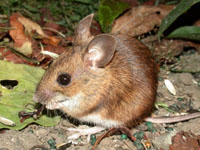
The wood mouse (Apodemus sylvaticus) is the UK’s most common wild rodent. It lives in woodland, but also fields (it’s also known as the long-tailed field mouse), hedgerows and pretty much anywhere that has cover, is not too exposed (they are not found on uplands as a rule) or too wet.
How do you recognise a wood mouse? Its most distinctive features are its big eyes and ears. It has a glossy brown coat unlike the greyish colour of a house mouse. And they don’t smell like house mice do. The wood mouse and the yellow-necked mouse (found only in the southern areas of England) are very similar, but the latter is bigger and has a yellow ‘bib’ under its chin.
Wood mice are nocturnal, although they were popular with our old cat (unfortunately) which used to bring them in from time to time during the day. Other predators are foxes, weasels and owls, particularly tawny owls for which they are an important food source.
Wood mice eat seeds and small invertebrates, such as caterpillars and larvae. They like blackberries too, but will only eat the pips! They live in extensive, underground burrows, often with food stores. They will also make stores of food around their territory. Sometimes these are forgotten and the seeds germinate. They will also eat hazelnuts where these are available. Discarded shells give clues to what is living nearby – squirrels will split the nut in half, dormice will gnaw a circular hole with teethmarks radiating out from the centre, while wood mice will also gnaw a round hole but the teethmarks point downwards.
Farmers and gardeners sometimes view them as a bit of pest – they are adept at sniffing out seeds and can polish off a whole row in a newly-seeded veg patch with little effort – but overall whatever modest damage they do is offset by the weed seeds and insect pests they eat too.
Comments are closed for this post.
Discussion
[…] – bookmarked by 5 members originally found by pipka on 2008-10-24 The Wood Mouse http://www.woodlands.co.uk/blog/wildlife/the-wood-mouse/ – bookmarked by 2 members originally […]
Up early this morning at 5.15, my husband noticed a long eared rodent in the middle of the lawn. We are feeding a family of blackbirds with meal worms. Checked books and Internet to find out that our visitor is a Wood Mouse. He or she is obviously eating the mealworms which the blackbird was happy to share. Would this little creature be responsible for the nibbled strawberries. I expect we will be up early tomorrow to see if it appears again.
Franka
5 July, 2012