Keeping pigs in woodlands
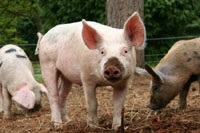
Many people have asked us how practical it would be to keep a few pigs in their woodland so we've asked around …
Pigs are native to Eurasia and North Africa and are in their element in their natural habitat of the forest. Pigs were some of the earliest animals to be domesticated by humans, and first tamed around 6000 BC. They’re now more likely to be farmed intensively in barns or fields than left to root around for their food in a forest. However, woodlands provide an ideal environment for pigs, offering a steady supply of food and space to roam. Pigs do their bit for the ecosystem, clearing the undergrowth to allow plants to regenerate whilst foraging for their own food.
Pigs are omnivores, with many living on a varied diet of seeds, roots, acorns, nuts, vegetation, fruit, fungi, insects and small animals such as snakes. These are abundant in wooded areas, and some pig-keepers maintain that a healthy, natural diet of acorns and beechnuts actually enhances the taste of pigs’ meat. Although pigs will forage for their own food on the woodland floor, it’s important to provide water and extra food such as bread, fruit or vegetables. If left to rely on the forest for food, they’re likely to strip tree stems, dig up roots and destroy vegetation.
The damage that pigs can cause to the delicate environment means that they shouldn’t be kept in ancient woodland. Fiona Tooth, whose forest was once home to a family of Gloucester Old Spots, warned me of their potentially destructive habits. She told me that pigs often plough bulbs and bluebells, disturbing the balance of the woodland floor and clearing significant expanses of land. To limit the damage, she recommended rotating the land where pigs are left to roam.
Fiona compared her pigs to children, saying that the young ones were hyperactive and naughty. She told me that you could often tell a pig’s emotions, and that these intelligent, sociable mammals are not happy if kept on their own and should be kept with a litter mate or group.
The bulky, hoofed animals can trample over ground-nesting birds and should be kept away from vulnerable nesting sites during the winter and spring months. In summer and autumn, when young birds have fledged, pigs can be left to rove freely within the forest. It’s important to keep roaming land secure to prevent pigs from escaping. Fences must be strong and well maintained, as pigs are skillful diggers. They are particularly suited to broadleaf woodlands, which feature trees like ash and beech and provide a plentiful supply of food.
Have you used woodland for keeping pigs or other livestock? Share your experiences here.
Comments are closed for this post.
Discussion
Hi,
How much North Yorkshire forest would a couple of pigs need to be left without any feed? There are areas of dense vegetation for shelter.
Thanks!
Are there any rules on pigs being kept next to public footpaths? I am not sure what the rules are regarding the public having access to feed the pigs and therefore no control over the food chain? Do pigs have to be kept on a small holding or can a piece of land be rented remotely?
Thanks Julie, I’ll give it a stab and will let you know if anything comes of it..
mark
Mark Horne, it’s a long shot but try advertising with Streetlife. Let me know if you get a response!
I have seen a plot of mixed woodland up for sale locally (Hampshire) Is there much demand from pig breeders for woodland? Am trying to think of ways to make an income if I buy it!
Could any one please recommend a breed of pig for a first time owner. Preferably easy going and not over demanding. Also is there a guideline for space per animal similar to 1 acre per cow etc.
wild boar more respectful of surroundings and forage less?
Really?
Where did you get that info cos the wild boar around here certainly haven’t been told that… the damage to woodland and crops is terrible.
can wild boar be raised on privately owned Woodland. They eat and forage less than domesticated breeds and more sympathetic to surroundings. Where can I find regulations?
Can anyone tell me if woodland regulations allow one to keep wild boar commercially once the woodland has been purchased. We’re can I find regulations. Is it that only a few pigs can be kept? Wild boar are more respectful of surroundings not over foraging or eating compared to more domestic breeds who will eat whatever they find.
I also have some woodland (Beech, Ash, Alder and Willow mainly) I would like to clear. There is 3-4 acres although it is split into 3 parts. I have been thinking about buying the pigs myself and having them in hand but it isn’t really a commitment I can make now. Is there anyone out there who might like the space for their own pigs?
I live near Odiham in Hampshire
Ian, I would take up this offer of looking after the pigs for you .
I have an area of land that is an old garden of about 1.4 acres located Kirk Deighton near Wetherby North Yorkshire.
It is ideal for rearing pigs but I do not live close enough or have the skills or dedication to look after them myself.
I would like someone to keep the pigs for me. I will put up any fences necessary andf would only seek to cover costs.
Would anyone like to take up this offer.
Does anyone know of any moves by the forestry commission towards keeping pigs on their land?
Mick…..the law of ‘Adverse Possession’ stated (it may have changed) that if you use a property or land for 12 yrs continually you can claim it as your own and gain the legal deeds and rights to it (30 yrs for MOD and Crown Property) Just found this link: http://www.landregistry.gov.uk/professional/guides/practice-guide-4
We have been told that we can use a piece of woodland, basically it is overgrown, not touched for 13 years we have lived here. We cleared all the “evil” thick wild rose growth, and brambles and fenced part of it off and have got 3 pigs in there now. In 4 weeks they have cleared all the overgrown ivy which was nearly 1 ft thick in places. It now resembles a minefield where they have dug out the bramble roots that we couldn’t move. We were told we could do whatever we wanted with the woodland, as the owner didn’t want nothing to do with it anymore. We were given this information after a chance meeting that one of our neighbours had with the owner. We cannot find the owner, neither can our neighbour as the owner moved away approx 15 yrs ago and has never been back since. It is not a huge piece of woodland, only approx 60mt x 30mt with a few hawthorn and willow trees in it. We are in the process of trying to find how to claim it for ourselves to rotate pig rearing on it in sections. We also want to erect nest boxes for birds and hopefully bats as we have bats in the area. Any advice would be gratefully appreciated.
I am having troubles keeping my pigs in wet areas that have tall grasses. I have tried electric but the tall grasses ground the wire. I tried hog panels put down with t posts to keep it temporary but the hogs just lift up the fence, t posts and all. Do i have any other options for making a temporary fence?
What land-use conditions that might we have to look out for if buying a forest with the thought of keeping a couple of pigs?
I came across pigs feeding in the New Forest at the roadside near Penn Common in early August. The pannage season is September to November so these were probably ‘privilege sows’ allowed out the whole year round. I suppose on ‘the adjacent commons’ and roadsides – as opposed to the woods – these pose little danger to nesting birds.
Interesting comments here about pigs and pannage (acorns etc) in the New Forest – in the autumnal months
http://www.newforestnpa.gov.uk/pigs
Hello Rose
Please can I take this opportunity to correct you on this sentence “The bulky, hoofed animals can trample over ground-nesting birds and should be kept away from vulnerable nesting sites during the winter and spring months. In summer and autumn, when young birds have fledged, pigs can be left to rove freely within the forest”.
Birds nest between March and August (primarily) they do not breed in the winter and will certainly be breeding (and have nests) through the summer. It is therefore best to keep the pigs in a woodland over the Autumn/winter period not the summer as you suggest.
Thanks
Chloe
I run a dozen Old spot Tamworth crosses on 3 – 4 acres this wood land was well over grown and in dire need of maintenance I feed twice daily and the pigs do the rest you’ve never tasted pork like it, as far as fencing is concerned two lines of electric suffice and the old saying goes here and thats you never find a dumb pig they never forget its there
Hope this has been of help
Note that pigs should have access to water and will love somewhere with a bit of wet, muddy soil.
If you want to take children to the wood be aware that pigs are somewhat overwhelming and easily scare the children, even when they intend to be friendly.
Building fences – and moving them later on when the pigs need a new area – makes pig keeping somewhat high maintenance in my view. Fun animals though.
We keep Oxford sandy and black pigs in wooded areas which is ideal. Our Pigs are rotated periodically, watered and feed everyday and have arks with straw to shelter and sleep.
The area as a whole is stock fenced and electric fenced too as pigs will find a way to escape. Our pigs are outside like this all year round, apart from a few days post-farrowing when sows are shut in a farrowing house to bond with piglets.
Barbara & Jon
4 May, 2022