Cruck Frame Buildings
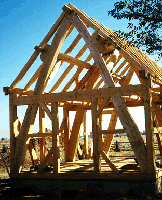
A cruck frame is one where the structure of the building depends on two or more 'A-frames' which go from the top of the building down to the ground. These frames are usually constructed of curved timbers (the cruck blades) using the natural shape of a tree and in many cases the tree is sliced long-ways down the middle so that whatever the shape of the curve the two sides are symmetrical. The two beams are joined together at the top by a 'collar' or tie-beam.
Cruck barns probably evolved in Anglo Saxon times and the earliest archaeological evidence comes from 4th century excavations in Buckinghamshire, but this building technique really came into its own in medieval times. Large halls were built in towns and villages and a large cruck barn also became a sign of an individual farm's prosperity. The barns could be easily divided into sections or bays and threshing would have been done indoors.
By the eighteenth and nineteenth century, cruck-framed buildings were in decline both because of the success of box framing and because they used so much timber. Farm modernisation also reduced the need for indoor threshing areas. The box frame as an alternative had also become popular for residential buildings because it allowed the building of second and third floors and, being a square construction, made more use of town-centre space above the ground floor. Box framing also made it much easier to add extra wings to a building.
The inverted 'v' shape has the advantage that the roof load is carried directly to the ground so that the wall frames can be made using a lighter construction and the walls also use the cruck frames for support. In medieval times the timber would have been felled using a two man saw and axe and then squared up with an adze. The procedure for construction would usually involve assembly on the ground and subsequent erection to a standing position. Once this is done the heaviest part of the operation is complete.
There are various types of cruck frames. Most seem to start at ground level whilst others start just below the wall plate level (raised cruck frames). In some constructions of wider buildings the frame starts at ground level but finishes at the collar which is a piece that joins the two cruck blades and this collar then supports the main roof timbers.
You can see cruck framed buildings in many parts of the country but one well-known example is the Herefordshire Cruck Barn at Avoncroft Museum in Bromsgrove (www.avoncroft.org.uk). There is also a reconstructed cruck barn at the Greenwood Centre in Coalbrookdale near Ironbridge, Shropshire (home of the Small Woods Association).
If anyone has had experience of constructing a cruck frame structure or knows of any interesting examples of cruck barns or cruck houses - please tell us about it in the comments section below.
Comments are closed for this post.
Discussion
If anyone would like to interest children in these buildings, there’s a really good children’s story (ages 10 and up) called “Children of Winter” by Berlie Doherty, in which three childlren from the present time become children from the time of the Plague, who spend the winter in a cruck barn near Sheffield.
We produce modern composite cruck framed homes.
Hi everyone,
i am currently working on a contemporary project using the cruck structure technology – load bearing crucks from foundations and carrying the roof, however my concern is adding different levels within the structure. Please send examples if you know any, of how stories are incorporated in a cruck structure – old as well as contemporary projects. Thank you in advance ! And great article and thread!
A.D
TO ANY medieval historians or architectural detectives out there..
We started renovating an old cottage in Herefordshire (2012) stripping back 1950’s handy work and the false ‘straight dry-lining walls,” even 87 bags of rubble came out of the fireplace….
To find everything in the interior of the house pretty much original. There is a full cruck and half cruck that may have been a hip end over possibly a cattle stall / barn.
My wish now is to possible date the cruck bay. Much of the timbers are elm so more difficult to age than oak but I’m sure a lot of the woodworking tool marking , such as the adze marks and square chiseled out peg holes may offer some clues.
The Cruck walls are wattle & daub and under 4 layers of lime plaster we found small fragments of old print, with reference to Agencourt ( with an E ) and Harry Hotspur who was killed in the battle of Shrewsbury 1403.
Any advice very gratefully accepted
cheers Rob
I own a house near Wigan (Lancashire) that has full crucks which has a part that was used to keep animals in . It is T shaped built up to first floor level in thin strips of stone miixed in with manure.
The gable end is built of logs covered with wooden tiles; however, the building is now rendered over this…it still has the original kitchen door of axed planks and I estimate it was built around 1575.
We built http://www.cruckbarn.co.uk in a small woodland in Herefordshire.
Hi there,
Is anyone still about on this thread?
I am in the process of purchasing an old Welsh farmhouse, which has a large Cruck barn in the grounds and would dearly love to restore it to its former glory.
To that end I am trying to find as much information as possible about materials used, tooling methods, construction methods, etc., etc.
This beautiful building (in my eyes anyway), has been left to rot and is in danger of collapse, I will endeavour to halt any further decay and preserve what I can, but do not want to use any modern building materials if at all possible. Some of the timbers will be beyond repair, I realise that and I will have a timber survey carried out to find out what is salvageable and what has perished, but any other help anyone can give will be very gratefully received.
Cheers
Kane
A large Cruck Barn has been built by the owners of the Craven Arms in Appletreewick, North Yorkshire.
It is used a a function room for Wedding Parties and other events.
The project was well researched and the building has been constructed using traditional materials and construction techniques.
Many people will be familiar with the enormous and beautiful C14 tythe barn at Leigh west of Worcester. If not, then I recommend a visit. It’s in care of English Heritage and is free to enter. Check opening times. It’s on a narrow lane with very limited parking. A lovely Norman church next door too.
Gwyneth
26 August, 2022