Woodland updates
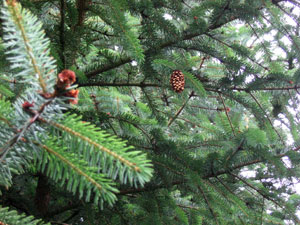
Lighting up the trees.
When there is thunder and lightning, there is sometimes a phenomenon known as St Elmo’s Fire. It appears as an eerie ‘violet / blue ’ light on the masts of ships’ or church spires and it may be accompanied a slight buzzing sound. Sometimes it can be seen on the horns or antlers of animals and in the right conditions may light up forest canopies with a faint, flickering eerie glow.
This has now been investigated by Patrick McFarland (and colleagues) - a meteorologist at Pennysylvania University. He has produced photographs / videos of coronae (electrical discharges) on the very tips of trees during thunderstorms. Back on campus, the phenomenon was reproduced by exposing a branch from a spruce tree to a strong electrical field created between charged metal plates. The waxy tips of the spruce needles glowed with a purple light; an artificial St Elmo’s Fire was produced .
(Further details to be found in the New York Times or at Wikipedia : https://en.wikipedia.org/wiki/St._Elmo's_fire ).
Interesting fact : In 1751, Benjamin Franklin hypothesized that a pointed iron rod would light up at the tip during a lightning storm, similar in appearance to St. Elmo's fire.
A ray of hope ?
A survey of land holdings in Scotland, where nature restoration / rewilding has been encouraged, has indicated that bird and insect pollinators are flourishing. The study involved the Northwoods rewilding network; this includes some 100 farms, crofts and woodland sites - which are quite widely dispersed but covering more than 30,000 plus acres. 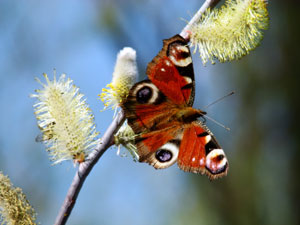 The survey compared areas of the rewilded land with neighbouring areas that were managed more conservatively / traditionally. Bird populations were assessed at five of the sites and butterflies and bumblebees at six.
The birds doing well in such areas included the spotted flycatcher, cuckoos and woodcocks. Butterflies that were recorded were the painted lady, green veined white, red admiral, scotch argus butterfly and the peacock. Bees included the buff-tailed bumblebee, the common carder, early and tree bumblebees.
Further details in The Scotsman [Katharine Hay, Friday 6 March 2026] or Apple News : https://apple.news/ AWyx1qpa9SbeOg-2HGmMtXw
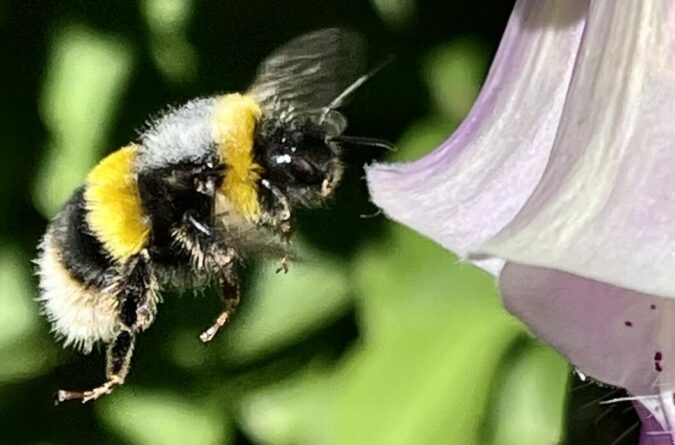
Bumblebee visiting foxglove

Leave a comment