Heat waves and urban heat islands
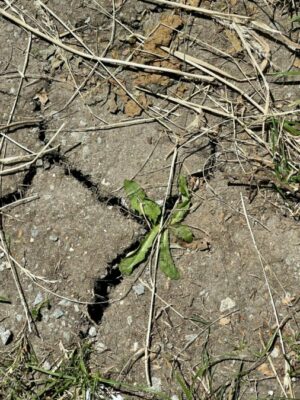
Mosses and lichens are often overlooked as part of the woodland flora. The same is true in towns and cities. They can be found on the trunks of trees, on walls and rooftops. They are epiphytes, that is, plants which grow on the surface of another plant. They derive moisture and nutrients from the air, rain, and debris that is deposited on and around them. They cling to these surfaces, come rain or shine. Climate change and pollution affects these small, often unnoticed plants in both woodland and urban settings. As global temperatures continue to rise, many places face extremes of temperature. Heat waves are becoming more common, as we have recently experienced. Some 1500+ heat-associated deaths were recorded in England during the heat waves of last summer [2025]. The highest rates were among elderly individuals [aged 85+] with the impacts felt particularly in care homes and hospitals. London and the East of England recorded the highest number of heat-associated fatalities.
Cities and urban environments often face the brunt of these climate extremes. The concrete, brick and tarmac of cities absorb and hold onto the sun’s energy creating ‘urban heat islands’. Urban temperatures are often several degrees higher than surrounding rural areas. Urban temperatures have soared in recent times, for example in New Delhi, a record high of 126.1oF (52.3oC) was recorded. Such temperatures claim lives. This year parts of Europe have recorded temperatures of 40oC.
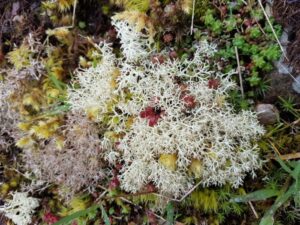 Urban trees suffer in this heat as do their epiphytic flora. The mosses and lichens in our cities fall into this category. Researchers at Leiden University have investigated the effect of changing temperatures on the mosses and lichens growing on Lime (Linden) trees in Dutch cities (Amsterdam, Leiden, and Rotterdam). They sampled numerous sites, measuring the microclimate for each tree and recording the species present. They found, perhaps unsurprisingly, that urban heat islands were reshaping the moss and lichen communities. Species that were adapted to drier, brighter and nitrogen-rich environments were favoured; for example, a type of wreath lichen [Phaeophyscia orbicularis]. When wetted this turns from a grey / brown colour to green, and its symbiotic green algae can begin to photosynthesise producing sugars. Those species that were associated with moister and shady conditions were found to be ‘losing out’. They noted that the larger lime trees supported more diverse epiphyte communities; this might be associated with the older bark offering more micro-habitats for the mosses and lichens to ‘gain a foothold’.
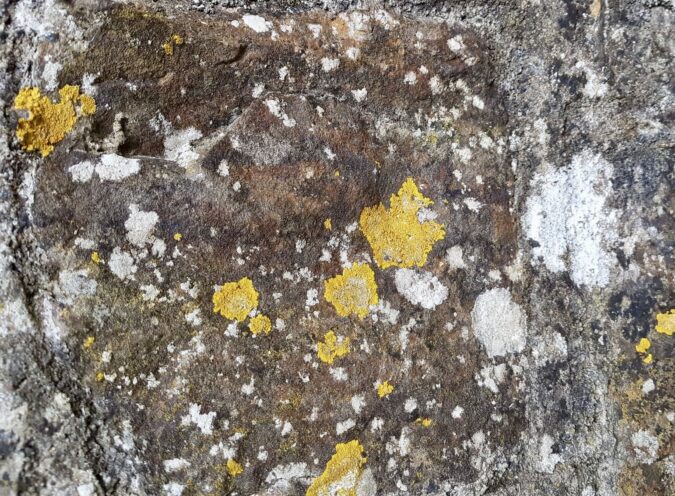
Lichens on an old stone wall.
The changing climate and urban heat islands are altering the species that can survive in our towns and cities, on trees and artificial surfaces.
Comments are closed for this post.