Holm, Holegn or Holly by any other name.
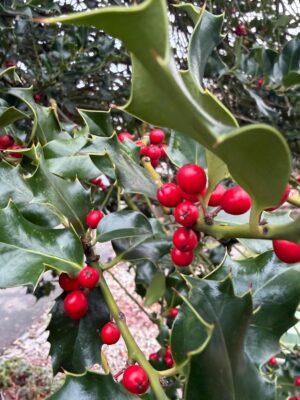
Holly is not a ’typical’ woodland tree, it is an evergreen tree but not a conifer. Also, holly trees are either either male or female; that is, holly is dioecious. Lastly, holly leaves usually have spines and a shiny appearance due to their thick, waxy cuticle.
The word ‘Holly” comes from the Old English “holen” or “holegn”. It was also known as ‘holm’, ‘holme’, or ‘hollin’. These names are useful when examining old maps and ancient texts to determine the historical distribution of holly woodland across the U.K. It is certainly the case that the holly woodland was more widespread, for example, there was Needwood Forest in Staffordshire. Needwood was an ancient midlands forest but following the Enclosure Act of 1803, large numbers of trees were felled. Professor David Mabberley notes in his ‘Plant Book’ that some 150,000 holly trees were taken from Needwood to provide wood for the bobbins of the cotton mills of Lancashire. Bagot's Wood is the largest remaining piece of Needwood Forest, found near to Abbots Bromley.
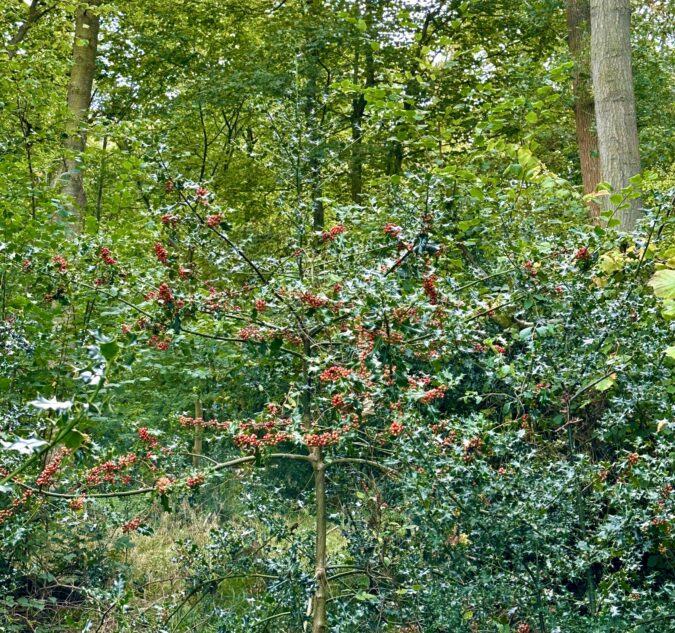 One of the more unusual holly woods is found at the Stiperstones in Shropshire. Here, some of the holly trees are pollarded and thought to be over two hundred years old, possibly more as judged by their circumference. Some of the holly trees have other species growing out of them, such as Rowan. They are sometimes referred to as ‘cuckoo trees’.
Holly was much more common in the past, and was a source of fodder. The leaves are palatable to livestock, despite their spines. It is the only evergreen tree (found in deciduous forest or woodland) that does not contain chemicals that are toxic to sheep or cattle. Yew, one of our native conifers, is very toxic. For many centuries, it was common to provide holly for livestock during the winter months, when other foodstuffs [such as hay or grains] was in short supply. Without the holly, livestock might have to be slaughtered leading to problems in subsequent years. Using holly as fodder was more common in areas like Cumbria, the Welsh Borders and the Pennines.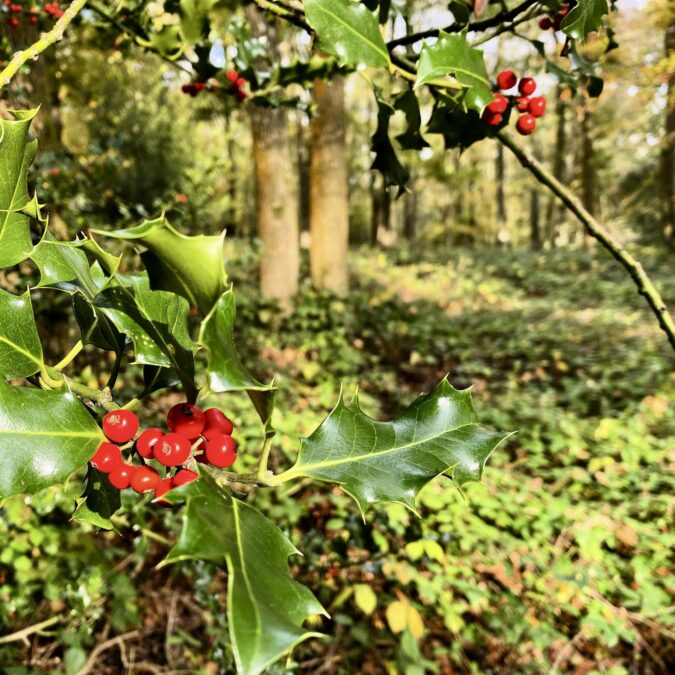
The leaves contain a bitter tasting alkaloid - ilicin. This bitter taste deters many leaf eating insects. Indeed, compared to oak, the holly is rarely subject to sustained attack by insects.  However, its leaves can harbour the holly leaf miner and the larvae of the Holly Blue butterfly (Celastrina argiolus). The leaf miner can leave pale, twisting trails in holly leaves, as it feeds upon the tissues of the leaf. The larvae are protected to some degree by the tough cuticle of the leaf. Holly exhibits heterophylly, that is you can find different types of leaves on the same tree. Lower branches and young trees produce prickly, spiky leaves which deter browsing mammals, like deer. However, higher up in the canopy and out of reach of animals, the leaves have a smooth outline and few, if any spines. The prickly leaves and interlocking branches provide a relatively predator-proof home for nesting birds, such as the Mistle Thrushes. The berries are a food source for birds such as redwings and fieldfares. Holly woods have a distinct ecology due to the plant’s evergreen nature. Stands of holly can form a dense canopy so that the amount of light reaching the woodland floor is limited so that many of the ‘usual’ woodland plants cannot gain a foothold. However, the canopy can create the right conditions for mosses, liverworts and lichens.
In the past, Holly was used for hedging as it was relatively impenetrable and durable. The downside of using holly was its relatively slow growth compared to hawthorn. The wood of Holly has been used in cabinet making, wood engraving and veneering. The leaves, berries and twigs have been used to decorate homes and holy places for centuries. The foliage and berries tends to last quite well in garlands and wreaths, and other displays. An early reference to the use of Holly at Christmas time can be found in Stowe's 'Survey of London' (1598) to quote 'every man's house, ….. the corners of streets were decorated with holme' (where holme is one of the old names for holly).
* The British Agricultural History Society website http://www.bahs.org.uk/ has information and articles on Holly, for example 'Holly as a Fodder in England' by Martin Spray, 1981; 'Holly as a Winter Feed' by Jeffrey Radley, 1961.]
Leave a comment