The ongoing effects of ash dieback.
by The blog at woodlands.co.uk, 27 January, 2023, 0 comments
Various Wildlife Trusts are experiencing financial problems as a result of Ash Dieback. Dead and dying trees are to be found in woodlands up and down the country, (some of which are managed by local Wildlife Trusts).
The fungus has its origins in Asia and has spread across Europe for the last thirty years. It was seen in Denmark in 2002, and has spread across the country by 2005. It is now to be found in Austria, Belgium, the Czech Republic, Denmark, Estonia, Finland, France, Germany, Hungary, Italy, Latvia, Lithuania, The Netherlands, Norway, Poland, Slovenia, Sweden and Switzerland. It probably arrived here on imported (and infected) plants, though its spores are easily spread on the wind. Once infected, the fungus affects the movement of water, minerals and sugars as the vascular system (xylem and associated tissues) is impacted. Once a tree has been infected with the fungus, it may then be colonised by another pathogen such as the honey fungus (Armillaria spp).
Symptoms of ash dieback may include
Shoot tips become black and shrivel, side shoots on young trees may die.
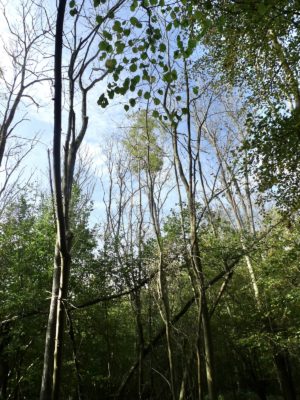
Dead and ‘black’ leaves can be seen, their veins and stalks of turned brown. Leaves shed early.
Branches begin to dieback
Diamond-shaped dark lesions form on the trunk near to dead side shoots.
In late summer, small white fruiting bodies can be found on blackened leaf stalks (see Jasper’s detailed blog).
[caption id="attachment_39049" align="aligncenter" width="600"] the fungus emerging from blackened dead ash petiole.[/caption]
The dead and decaying trees pose a threat (as they become weakened and brittle), and need to be removed. Removal is an expensive process and takes money from the Wildlife Trusts that would otherwise be used for habitat restoration, new planting etc.
Apart from affecting the beauty of our woodlands and hedgerows, the loss of these trees has ‘knock on’ effects for other species. Brown eared bats and barbastelle bats are known to nest in ash trees, the trees also provide perches and nest sites for birds and act as a substrate for epiphytes such as lichens and mosses. The loss of ash tree will also affect the plants beneath, plants that like damp shady conditions such as lady fern (Athyrium filix-femina) and dog’s mercury; these may be replaced by light loving species / grasses.
Featured image : Ash in winter
Detailed information of Ash Dieback : https://cdn.forestresearch.gov.uk/2017/06/fcrn029.pdf [note this link downloads a PDF].