You are here: Home > Blog > Flora & Fauna > Sweet Chestnut

Print this page

Sweet Chestnut ~ by Chris

Sweet Chestnut

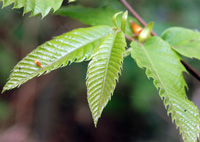
Both horse chestnut and sweet chestnut trees are common throughout the UK, though the former is presently under attack from moths, bleeding canker, drought and leaf blotch fungus. Like oak and beech, to which it is botanically related, the sweet chestnut can grow to a height of 30 metres (for basic information about the tree, see the Woodlands “Guide to Tree Identification”).

Sweet chestnut is not thought to be a native tree. Pollen analysis indicates that it was not present before Roman times. So why did the Romans introduce the tree ? There have been various suggestions.

For its fruit. The nuts formed an important part of the Roman diet (roasted or ground for flour). However, the nuts from UK trees are smaller than those from Italy or Spain.

For firewood. Sweet chestnut is quick growing and coppices would provide material for firewood. However, the wood is not noted for burning well or giving off great heat. (Surely the Romans would have used a native tree like ash ?)

For making charcoal. Charcoal was extensively used for working with metals (tin, copper, iron etc) for example, in the Forest of Dean. Did the Romans introduce a new species just for charcoal production? Iron production was quite extensive in the 1st Century AD, so perhaps a ‘new’ fast growing species helped.

For use in the vineyards. Sweet chestnut stakes could be used to support the growing vines (as the wood is rich in tannins it would not rot too quickly when stood in soil). Perhaps, the answer lies in the fact that the tree could be used for all of these things – the wood was versatile.

For lots more information on the Sweet Chestnut, its history and uses read Chris Howkins’ book “Sweet Chestnut – history, landscape, people”.
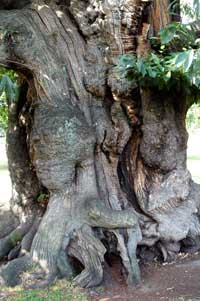
Veteran sweet chestnut trunk

Posted in: Flora & Fauna ~ On: 21 March, 2008

18 comments so far

Tracy Pepler
11 April, 2008

Chris Howkins book is really good!

Some Common Botanical Terms | The Woodlands.co.uk Blog
2 May, 2008

[...] Archaeophytes are ‘ancient introductions’, plants that were introduced (accidentally or deliberately) by humans before 1500 AD.  Ancient introductions are plants like poppies (Papaver sp), which came in with crop seeds, whilst other species might have been introduced for medicinal or other uses.  Many are now are now thought of as part of our flora, such as the Sweet Chestnut.  [...]

MJ Calvert
12 October, 2008

Please advise if the sweet Chestnut can be grown from seed, and if so, how should the nuts be Planted.
Regards
Michael Calvert

Chris
16 October, 2008

I do not know much about sweet chestnut mgermination myself, but a quick look on the web revealed
http://handbooks.btcv.org.uk/handbooks/content/section/3572
and if you search the page, then there is some information on growing seeds, including sweet chestnut.
There is also
http://www.treeforall.org.uk/NR/rdonlyres/08FEC65D-B1E9-4002-BE69-50FBBADBA746/0/growingseeds2trees_3348.pdf
Hope this helps
regards
Chris

Bashkim Mal LUSHAJ
10 December, 2008

Mr. Chris Howkins, your book “Sweet Chestnut – history, landscape, people” is really good! I need an original copy.
I hope in your help.
Sincerely,
Bashkim

Chris
14 December, 2008

The book on the Horse Chestnut was written by Chris Howkins – not me, and is available from http://www.summerfieldbooks.com/ShowDetails.asp?id=946.

Chris
14 December, 2008

correction the above should read Sweet Chestnut

Will
13 February, 2009

Can anyone tell me, is Sweet Chestnut good for making charcoal with?

Tracy
7 July, 2009

Hi Will, yes, we have had no problem making charcoal with our SChestnut.

Diana
20 October, 2009

I have just spent some time in Brittany, France where the Sweet Chestnut trees grow in abundance. Can anyone please tell me are the sweet chestnuts sold in our UK shops grown in S.C ‘orchards’ and if so how are they harvested or are they gathered by hand in the wild so to speak. S.C from trees in France might be small but they cooked well on top of the log burner.

Plants, Past & Present Part 2 | The Woodlands.co.uk Blog
9 June, 2010

[...] Archaeophytes are ‘ancient introductions’, plants that were introduced (accidentally or deliberately) by humans before 1500 AD. Ancient introductions are plants like poppies (Papaver sp), which came in with crop seeds, whilst other species might have been introduced for medicinal or other uses. Many are now are now thought of as part of our flora, such as the Sweet Chestnut.  [...]

Some Common Botanical Terms | The Woodlands.co.uk Blog
4 September, 2010

[...] for medicinal or other uses.  Many are now are now thought of as part of our flora, such as the Sweet Chestnut. [...]

Sarah
9 June, 2011

I brought some sweet chestnut seeds back from a holiday in Italy at Easter. There was a huge tree in the garden of the cottage we rented, and I found the nuts splitting, sending out a root and some small leaves. I potted them up at home and left them on a sunny windowsill, they are romping ahead. I didn’t know the tree grew so huge until I read up a bit. I have a large garden, but I think I’ll have to coppice them to keep under control. They have grown about 4 inches since Easter, and it’s very exciting to have something different from all the ash and beech we have around our property.

Stephen Corner
20 September, 2011

I wondered if you could help me locate some near by sweet chestnut trees to runcorn or cheshire.

I can find plenty of hazelnuts but have had some difficulty finding sweet chestnuts.

Yours Sincerly

S.Corner

Andy Trayford
1 November, 2011

Does anyone know if ivy growing up a sweet horse chestnut tree could kill it off or have some adverse affect on it. I have just pruned a few dead branches off one where there is ivy growing up it through to the top.

john bishop
8 November, 2011

Can, and when, should I plant sweet chestnuts in the Midlands-Leicester ?

marlis Malein
27 November, 2011

hello
my husband is suddenly “crazy” about nut trees which grow big eatable nuts.
Where would we get the seeds from and which are the best varieties for damp Pembrokeshire?
I have heard of French Sweet Chestnuts Marigoule or others
Walnuts again french Franket, Perricot or Vernore (spelling not exact)
not Broadview (bad for blight).
Thanks for your help
regards
Marlis

Blogs
28 November, 2011

Leave a comment

© 2012 Woodland Investment Management Ltd | Disclaimer | Contact us | Blog powered by WordPress