Chainsaw Training
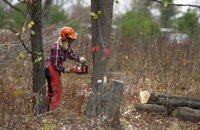
Proper training is essential if you're planning to use a chainsaw. Make enquiries with the National Trust or your local agricultural college about City & Guilds NPTC Forestry, Chainsaw and Arboriculture courses. Mike Pepler gives us the lowdown on his course:-
I've been out on the chainsaw training course. The course was a week long.
- I've done NPTC units 30 and 31. I plan to do the assessment in a few weeks so that if I want to I can get insurance and work on other people's land.
- Even if I wasn't doing the assessment (not everyone on the course is), the training is invaluable. A lot of what we are learning will work just as well with hand saws as it will with chainsaws.
- Unit 30 covers maintenance and cross-cutting. A poorly maintained saw is a dangerous saw, especially if the cutters are not sharp. Sharpening requires a few special tools and some tuition to get it right. It takes a while, but you really notice the difference when you use the saw!
- Unit 31 covers felling trees up to 15" diameter, and you go through the use of several types of felling cuts, as well as using a felling lever, cant hook, turning strap, winch, etc. You also cover efficient methods of working, such as moving logs, stacking them, felling trees on top of eachother to get them of the ground. This last point is key, as it makes snedding (removing the branches) much easier. Even snedding has a special method though - there are 6 permitted cuts, and 2 not permitted. The 2 banned cuts are dangerous, and have resulted in accidents where the chainsaw trousers can be breached!
- We've studied a lot of safety, including why the back of a tree being felled is as dangerous as the front - the tree can split, and the back will kick up hard enough to knock you through the air. Our instructor knew someone who had been killed in this way. Ash is the worst for it, and is known as the "widow maker". Sycamore and chestnut do it too.
- Protective clothing: the minimum is protective boots, trousers, helmet, ear and eye protection. Gloves are useful for handling anyway, but the risk of actually having the saw hit your hand should be close to zero if you use it properly - you are meant to keep two hands on at all times, and apply the chain brake before taking a hand off! A chainsaw jacket is not really needed for work on the ground - they are for tree surgeons. Our instructor had never heard of an upper-body injury happening on the ground in decades. For eye protection goggles are OK, but prone to misting - we all used metal visors. Ear protection is vital for anyone within 5-10m. Having said all this the biggest protection is proper training...
- Some people have mentioned kickback. All the saws we used had a combined manual/inertial chainbrake. We saw this demonstrated by the instructor - as soon as kickback happens the brake applied itself and the chain had stopped dead before it had moved 8-10 inches. However, you obviously try and avoid kickback through proper use of the saw, simply because it is annoying and disrupts your work. Also, checking the chainbrake stops the chain at full throttle is one of the daily safety checks you must perform.
- Finally, choosing a saw... The important thing is to try some out. After the maintenance part of the course I was quite keen on the Stihl 260 as it looked easier to work with. However, having tried it in the wood I went off it, compare to a Husky 242. The Stihl stalls a lot (a common 260 problem according to our instructor), and it also kicks a lot in your hand when you rev it. The Husky ran better, didn't kick on revving, and generally was a better-handling saw. So, I've chosen the Husky 346XP, based on experience and the instructor's advice. It's a pro-quality saw, with a 50cc engine and variable rate oil pump. I got it with a 13" bar, which gives more power and is easier to use for most work. I also got an 18" bar for the odd occasion when I need to tackle something bigger.
There are videos of different types of cuts on our blog www.peplers.blogspot.com
Comments are closed for this post.
Discussion
I would like to do a chainsaw training course including how to fell trees .
I live in Fishguard PEMBS SA64 0BA.
Are there any near me please?
Thanks
Louis Warren
hi there I’m looking to do a tree felling course in south wales just outside Cardiff I live in a town called Pontypridd does anyone know where I can go locally to do the training
very nice articles with a lot information.thanks
I am involved with the Cleeve Prior Heritage Trust we manage 28 acres of woodland, orchards and meadows in the village of Cleeve Prior near Evesham, Worcestershire. We need to train several volunteers in chainsaw use. Does anyone know of who could put on a course in our area. Does anyone know of grant availability for this type of training to charities.
You’re right that taking a training is very necessary to use a chainsaw. Nowadays there are many classes opened for this purpose and not many people can imagine what they will lean in those classes. Thanks for sharing useful information.
This is all really interesting reading – it would be great to know what initial equipment costs are of obtaining chainsaw / equipment etc prior to taking the CS30/31 course. Does anyone have any recommendations? We’ve looked into reconditioned equipment to make it a bit cheaper – but of course safety comes first and would only use recommended retailers. If anyone can suggest start up costs of equipment (prior to taking on the aerial courses etc) it would be really helpful.
I did my CS30 and CS31 with Andrew (excellent instructor) at ProClimber (http//www.proclimber.co.uk), based in South Wales. Sincerely, I never thought education could be so much fun. ProClimber also runs a FastTrack course, run over six weeks, which I intend to join at the right stage to complete my remaining tickets.
The aim is to become a full time tree surgeon/arborist, dabbling in firewood supplies, and venturing into more money-from-wood ideas as time goes by.
Certainly beats the 12 years of I.T. I’ve been putting myself through. Sitting in a chair just doesn’t feel right anymore.
Happy chopping.
Just done a CS30 & 31 course in Devon with Dave Berryman of Lynher Training after reading some of the comments listed. I’m really glad I did as I learnt so much and it was FUN. Would recommend everyone who uses a chainsaw do the same, it really brings home how dangerous chainsaws can be !
I’m taking the NPTC Units CS30 & CS31 at the end of Jan 2011 – minus the cost of equipment, it’s costing me £650.
Does anyone know if there are any grants available – government funded or otherwise – for the remaining courses/qualifications (e.g. climbing, aerial rescue, the use of chainsaw from rope & harness)? Otherwise, the necessary qualifications will cost an estimated £5,000 – £6,000 (that’s the cost for the all-in fast-track course).
Nice advice
Im strudying arboriculture at present and am looking at getting my tickets soon, this information is very helpfull many thanks.
Ill put some videos on my blog please take time to have a look, http://arbgraft.blogspot.com/
Cheers
Website can be found at
npctraining.co.uk
Hi all.
I couldn’t agree more that correct training is vital to reduce the chance of an accident with a chainsaw; it is also a legal requirement in the workplace.
If anyone is interested in this training in the South East of England, please give the website a look and get in touch. You never know, it may be the best thing you ever do.
Thanks for reading this.
David Rossney, chainsaw trainer in E Sussex and Kent has an updated site:
Hi Marshal
If you know of any good trainers up your way, we would love to add their details to our database. We often get asked about chainsaw training.
Sounds like you need to go for it and get back into it!
Tracy
“Hello there, well I worked with the forestry for more than 9 years all over Argyllshire(and they say that if you can work there you can do the job there, you can work anywhere in U.K, as it’s that steep!)and I’ve got to admit that it is the best career in the world (well,apart from playing on stage with Status Quo !!)
What other job gives you different scenery every few months, being at one with nature,a good level of fitness, a great smell of pine resin (much better than ‘Old Spice’for charming the ladies!!) and a good measure of danger thrown in!
But I find that having been out of it for some years now due to my own fault, I would need to get a safety certificate to go back to the job I once loved which is no bad thing, even though I could teach the job blindfold ! Oh well, maybe one day….! Marshal K-Craig
I am doing a chainsaw course in Kent from the 5- 8th Aug, for felling small trees. Need one more person to join in! Please email me if you are interested, costs about £450
Those were some pretty good tips on falling trees. Safety is always first as you know. I grew up in oregon and know several people who have had family killed in the logging industy from accidents, others with injury’s that will plague them for life. Thanks for the tips.
Yes, the boring cut is an important one for trees that may split. It’s learning how to do this kind of thing that makes the chainsaw training worth the money.
Mike
Thanks for the notes, and the videos of different are very useful. The boring cut was mentioned recently on radio 4 (can’t remember what programme, possibly Open Country), stating it must be used with Alder as they are very likely to split otherwise (useful info as we have alder in our wood).
I’m currently trying to get training via the local wildlife trust (and in return will give them a decent amount of my time working on their reserves using what I learn ).
cheers
Binz
Hi, just an update on the above – I did the exam a short while later, and passed with no problems. I can strongly recommend my instructor, Dave Rossney of Esus Forestry http://www.esusforestry.co.uk/
I’ve made a few videos since of different tree felling techniques, they’re on our blog:
http://peplers.blogspot.com/2008/02/another-felling-video.html
http://peplers.blogspot.com/2008/02/yet-another-saturday-in-woods.html
Thanks, Mike

Hi I AM LOOKING TO BE A FULLY QUALIFIED CHAINSAW OPERATOR CAN YOU PLEASE TELL ME THE COSTINGS
Regards
Rob Reed.
rob reed
8 December, 2019