Woodlands.co.uk

Blog - squirrels

beech nut

Mists, Mast and mellow fruitfulness

by The blog at woodlands.co.uk, 26 September, 2025, 0 comments

Autumn is here, whether you follow the definition of meteorological autumn, which starts on the first of September or the astronomical autumn which starts at the autumn equinox.  The equinox is when day and night length are equal, after that time the days get shorter. Or it might be that you are noting the signs of the seasons changing.  The BBC, the Woodland Trust and Nature’s Calendar chart the advance of autumn by recording events in the life of key species, for example blackberry, hawthorn, swifts, conkers, ivy and oak.  The information collected helps build a picture of how climate change is affecting the time of flowering, fruiting  etc. of many species. The blog has already commented on the early flowering of the blackberries but now woodlands are starting to transform into a mosaic of reds, yellows, and oranges as the leaves prepare to be shed and the woodland floor becomes a fungal jungle, (as Jasper has described). Hawthorn, Blackthorn and other bushes are laden with berries, conkers and acorns will be strewn across woodland floors. Squirrels eat hazelnuts (and hide some of them as a winter food store).  This banquet of fruits and seeds may be a response to the long, hot and very dry summer we have just experienced.  Trees and shrubs have been stressed by the heat and drought. Some have responded by mobilising their reserves / efforts into producing more fruits and seeds, to ensure that they pass on their genes to the next generation.   [caption id="attachment_24651" align="aligncenter" width="600"] Sloes on Blackthorn[/caption] If it seems like you have been noticing more acorns on the trees than normal that could be down to a "mast year”. Mast years occur roughly every five to ten years and refer to years when certain species of trees Like oak & beech) and shrubs produce a larger than normal crop of berries, nuts and fruit.  This boost in production means far more is produced than can be eaten  by the usual herbivores, squirrels, dormice etc, thus ensuring at least some of the mast goes on to grow new plants.  However, this ‘over-production’ can come at a cost to the tree, using vital resources so that growth in the subsequent year may be reduced.  Quite what causes trees and shrubs to ‘go mad’ and overproduce is not known but some theories are explored in a previous blog, though the weather in Spring is an important factor. [caption id="attachment_42689" align="aligncenter" width="675"] Collecting acorns.[/caption]
Deer in woodlands

Deer in woodlands

by The blog at woodlands.co.uk, 22 June, 2024, 3 comments

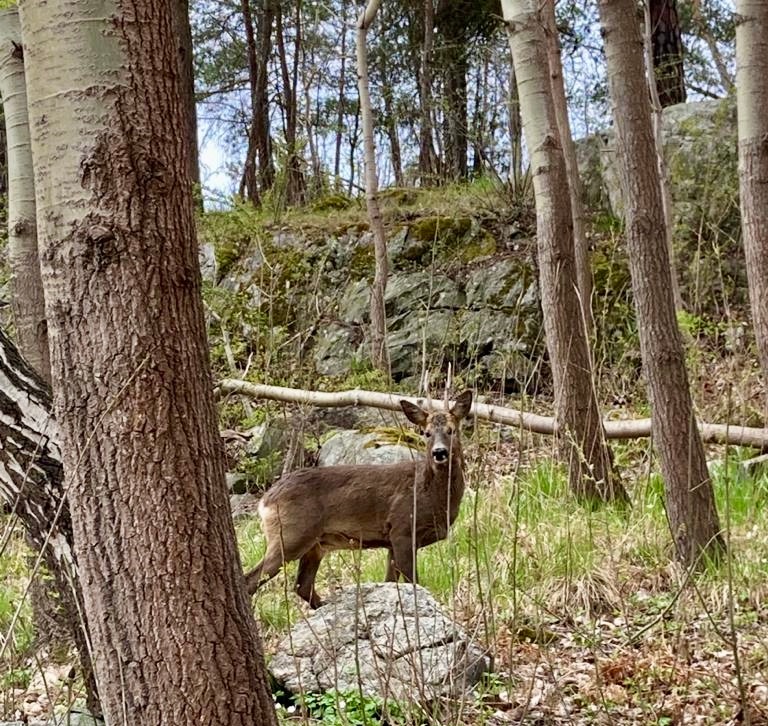
Woodland covers some 1,000 hectares of the Ashdown Forest, that is roughly 40% of its area. Much of the woodland is relatively young. However, the forest’s capacity for regeneration / renewal is being damaged by overgrazing.  Local deer populations have grown and now represent a problem. Deer browse / graze on vegetation, shoots, flower buds and foliage are stripped off plants.  Young saplings are damaged and bark is eaten, especially when food is scarce.  Consequently, tree and shrub regeneration is limited.  Other species are affected by the feeding of the deer, either through loss of niches or food.  Among those at risk are small mammals and certain butterfly species. [caption id="attachment_34368" align="aligncenter" width="650"] deer damage[/caption] Damage is found in woodlands in many parts of the country, as deer populations have increased in recent times. In the 1970s, the deer population was estimated to be around 450,000 as compared to today’s estimates of over 2 million.  The National Forest Inventory highlighted that "40 percent of British forests have ‘unfavourable’ levels herbivore damage, which limits the survival of young trees and threatens biodiversity".  Apart from deer damage, there is damage by the grey squirrel populations. Deer browsing can : Prevent natural regeneration Affect biodiversity Affect woodland resilience Reduce food availability to the herd which can lead to starvation / loss of condition Deer are also hosts to ticks.  The ticks may be infected with Borrelia burgdorferi  bacteria and transmit them to humans, resulting in Lyme disease. Deer  also contribute to collisions with motor vehicles; more than 450 deer were hit by vehicles on Hampshire roads last year .  In Scotland,  government agency figures indicate that deer vehicle collisions  [DVCs] have almost doubled between 2008 and 2020.   Sadly, people are injured or killed in DVCs, and the repair cost to vehicles runs into millions. The solution to the ‘problem’ is not clear cut. Culling [the selective killing of animals] to control deer populations is one way in which numbers can be reduced, and the damage to woodland mitigated.  However, this approach has been met with opposition by many, including animal rights organisations.  There is the argument that whilst a reduction in deer numbers might fix some problems in the short term, the subsequent increase in plant growth and food availability might lead to increased breeding by the remaining deer and numbers would then increase again.  Also, unsuccessful or inaccurate shooting leads to animal suffering, mutilation and / or a lingering death.   Some might advocate rewilding and the introduction of apex predators (such as the wolf, lynx, wild cats*) as a means of reducing numbers but that might raise other problems! Deer have been 'part and parcel' of woodlands since mediaeval times, when the forests were used for hunting. In the Ashdown Forest, the number of red deer declined during the C17th,  and poaching was a factor in their decline. Fallow deer numbers also declined. [Fallow deer were introduced to England by the Normans around 1100 AD.]  The deer population roaming the forest has increased significantly in the recent decades, and now there are the relatively recently introduced species, muntjac and sika deer.   There are six species of deer in UK woodlands – the two native species, the red deer and roe deer and fallow, muntjac, sika and chinese water deer make up the four non-native species. The problem of over grazing is not unique to the Ashdown forest. For example, deer numbers in Scotland have doubled in recent years to almost a million since 1990.   Finding sustainable (and humane) solutions to the large numbers of deer is difficult. * Wildcats were once widespread in Britain, but by the end of the 18th century, they were to be found only in the northern regions. [caption id="attachment_34415" align="aligncenter" width="700"] Remnants of birch woodland near Loch Muick are subject to browsing by red deer (especially in the winter), so temporary fences have been put in place to allow for regeneration.[/caption]
beech nut

Masting

by The blog at woodlands.co.uk, 10 December, 2021, 0 comments

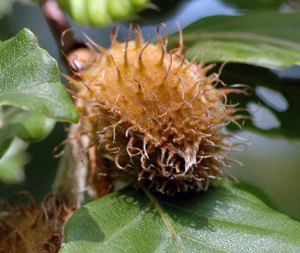
‘The Fall’ in the eastern United States has been colourful and plentiful this year.  There have been bumper crops of acorns, maple seeds and pine cones.  It is a Mast Year.  The trees have produced enormous numbers of potential offspring. These seeds and fruits will have significant 'knock on effects' in the ecosystems for some years.   Beeches and oaks can release so many seeds that they significantly increase the organic content of the soil and its nutrient value.  This fuels fungal and microbial growth. Small mammals feast on the acorns / mast and their numbers increase.  They, in turn, are food for foxes, owls and other predators *.   Quite what drives a mast year has long been a cause of speculation.  Ideas have included  masting evolved to overwhelm seed predators (mice, squirrels etc.) and thus ensure that at least some seeds survive to germinate and grow on.  fluctuations in nutrient availability affect the trees and flower / fruit production environmental prediction - that masting occurs in those years when seeds are likely to have good weather for sprouting in the following Spring.   even sunspot activity has been invoked Recently, a database [MASTREE] was created of mast years (for Beech and Norway Spruce) that extends back centuries.  This has enabled scientists to explore the environmental prediction idea, that is, whether masting is correlated with climatic events and occurs when seeds are likely to have favourable weather for germination and growth in the Spring after their production. On comparing the data with climate records, they found masting events [in beeches] correlated with climate patterns associated with the NAO - North Atlantic Oscillation, i.e. changes in air pressure between Iceland (low) and the Azores (high).  A “positive” NAO phase favours both masting and subsequent seedling growth; that is warm wet winters promote seed production and dry springs favour seedling growth.  Quite how the trees turn such climatic events into ‘signals’ for masting is another matter. Not all are convinced however. Some argue that the resources used up in producing so many seeds / fruits mean that the trees are exhausted and it takes time for these resources to be replaced and for the tree to flower and fruit fully again.   Professor David Kelly has a somewhat different hypothesis related to weather .  He suggests greater warmth in the previous growing season(s) may be the trigger.  Quite how the trees ‘remember’ the warmth that they have experienced is not known; but one thought is that it is due to what is termed ‘epigenetic marking’.  It is possible that the DNA of the genes that affect flowering is changed by the warm temperatures.   The activation of particular genes can be altered by their DNA undergoing methylation - a process where methyl (-CH3) groups are added (or removed) from the DNA.  Further information on masting and climatic effects on trees - visit science.org * [Sadly, a Swiss study found good masting years were later associated with a rise in tick-borne disease.]  

Next Page »