Invaders – wallabies!
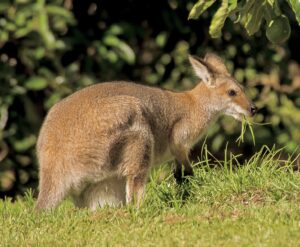
The nineteenth century saw the introduction of many ‘exotic’ or non native species. Some of these introductions have proved to be invasive, for example the Himalayan balsam. Invasions have also included animals. For example, muntjac, parakeets and grey squirrels. More recently, there have been many sightings of wallabies. Their presence is thought to be due to escapees from wildlife parks, zoos and possibly private collections. It has been suggested that some were released during the WW2 as people were unable to look after them.
On the Isle of Man, there is a thriving population of red necked wallabies, which dates back to the 1960’s. A recent survey (2023 & 2024) using thermal imaging and drones estimates the population to be around one thousand animals, possibly more. The grassy and woodland habitats are not dissimilar to those in Tasmania, though the climate in the Isle of Man is somewhat cooler and wetter. 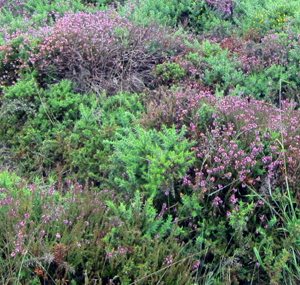 Here, there are no predators and they seem to have adapted well to the somewhat cooler conditions. They feed on heather, bracken, bilberries and grasses. The local wildlife trust is concerned that the animals may be having a detrimental effect not only on the native vegetation but also the local fauna - such as ground nesting birds. On the plus side, there are those who think their presence helps to support the local tourism industry.
Beyond the Isle of Man, there have been many sightings of wallabies across the U.K, ranging from Cornwall to Scotland. Sightings are more common in the South. In some areas sightings of wallabies are no longer reported as the animals are ‘common place’. The Chilterns being a possible hot spot for sightings. However, at present it seems that there is little evidence for self sustaining populations though this might change as our climate becomes milder. There was a small population in the Peak District but it has since died out, possibly due to a harsh winter in 2010. This population arose from the introduction of five wallabies by a local landowner, Henry Brocklehurst, the wallabies formed part of his private zoo at Swythamley.
Featured image : thanks to Sandid on PIxabay
Comments are closed for this post.