Yet another problem for bees.
The use of chemicals to control insect pests of crops has a long history. One of the most concerning episodes was the extensive use of DDT, an organochlorine compound. Initially used to control outbreaks of malaria and typhus, it was then used as an agricultural insecticide. Within a few years there were warning signs of its adverse effects, and in 1962 Rachel Carson published Silent Spring which questioned the indiscriminate use of insecticides.
- The use of these chemicals continued despite evidence of bioaccumulation in ecosystems and
- Identification of specific effects such as the thinning of the eggshells of birds of prey. Consequently, populations of eagles and sparrowhawks declined.
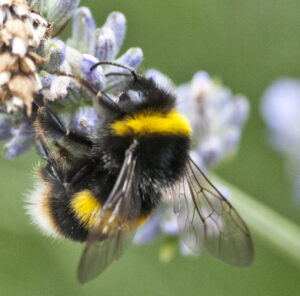
It was not until a decade later that the use of DDT was banned or severely restricted. Now the use of insecticides such as the neonicotinoids is being questioned. These are still used for seed dressings of oilseed rape and maize. Even in very low concentrations, there is evidence that these chemicals are damaging to pollinators such as bees and bumblebees. Various studies indicate that these chemicals affect the bees ability to navigate, so that some do not return home. The chemicals also affect the number of bumblebee queens produced by a colony.
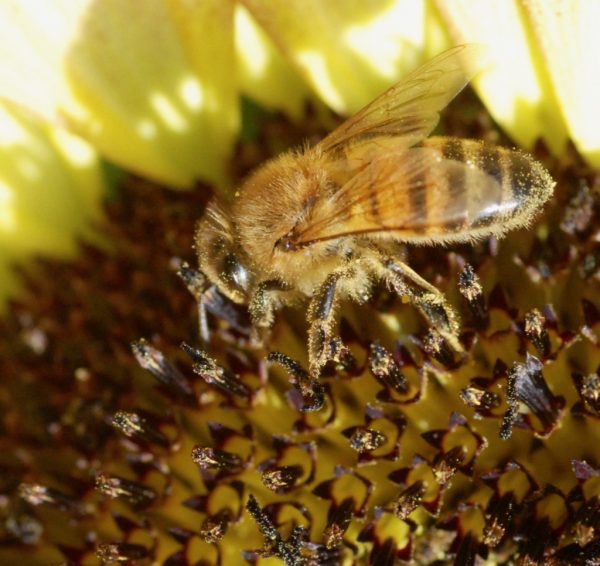
Much of the pesticide research has focused on the physiology of honeybees. This research has indicated that worker bees can help protect the queen from chemical contamination by filtering out certain substances in the food provided for her, some of which may pass to the honeycomb. Recent studies suggest that this ability to sequester chemicals may be overwhelmed and that pesticides can accumulate in the queen over time. To offset this build-up it seems that the queen can offload toxic chemicals into the eggs she produces. A queen may produce several hundred eggs each day which ultimately develop into the workers required to sustain the colony. However, eggs containing these chemicals such as methyl parathion [an organophosphate insecticide] may not develop fully. Consequently, there may come a point when the chemical burden means the colony is no longer viable.
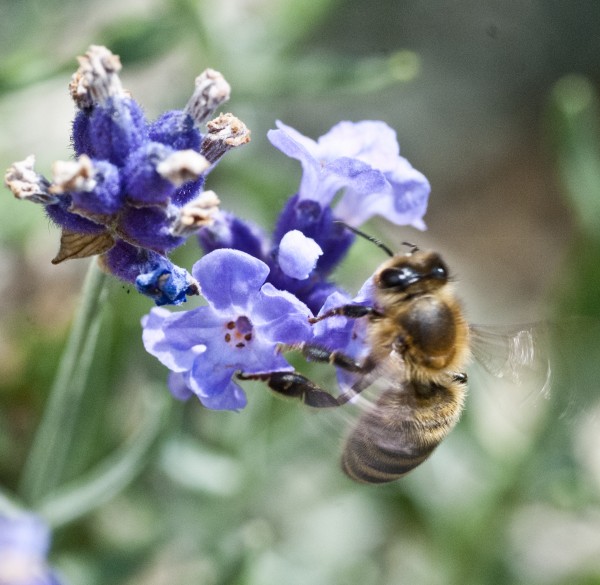
Honey bee - wings beating furiously
Honeybees are responsible for the pollination of approximately one-third of the world’s food crops including oilseed rape, mustard, cabbage, peppers, citrus fruits, coffee, sunflowers, avocados and raspberries. The rapid decline of these pollinators threatens agricultural productivity and ecosystem stability.
Details of the most recent work on pesticides and honeybees :
https://www.sciencedirect.com/science/article/abs/pii/S0960982226008195
Leave a comment