Disney’s Love of the Woods
Disney’s animated films went wandering in the woods almost 90 years ago and haven’t left them since. From Snow White’s flight through a haunted wood to escape the Evil Queen in 1937, to the journeys through the autumnal forests in Frozen II, woodlands have remained an essential tool in the studio’s storytelling toolbox. But why is the setting so enduring?
One simple explanation is that woodlands provide industrious background artists with some ready-made beauty to draw from. In Bambi, watercolour and pastel backgrounds show the forest developing from verdant springtime to a snow-swaddled winter, while Robin Hood foregrounds Sherwood Forest’s pretty, dappled trails and moonlit streams. Though Walt Disney Pictures took the castle as its emblem, its artists have always seemed more taken with the natural world that lies outside of it.
Disney’s storytellers have also recognised over the years that a natural kinship exists between people and the natural settings that surround them – even the spooky ones. From Bambi and The Fox and the Hound to Pocahontas and The Jungle Book, the protection of natural spaces from destructive man-made forces has been a consistent moral theme.
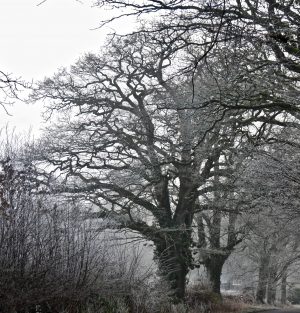
Mature oak in winter
But perhaps the best explanation for Disney’s interest in woodlands can be found in a 1958 documentary featurette, the rather plainly titled Four Artists Paint One Tree, in which four of the animation studio’s artists are tasked with painting an oak tree. Each takes his own view. To the first, the oak is a “marvellous piece of engineering”, and should be painted as if it were a skyscraper. The second invokes ancient druids who believed trees to be inhabited by spirits. The third takes to his task as if he were a portraitist, focusing on the gnarled face of the trunk. And the fourth homes in on the “explosive force” of the tree’s growth pattern.
Beyond showing off the studio’s pool of artistic talent, the featurette reveals something about the imaginative potential provided by the natural world. Woodlands are not fixed or definite spaces. They shift and grow, crawl and scuttle. They look different in the gloom, or at dawn, or out of the corner of the eye, and appear differently to different people. The stories begin to write themselves.
In Britain, woodlands possess the special quality of being both endlessly mysterious and wonderfully familiar. When children have had a chance to explore woodlands for themselves, and time to wonder at what marvels they might contain, they are only too happy to be provided with fantastical answers like evil witches, magic grottos, and singing animals.
The best of these films will prompt children to return to the woods with renewed curiosity and attention. Though they won’t necessarily find any witches amongst the trees, they might chance across Sleeping Beauty’s owls, the woodland creatures of Bambi, or the great drifts of snow they saw in Frozen. And watching them make these discoveries gives adults the opportunity to recapture those feelings the woods once also inspired in them: the curious joy, the slight fear, and above all, the wonder.
Leave a comment