In praise of snails.
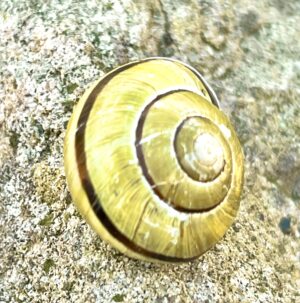
Woodlands have many different species that contribute to their biodiversity. Trees, flowers, deer etc are obviously visible, but there are many ‘hidden’ organisms that contribute to the stability and working of the ecosystem. Snails fall into this category, whilst they might be relatively small (and slow) they contribute to the functioning of the woodland ecosystem.
Snails feed upon leaf litter, decaying plant material, and fungi. The feeding and movement of the snails help break up the decaying leaves etc, making the material more accessible to bacteria and fungi. They contribute to the recycling of vital nutrients such as carbon and nitrogen, as do saproxylic beetles, worms, fungi and bacteria. Their activity helps in the formation of humus and a nutrient rich soil. Humus helps with soil water retention, permeability and drainage.
As the snail shell is largely composed of calcium compounds, when the snail dies, the shell returns calcium to the soil. Calcium is needed by plants for their growth and the formation of cell walls. So, in a number of ways snails contribute to the complex of biogeochemical cycles that operate in woodlands (and other ecosystems).
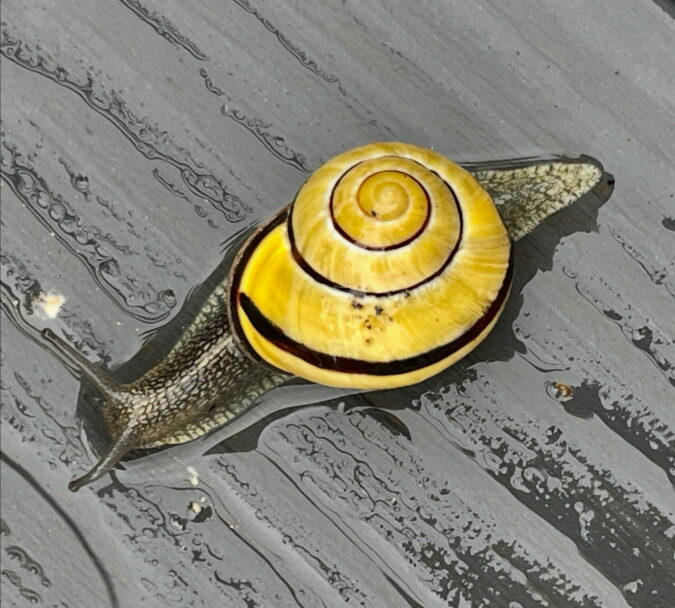
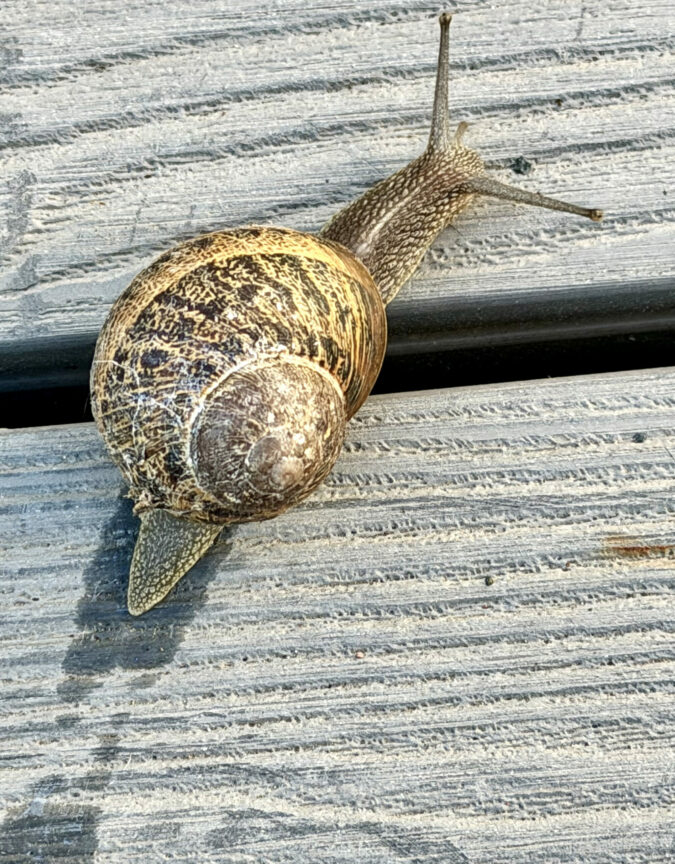
The banded snail - Cepaea nemoralis
Snails are also a food source for a number of woodland animal species. Birds such as song thrushes feed upon them, as do hedgehogs and amphibians. Birds need calcium not only for bone formation, but also to form their egg shells.
There are a number of different snail species to be found in woodlands. Some species like damp areas, others climb trees, or prefer leaf litter. One species that is often found in woodlands is the banded snail (Cepaea nemoralis), also known as the brown lipped snail or grove snail. Its is a particularly interesting snail to biologists as it ‘appears’ in a variety of colours and bands on the shell. The background colours of the shell can be yellow, pink or brown, and the number of dark spiral bands on the shell can also vary from one to five. The snail can thus appear in many forms or morphs. A key feature to identifying the snail is the dark / black ‘lip’ of the shell. The brown lipped snail has been studied intensively because its variation in colour and banding, which is known as polymorphism. The lip distinguishes it from a related snail Cepaea hortensis, which has white ‘lip’. Hence, its common name the white lipped snail..
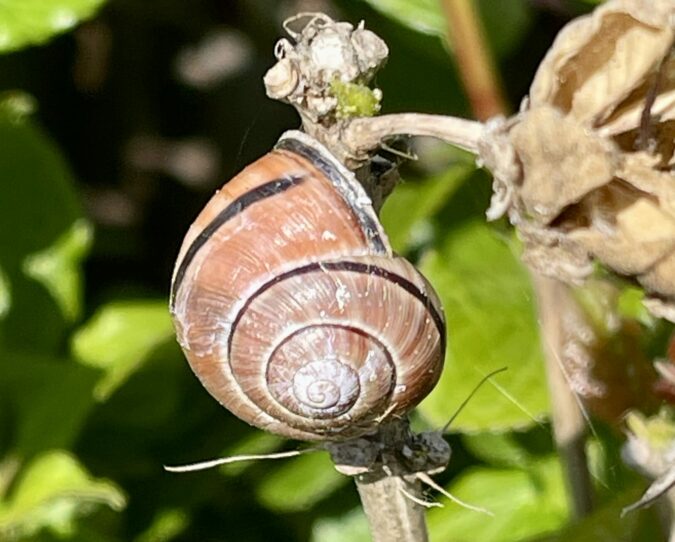
The banded snail is to be found across the country. though yellow snails are more common in grassland, whilst darker shells are more common in woodlands. The variation is thought to offer camouflage in different habitats and reduce predation.
.Look out for thrush ‘anvils’ where the birds use a stone / rock to break open the shell.
 Footnote.
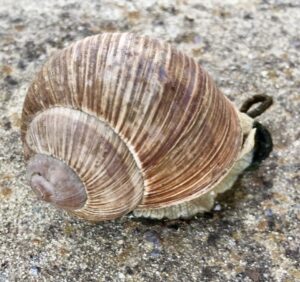
Snails are problematic pests for gardeners and farmers, causing considerable damage to vegetables. Consequently, use is made of chemical pesticides which not only kill snails but also other organisms. Something that deterred snails from eating crops / garden produce but did not have wider effects on the environment would be welcome. Recently, a study at the University of Belgrade has revealed that compounds [triterpenoids] isolated from certain mosses and liverworts can significantly reduce the feeding activity of roman/burgundy snails on lettuces. This suggests that it might be possible to develop a more eco-friendly product than current pesticides.
Garden Snail
.
Leave a comment