Ticks in woodlands and Lyme disease
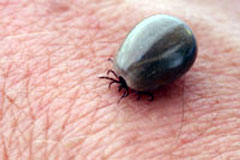
Anyone visiting woodland should be alert for ticks, which, though usually a harmless irritation, can carry Lyme disease.
What is a tick?
Ticks are Arthropods (animals with jointed legs). As they have four pairs of jointed legs, they belong to the Class Arachnida.This class includes spiders, scorpions, king crabs, and mites.
Ticks are large mites. Mites are to be found almost everywhere.The vast majority are quite harmless; living on decomposing matter in the soil or leaf litter. A few, however, are blood-sucking parasites of mammals (deer are often hosts) and birds. These parasitic forms can spread disease as a result of their feeding activities.
The parasitic ticks lurk on grass and other vegetation (they are paricularly fond of bracken), waiting for a host animal to brush against it. They are attracted to the host possibly by heat or carbon dioxide.Once on the host, the tick may move around, finding a warm, moist place to attach.Then it will begin to feed, using its mouthparts to penetrate the skin.As they feed over several days, they swell or engorge with blood taken from the host.The structure used to penetrate the skin is the hypostome; it has backward pointing projections on it that make the removal of the tick from the skin difficult.The tick may also produce a glue-like substance, which holds it in place whilst feeding. The glue dissolves away when feeding is complete, and the tick will drop off and fall to the ground with no ‘harm’ being done.
However, some ticks carry bacteria (in their stomach) that cause disease. They can cause illness such as Rocky Mountain spotted fever (in the States), Tularaemia, Q- fever, and Lyme Disease. It is the latter which is a particular problem in the U.K. The Health Protection Agency estimates that between 1000 and 2000 cases of Lyme disease occur each year. http://www.hpa.org.uk/infections/topics_az/zoonoses/lyme_borreliosis/enhanced.htm
The HPA is collecting information about Lyme disease and ticks – see http://www.hpa.org.uk/infections/topics_az/zoonoses/lyme_borreliosis/tick_recording.htm
See pictures at http://www.lymediseaseaction.org.uk/ticks.htm
Why is it important to remove a tick?
Because a tick on the body doesn't necessarily cause pain, it is important to look for ticks after visiting an area where they may be present.Check the backs of the knees, the groin, armpits and scalp.To reduce the risks of ticks, it is sensible to wear trousers / jeans, and keep them tucked into socks when walking through rough vegetation or wear insect repellent. (Also, check your dog if you took it with you.)
Removing a tick
As mentioned above, the tick feeds by pressing its mouthparts through the skin. In removing the tick, it is important to remove all of it and not leave the head or mouthparts embedded in the skin.Do NOT attempt to remove the tick by using a hot / burning match or chemicals as these may cause it to regurgitate its stomach contents into the wound, increasing the risk of bacterial infection.
Get hold of the tick with a pair of tweezers or forceps as near to the head as possible. Take care not to pull so hard that the animal is torn apart. Pull firmly but slowly until it releases its grip. Then apply an antiseptic cream or lotion. 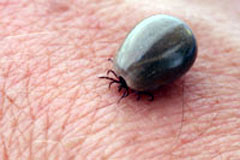 If this doesn’t work, try looping a cotton thread around the tick as close to its head as possible and again pull firmly and slowly until it lets go. Then apply an antiseptic cream / lotion. If the tick is torn apart and the head remains in the skin, there is a risk of skin infection (but not Lyme disease).In which case, it is wise to have the bite checked out by a doctor.
If you have been bitten but successfully removed the tick, it is still important to watch out for any signs of Lyme disease. At the site of the original bite, look out for a red spot which gradually ‘grows’. A pale area may form at the centre; this redness is known as erythema migrans. It may appear some three to thirty days after the bite, accompanied by headache and fever. Other symptoms include muscle and joint pain, drowsiness, swelling of the lymph glands (neck, arms, groin) and other red spots. If erythema develops - see a doctor immediately. Full details of symptoms, complications and treatment of this condition can be found at http://www.ilads.org/burrascano_1102.htm) and there is an excellent article on Ticks and Lyme Disease athttp://www.wadhurst.demon.co.uk/lyme/
Comments are closed for this post.
Discussion
Note ‘checkthetick” has not been tried by any woodlands personnel.
Currently after a tick bite, you no longer have to wait a few weeks for the test results, but you can immadiately TEST the tick for disease carrier and get the results in 10 minutes. When the TEST shows that the tick has been infected with the virus, you know that you need to see a doctor immediately, which can significantly speed up the introduction of appropriate treatment. If the TEST shows nothing and you still think the tick may have transmitted Lyme disease, you can still go to the doctor, test yourself and start treatment but a few weeks later. Although our TEST should never be treated as the only way to confirm or deny a person’s Lyme infection (and blood tests are still the surest way), it is a great complement to the diagnosis of Lyme disease, as it can significantly speed up the diagnosis of the disease and the introduction of appropriate treatment. The speed of drug administration certainly reduces the occurrence of possible side effects associated with Lyme disease in an infected person. More about the test on http://www.checkthetick.com
NICE (National Institute for Health and Care Excellence) have recently, April 2018, just published new guidance on Lymes Disease for health professionals. https://www.nice.org.uk/guidance/NG95 Makes interesting reading for those working in high risk areas.
Public Health England have also updated, April 2018, their guidance, again very useful resources. https://www.gov.uk/government/publications/tick-bite-risks-and-prevention-of-lyme-disease
Richard
[…] on bracken – sawflies and moths, and it is also a habitat for the sheep tick (Ixodes ricinus – lyme disease) and some important Fritillary butterflies. If eaten, bracken can induce poisoning in cattle and […]
Watch the documentary ” under our skin” a few years old now but worth the time:
Watch the documentary ” under our skin” a few years old now but worth the time:
http://topdocumentaryfilms.com/under-our-skin/
I have Lyme, went to Germsny for Western blot tests. I live in the Netherlands where they only did Elisa test at the time.
Advanced Labs do new tests, also wuite reliable but diagnosing remains a problem.Antibiotics don’t work unless used as soon as the infection attacks. Lyme spirochetes get into the cella and short course of AB then no use When chronic , only long-term AB seem to work.
I have now tried alternative treatment. Am feeling a little better but have a long way to go.
All the best !
Maria
I am 99% sure that my German Shepherd cross contracted Lyme’s disease last year as he had a tick under his front leg, when I 1st found this I thought it was a growth it was as big as a baked bean & it was head down, anyway I rubbed alchol round it waited a while rubbed more alchol & then got it off with tweezers. Just after I noticed he was dragging his claw while walking on the sand. I took him 2 the vets who said it was MD disease. I told her about the tick I found on him,(but she just dismissed it) she was adament that it was MD.I asked her why she was so sure, she picked his paw up & he didn’t put it flat straight away, so that’s why she said she was sure it was MD.Why are these vets in England so adament, this disease has come over here & still they deny it.
Quote
“A species of blood-sucking tick native to continental Europe has become established in the UK, scientists say.
Researchers found five European meadow ticks in south-east England and west Wales during a search of the UK’s dogs”
for full details see http://news.bbc.co.uk/earth/hi/earth_news/newsid_9432000/9432605.stm
We lost our Red Setter “Paddy” on 31 December 2009 at the age of six and are absolutely devastated. He became ill just before Christmas when our vet diagnosed a stomach “bug”. He was lethargic, lost his appetite and vomited. He responded to antibiotics for a short period. However, shortly after Christmas he became very lethargic, he could not even stand. Following an x-ray and blood tests (most of which were completey off scale) our vet diagnosed either hepatitus (for which Paddy was annually vaccinated) or a very “serious infection”. Paddy was hospitalised at our vets but the following day he had deteriorated so badly that the inevitable happened.
We live at the edge of a busy town but close to woods where there are deers. Paddy had several “tics” last year and we always used preventative treatment on him. However, on further research, together with his symptoms, it is highly possible that he had Lyme’s disease but we will never be sure if this was the case. Perhaps our canine friends could in future be annually scanned for such hidden diseases?
[…] For more info and some pictures please see the Tick Prevention Week Website or see the Woodlands Site. […]
I think ticks exist over the whole of mainland Britain. I picked up two near Knoydart on the northwest coast of Scotland. I have read that Lyme disease is spreading but don’t know if that is due to climate change.
Great blog, reading it through RSS feed as well
dat is like very gross it looks like a snail
In my native Norway, ticks are spreading and moving north. This is likely a symptom of climate change. Is this also evident in the UK?
There is a press release (March 2007) from the Health Protection Agency (HPA), which updates information on the number of cases of Lyme Disease and also offers general advice – see
http://www.hpa.org.uk/hpa/news/articles/press_releases/2007/070321_lyme.htm
The easiest way by far to remove ticks (from people or dogs) is to use a device called an “O’TOM Hook”. They are green plastic, look a bit like a cross between a hockey stick and a fork(!) and you get 2 in a packet – one for little ticks which have just attached, and one for bigger ones. You just place the forked end around the tick, twist a couple of times, and as if by magic the tick will detach itself! As a regular walker and multi-dog owner I have tried most of the remedies and this is the only one I’ve had 100% success with. Most vets will sell them and they cost about £4 or £5.
I’ve heard that using pinewood on a campfire will keep away flying biting insects, as will allowing the smoke to impregnate one’s clothing. Does it work with ticks, too?
Gary Davis
13 October, 2021