Diet and Digestion in Grey squirrels & Red squirrels.
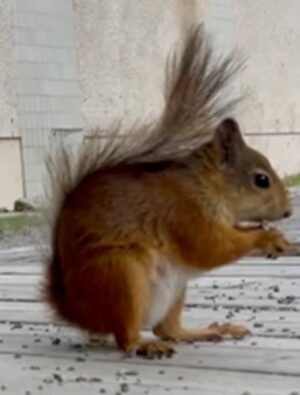
Whilst it can be amusing to watch the antics of a grey squirrel hopping about in your garden, they are generally seen as a pest. In your garden, you might find some of your bulbs have disappeared or in the fruit season, some of your soft fruits might be ‘missing’. However, in woodland and forests they are adept at stripping bark from trees, which obviously wounds the trees, distorts growth and may allow for the entry of pathogens. Grey squirrel damage to trees in England and Wales has been estimated to cost £37m a year in lost timber value and reduced carbon capture.
The squirrels tend to select vigorous trees as they have a bark with a rich sap content, such as sycamore, beech, birch and oak. It has been suggested that they targeted such trees for their sugar content, as much bark stripping activity occurs in May to July, a period when the tree would be actively photosynthesising and transporting sugars around the tree in the phloem tissue (bast). However, recent work suggests that they may be after micro-nutrients, such as calcium.
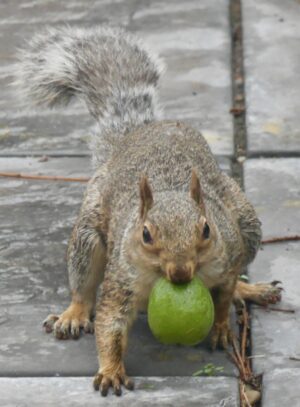
squirrel
Scientists from Bangor University have investigated and compared the microbiome of grey and red squirrels. The microbiome refers to the make-up on the bacteria and other microbes present in the gut. They help in the breaking down of food materials, and the production of vitamins. They found the intestinal (caecum*) microbiome or microbiota of grey squirrels is more diverse than that of red squirrels, and where there were bacterial species in common then the amounts differed. These findings might help explain why grey squirrels can, for example, digest acorns readily despite their tannin content, whereas red struggle to make full use of this plentiful food supply.
The grey squirrel gut also has a bacterium - Oxalobacter. This bacterium can change the insoluble calcium from tree bark into a more digestible form. Calcium levels in trees tend to rise in late spring / early summer when squirrels indulge in bark stripping. Red squirrels strip bark less frequently than greys, this may be due to their somewhat more limited, less diverse microbiome. The microbial diversity of grey squirrels may enable them to use a greater range of materials than the red squirrels, perhaps explaining in part their spread and the displacement of the red squirrel.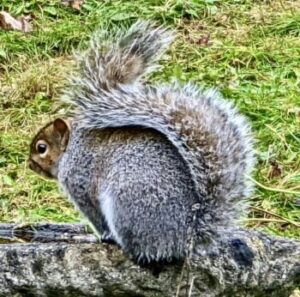 Another factor leading to the displacement of the red squirrel has been the spread of the squirrel pox virus into the red squirrel population. This virus has little effect on grey squirrels but leads to sickness and often death in red squirrels. The grey squirrel also harbours another threat to red squirrels - the adenovirus. Again grey squirrels seem unaffected by this, but red squirrels develop severe intestinal damage. This difference may again be related to the difference in the microbiome of the two types of squirrel.
Note : the caecum is a pouch within the gut, between the small and large intestine where the digestion of cellulose etc takes place, it is 'rich' in bacteria.
More detail on grey squirrels in the links below :
https://www.microbiologyresearch.org/content/journal/jmm/10.1099/jmm.0.001793
https://pubmed.ncbi.nlm.nih.gov/38354038/
and
Report Overview: The Cost of Grey Squirrel Damage to Woodland in England and Wales
Comments are closed for this post.