Watching insects on the move
Scientists from the Meteorological Office use radar data to track approaching storms and changing weather patterns. The radar works by sending out pulses of microwaves, these bounce off rain drops and other particles in the air. The time that it takes for this signal to return, plus its intensity gives information about the approaching weather.
Early radar [during the Second World War] also picked the movement of ‘angels’. These ‘angels’ were later recognised as the movement of birds, bats and insects. Scientists then had to develop techniques to remove this ‘biological scatter / material’, so that they could accurately predict storms etc. By removing this ‘biological component’ of the signal, a lot of biological information about the movement of birds, bats and insects was being ‘discarded’.
 Now, scientists from the University of Leeds have ‘repurposed’ the radar data (from many radar stations, which scan the skies many times each day & night) but this time they remove the data relating to the weather. This leaves information about the insects moving at a height of some 500 / 700 metres above the ground.
The results showed that some 11.2 trillion insects are moving during the day, and that this reduces to some five trillion at night. Some of these insects are actively flying, but some are being carried by the wind / thermals. Furthermore, there were more insects above areas such as woodlands, grasslands and even urban areas. However, the numbers were lower over intensively farmed areas, where plant biodiversity was reduced as compared to woodland or natural grassland. The numbers were also lower where artificial lighting was high.
Other work by the CEH, Newcastle University and Butterfly Conservation, has involved surveys of grassland and hedgerows in southern England (Thames Valley) some of which were lit by streetlamp, others were unlit. The areas that were exposed to night time lights had roughly half the number of caterpillars as compared to the unlit areas.
In another study, LED lighting was set up in fields, and caterpillars' numbers in these illuminated fields were reduced. The lighting may :-
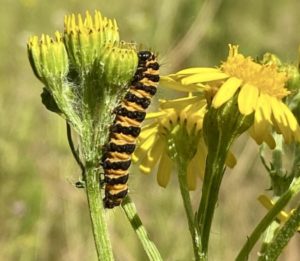
Cinnabar moth caterpillar.
- Deter nocturnal moths from egg laying.
- Make the night flying moths ‘easier targets’ for predators (such as bats).
- Affect the feeding habits of moth caterpillars.
Whilst it would seem that night time light affects insects and the feeding behaviour of caterpillars, quite how and why is yet to be determined.
Comments are closed for this post.