Fibonacci in Nature – seeds, leaves, snails and broccoli
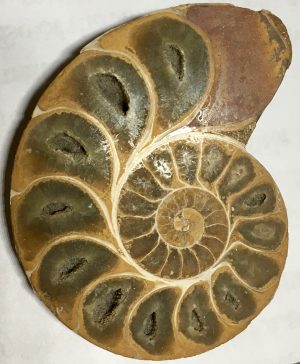
Eight hundred years ago Fibonacci identified a remarkable fact about the simplest of additions. When you start at 1 and just add the previous number, you get this series of numbers: 1,1, 2, 3, 5, 8, 13, 21, 34, 55, 89, 144 etc. In other words, 1 plus 0 is 1, 1 plus 1 is 2, 2 plus 1 is 3, 3 plus 2 is 5, 5 plus 3 is 8, etc. Any value in this series is a Fibonacci number and these numbers are often spotted in nature when one considers the number of petals on flowers, seeds in a sunflower or scales on a cone.
Another aspect of Fibonacci numbers is that very early in the series the ratio of two sequential numbers moves towards 1.618, being the “golden ratio”. For example in the series above, 34 divided by 21 is 1.619 and 55 divided by 34 is 1.618.
A Fibonacci spiral is a curved shape made by drawing quarter circles inside squares whose sizes match the sequence - as the squares get bigger, the connected arcs form a natural, expanding spiral. In nature, the logarithmic spiral of an ammonite shell approximates this Fibonacci spiral and snail shells often exhibit a similar pattern.
Many woodland trees also exhibit the ratios of the Fibonacci numbers in their leaf arrangements. This is because such patterns make the most efficient use of space or create the best way to maximise the capture of sunlight or water. For example, in many plants the leaves are arranged so that after you have gone round the stem 3 times, you will have passed 8 leaves, after 5 turns you will have passed 13 leaves and after 8 turns you will have passed 21.
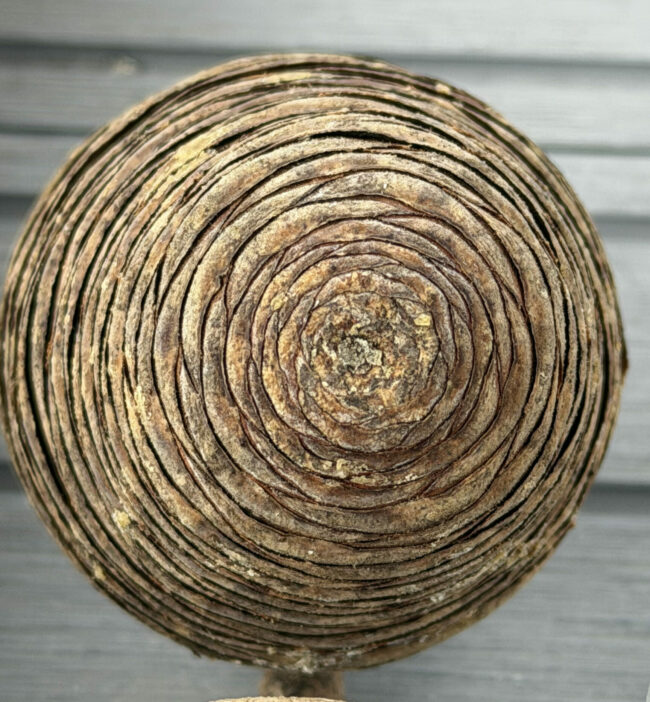
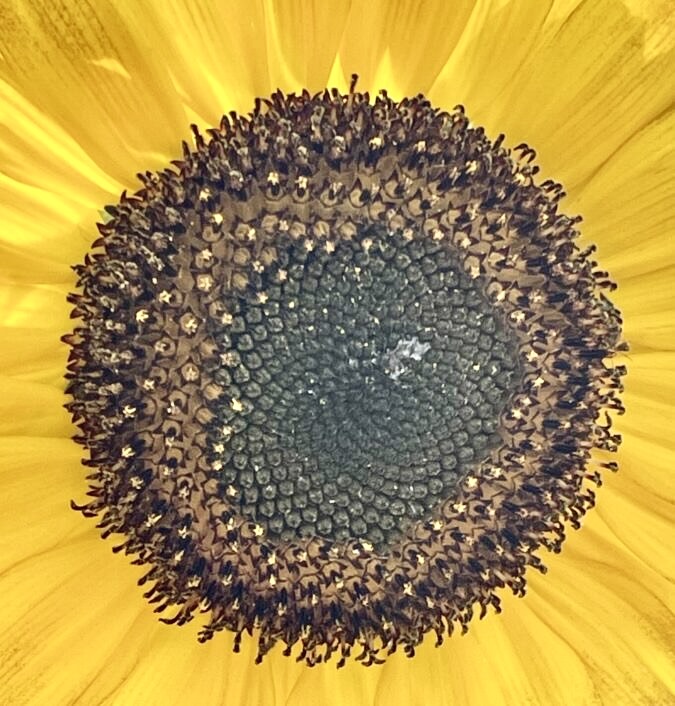 The head of a sunflower often has spirals of seeds in these ratios, such as 34 in a clockwise spiral and 55 in a counterclockwise spiral. Similar Fibonacci patterns are seen in pine cones, artichokes, Romanesco broccoli and pineapples. It isn’t that the plant is *calculating* Fibonacci ratios but that there is “emergence” of these ratios - the plant follows the rule of “putting the next leaf in the biggest available space.” One human-centred result in a pattern that be very appealing.
Discussion
Thank you for the article on the Fibonacci numbers and patterns. I came to the realization of this number later in life and used it in some of my design features. It never ceases to fascinate me. I never tire of reading about it or discovering new patterns in nature. Thanks!
Surely Charlie, growth is the root cause of life? Your last sentence seems to indicate rather muddled conceptions of reality… ? Did you mean greed grows lust for power & property, promoting patriarchal controls? I DO hope there’s deeper awareness not yet received or allowing you now to appreciate all wonders of woodland with care, respect & trust? :)
Thank you for the article.
Fibonacci figures can certainly generate pretty patterns; but my appreciation of things natural is in no way enhanced by that knowledge. In the infants class, we learned that drawing a circle with compasses, then striking off arcs, would create a geometrically-rendered impressive ‘daisy’; but the novelty soon wore off.
Scientists are convinced that science is everything – can suavely create “art” while solving all the problems of the modern world. It would seem that, outside of their own specialisms, their knowledge is philistine.
Reflection may indicate that science is directed towards solving problems caused by previous applications of science to manufacturing; and towards the invention of more consumer unnecessaries to promote ‘growth’, the new word for ‘profits’. Growth is the root cause of climate heating? Advertising is the pornography of growth/over-consumption/global warming?
Regards
Charlie, drawing pictures with compasses (or should that be compasses?? discuss) has never grown old for some of us, even got me through a degree in structural engineering.
Dave Lloyd
9 August, 2026