Elm Trees: disease-resistant elm trees now available
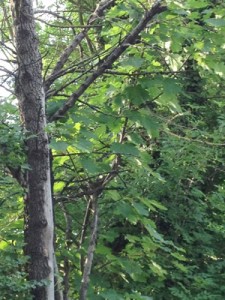
I was excited to hear from a close relative that there has now been progress on developing elm tree saplings which could be resistant to Dutch Elm disease. As one who grew up in the 1970s I remember their loss over a few years as a result of the disease. For others they will be familiar from old photographs, poems, and paintings, yet they are strangely absent from today’s countryside. Dutch elm disease [DED] reshaped the nation’s woodlands and hedgerows, killing an estimated 25 million mature trees and altering landscapes that had developed over centuries.
But the story isn’t over. A new generation of disease-resistant elm cultivars is beginning to change what’s possible for UK woodlands, conservation projects, and even urban tree-planting schemes. These elms are not the fragile giants of mid-century memory; they are carefully developed hybrids bred for resilience, longevity and ecological value. Their return opens up exciting potential for forestry, the countryside, wildlife recovery and long-term legacy forestry planning.
What resistant elms could do for UK forestry
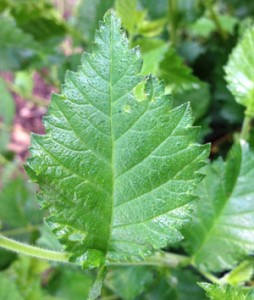
Leaf of Elm
The forestry sector in the UK is under pressure to diversify tree species, increase resilience to climate change and pests, and expand woodland cover at scale. Disease-resistant elms present a genuine opportunity to contribute to those objectives. Elm is a fast-growing hardwood, historically valued for its tough, interlocking grain and durability when wet. While its traditional uses in wheel hubs, shipbuilding, coffins and farm structures may no longer drive demand, elm still has a place in modern forestry. The new resistant cultivars grow straight, tolerate a range of soils and are adaptable to urban, lowland and upland conditions.
From a silvicultural perspective, introducing resilient elm back into mixed woodlands broadens the species portfolio at a time when ash dieback, Phytophthora strains and climate stresses are reducing the reliability of formerly dominant species. A more diverse woodland structure is a more resilient one — less vulnerable to the next big pathogen or extreme weather event.
Elm trees also provide excellent early canopy cover and can integrate well into long rotation plans. For foresters thinking 50 to 100 years ahead, resistant elms offer the possibility of establishing stands that can thrive well into the next century.
How reintroducing elms could transform the UK landscape
The cultural loss of the elm is written into the character of the British landscape. Country lanes once lined with towering cathedral-like trunks became visually bare within a generation. Many regions saw hedgerows thinned and their organic shapes lost. Even in towns and cities, the elm had been a dependable street tree until Dutch Elm Disease [DED] stripped avenues of their distinctive silhouettes.
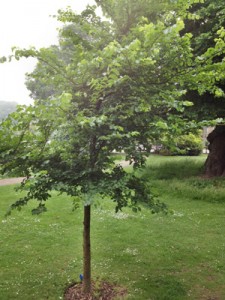
Young Elm
Restoring resistant elms has the potential to bring back this visual richness. Their broad crowns, sculptural forms and strong architectural presence offer something different from oaks, beeches, horse chestnuts and maples. Landscapes shaped by elms have a softness and particular grace — an interplay of height and curve that many native-focused designers have long missed.
Imagine the patchwork of English lowlands stitched again with lines of elms along watercourses. Picture Scottish or Welsh farmland bordered by hedgerows reinstated with elm that can survive more than a decade or two. The return of elms isn’t just ecological; it’s aesthetic, historical and emotional. It reconnects the modern countryside with an older Britain — restoring depth to the rural identity we sometimes forget is still evolving.
Even urban design also stands to benefit. Many of the resistant cultivars withstand pollution, road salt, and compacted soils, making them excellent candidates for street avenues, civic squares and parks. A walkable city framed by elms once again feels completely plausible.
Why disease-resistant elms might be good news for wildlife
Elms have always been wildlife trees. Their leaves, seeds and bark host a wide range of invertebrates, which in turn support birds and small mammals. But perhaps the most striking ecological story is the elm’s role as a critical food plant for the White-letter Hairstreak butterfly. This butterfly suffered a devastating decline as DED wiped out its primary larval host. Now, with resistant elms returning to woodlands, parks and village greens, conservationists have begun to integrate these cultivars directly into habitat recovery plans. Early evidence suggests that several resistant elm varieties are fully acceptable host plants, capable of sustaining healthy White-letter Hairstreak populations.
Bird species also benefit. Elms provide dense cover and good nesting structure, and their early leaf flush is valuable for spring caterpillar availability — an important food source for breeding birds.
In broader woodland planning, elm reintroduction helps to restore vertical layering and structural complexity, both essential for biodiversity. Combined with native shrubs and other hardwood species, resistant elms can contribute to dynamic ecosystems rather than monocultures.
UK suppliers offering disease-resistant elms
If you’re interested in planting some yourself — whether for a large woodland project or a small-scale tree-planting scheme — there are now some UK suppliers currently offering disease-resistant elm cultivars. One of them is Hillier Nurseries (Hampshire), one of the main UK distributors of the Resista® range, including Ulmus ‘New Horizon’ and Ulmus ‘Rebona’. These cultivars are widely used in both landscape and urban environments. Their website is at www.hillier.co.uk
I plan to plant a few in the Spring and see how they get on.
Discussion
On the Beds/Cambs border there are several individual mature elms, one a beautiful classic shape. Sadly a couple of huge pollards collapsed due to neglect. There is also a whole wood of elms – not merely the usual suspects where the top growth dies on reaching 15cm DBH.
Great article, thank you. I purchased 10 standard sized Ulmus ‘Wingham’ from English Woodlands the Burrow nursery in autumn 2024. They are in a valley bottom, free draining, in Dorset. Too early to say yet how they are doing, especially with the drought last year. They all came through it, with watering. I thought I had lost a couple but they shot again in September. My comments would be: they are still mostly expensive, so I don’t know how feasible yet they are for forestry at any scale, but I very much hope this improves. You can always mix a few in somewhere as a wildlife and landscape feature. Ulmus Wingham is supposed to have excellent resistance, nearly 100 %, but it is more of a ‘wolf tree’ form and probably no good for forestry. Ulmus ‘Fiorente’ has a better forestry form, but less resistance. The two mentioned in the article I don’t know. I’d love to hear how others are getting on with elm planting.
Great idea. Super. And most encouraging. I remember enormously tall elm trees littering the countryside, and particularly dominating the landscape in the aptly named Oxfordshire village of Ewelme; alas no more !
Unfortunately plants advertised here seem expensive, eg £35 for whips from Matthews and Hilliers deny their existence !
How about supplying ‘scions’ or short cuttings — free or at more affordable prices — which we might try to root ourselves ?
Best of luck !
A.L. Swanage, Dorset
I very well remember how as a young man living above Lympstone I use to trespass o haunt farmer Long’s estuary side meadows which I called “my Fields” watching the birds and other wildlife…(this was from 1969 to 1978)..I used to love the families of starlings that each year congregated along those fields in numbers noisily scouring the grass and shoreline. One midnight I was sitting under one of the large elms on the higher ground when Mr Long discovered me but was not angry or concerned but merely told me he had come to bid farewell to bullocks that were going to market the following day after three years with him. Sad, yet better than a lot of other practices. I would like to commend Mr Stuart Brooking for his always fulsome and interesting blogs and to wish him well this new year.
Jeffery John Higgs
17 January, 2026