David Hockney and the Trees
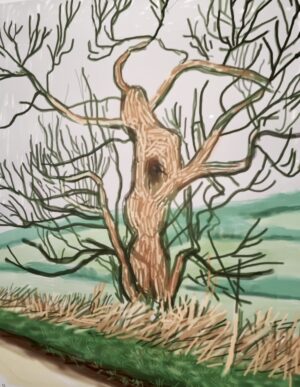
My own experience of David Hockney was an extraordinary set of bright images of trees and woodland at an exhibition in Saltaire in West Yorkshire. His death marks the passing of one of Britain's greatest artists. Many will remember him for his Californian swimming pools, his portraits and his restless experimentation with new technology. Yet some of his most original and affecting work came from a much simpler source: trees. In the last two decades of his life, Hockney became fascinated by the woods and forests of northern England. Again and again he returned to the same stretches of woodland in the Yorkshire Wolds, painting them through winter, spring, summer and autumn. Like a naturalist studying a favourite species, he observed every change in colour, structure and light.
The centre of this obsession was a small area of woodland near the village of Warter in East Yorkshire. Here he found the subject that would occupy him for years. The trees themselves were not particularly famous or ancient. They were ordinary beeches, ashes, sycamores and hawthorns growing beside country roads and in modest woods. Yet Hockney saw something extraordinary in them. Their branches formed intricate patterns; their colours shifted with every season; their appearance changed from hour to hour as the light moved across them. His masterpiece Bigger Trees Near Warter was the culmination of this fascination. Stretching more than fifty feet across, it transformed a relatively unremarkable patch of Yorkshire woodland into one of the most ambitious landscape paintings produced in Britain for generations. The work depicts trees in winter, stripped of their leaves. Without foliage to distract the eye, the viewer is drawn into a maze of branches and trunks. Hockney turns the woodland into something almost architectural, a vast structure built from living wood.
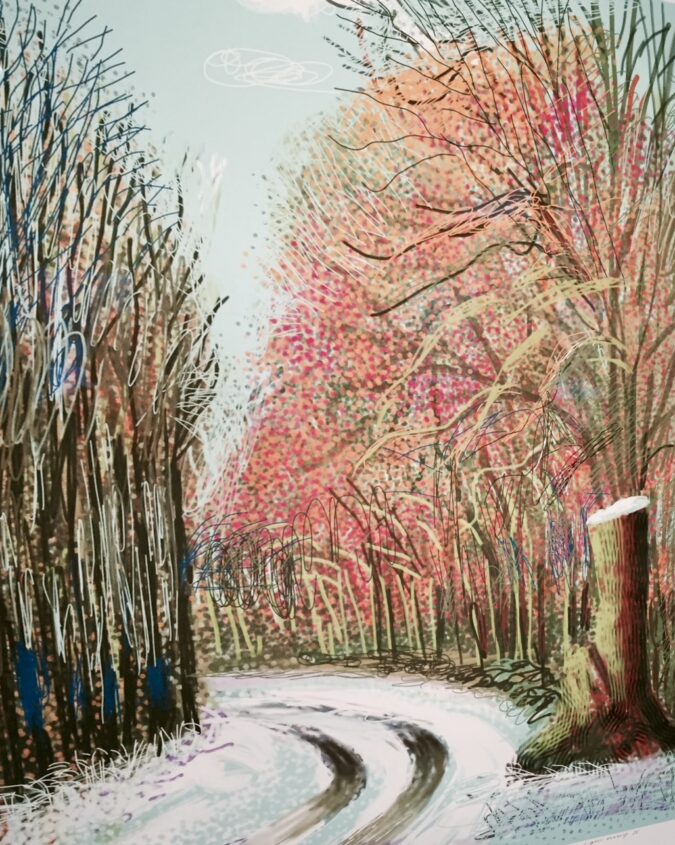
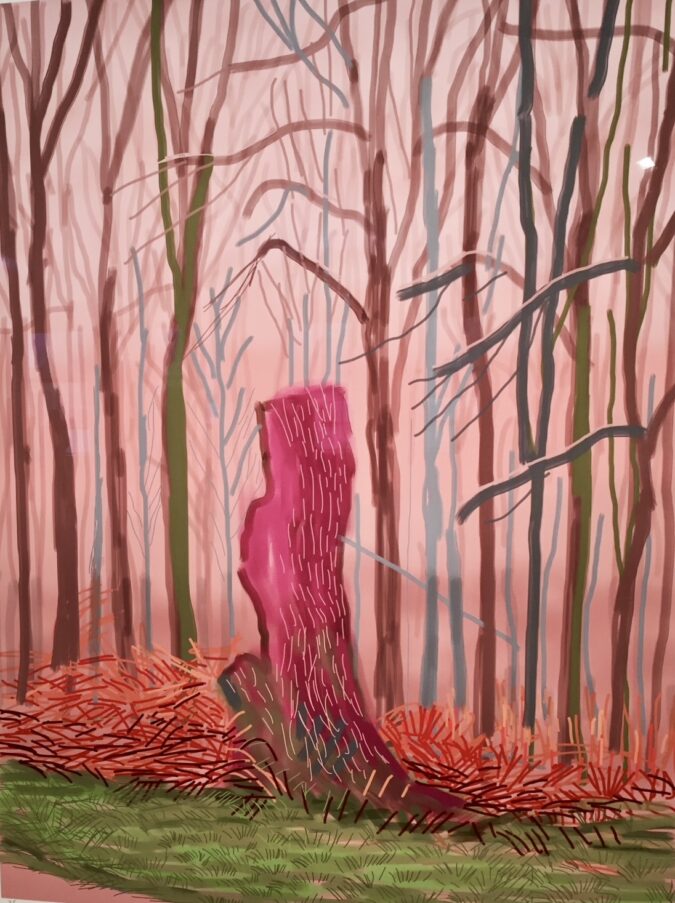
What distinguished Hockney's woodland paintings was his refusal to treat trees as background scenery. In much traditional landscape art, trees frame a view or provide decoration. For Hockney they were the main event. He painted individual trunks, tangled roots, branches reaching skywards and the spaces between them. He once remarked that trees are among the most complex things we ever look at, yet most people hardly notice them.
His favourite location became the lanes around Warter, Garrowby and the nearby woods of the Yorkshire Wolds. These landscapes appear repeatedly in works such as The Tunnel, October-November, Woldgate Woods and May Blossom on the Roman Road. The same roads and woodland rides recur year after year, allowing viewers to witness the changing seasons almost as if they were watching a film. In later life Hockney found a new woodland inspiration in Normandy. There, he rented a farmhouse surrounded by trees and produced hundreds of paintings and iPad drawings recording the arrival of spring. Blossom erupted across orchards and woodland edges. Fresh leaves appeared almost overnight. His celebrated series A Year in Normandy captures the seasonal cycle of a landscape seen with extraordinary attentiveness and joy.
Hockney's paintings remind us that forests are not static places. They are constantly changing communities of light, colour and growth. He showed that a roadside copse in Yorkshire could be as worthy of artistic attention as the Alps or the Grand Canyon. More than perhaps any modern artist, he taught us to look carefully at trees. That may prove his most enduring legacy. Long after the swimming pools fade from memory, the woods of Yorkshire and Normandy will remain alive in his paintings: places where he discovered wonder in every branch and every leaf.
Comments are closed for this post.