The trouble with squirrels
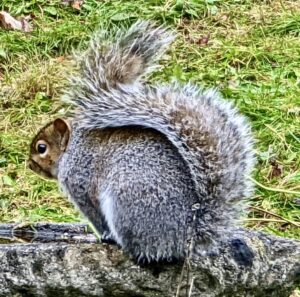
The red squirrel is a native species, it has been present in the British Isles since the retreat of the glaciers of the last ice age -so around for some 10,000 years. The grey squirrel on the other hand has only been here since the mid nineteenth century, when it was introduced from America. Though relatively small numbers were introduced at stately homes, it did incredibly well and they spread out from their original sites, colonising woodlands and spreading across the country. As the grey squirrel spread so the red squirrel retreated and its numbers declined.
Recent population estimates suggest that the grey squirrel population may now be as high as three million, whereas the red squirrel numbers are probably less than 300,000.
The grey squirrel is to be regarded as a pest. Why ?
(a). They strip bark from trees. This is the main type of damage type of damage. The squirrels remove bark to access the sap tissues underneath.
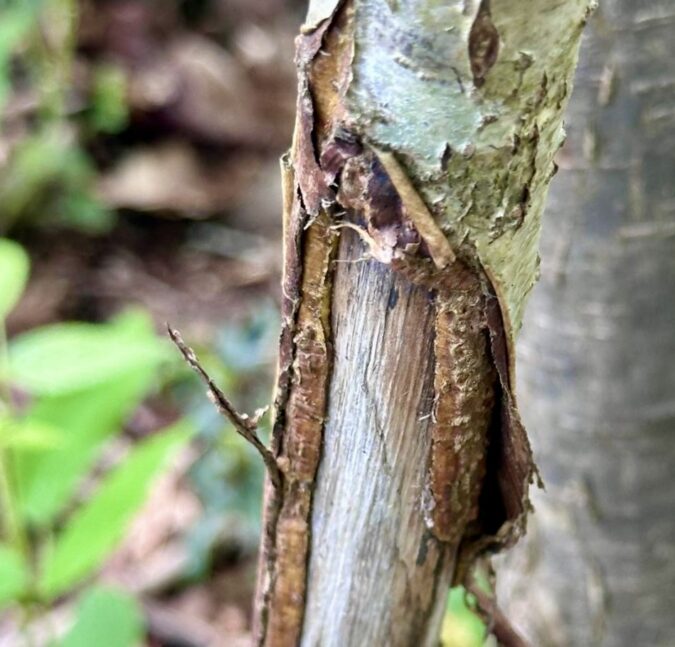
Squirrel damage
(b). They cause the death of trees. The damage to the bark and the underlying tissue can affect the flow of water and nutrients from soil to leaves. It can also allow for the entry of pathogens (parasitic bacteria and fungi).
(c). Their activities have an impact on the quality of timber that can be harvested.
(d). They are associated with biodiversity loss, not only do they complete with and displace the native red squirrel, their presence can affect other woodland species such as songbirds (eat their eggs) and dormice.
(e). Grey squirrels pass on the squirrel pox virus to red squirrels. Once infected the red squirrels tend to die of dehydration and starvation.
[(f). The grey squirrels that visit my garden dig up bulbs, like crocus, tulips and hyacinths. They also make raids on soft fruits.]
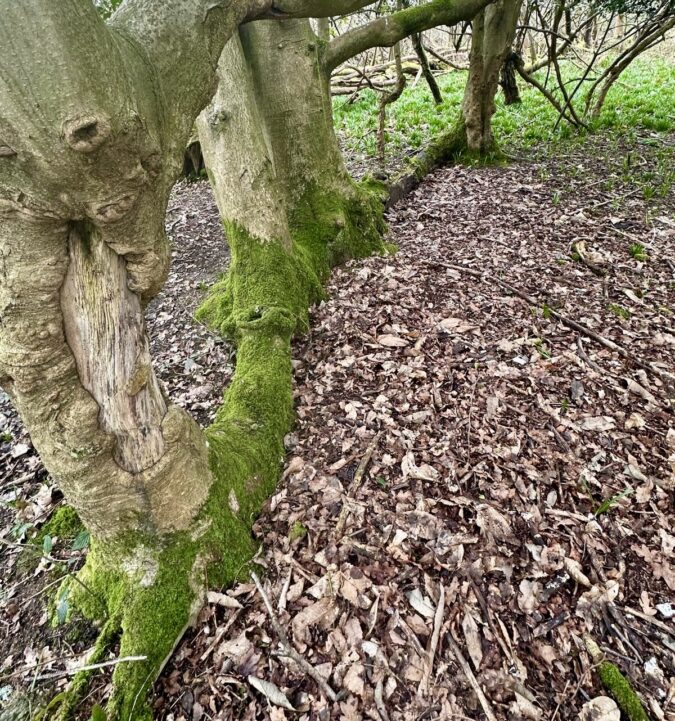
Older damage by squirrels
There are measures to stop or limit grey squirrels from breeding. One ‘extreme’ measure is shooting or trapping followed by euthanasia. Another measure is the introduction of Pine Martens, they seem to control the numbers of grey squirrels whereas red squirrels have co-existed with Pine Martens in areas like north Scotland for many years.
However, the Governments Animal and Plant agency is developing a contraceptive. This is a vaccine based product which causes the squirrel’s immune system to render both males and females infertile. The vaccine induces the formation of antibodies against the animals own reproductive hormones. The idea is to fed it to the grey squirrels through feeding hoppers that grey squirrels can access but not red squirrels or other animals. The bait will need to be palatable and attractive to the squirrels. Should this prove successful, it will be a non-lethal way of reducing the numbers of the grey squirrel without shooting or trapping.
For detailed information on the squirrel contraceptive project, visit https://aphascience.blog.gov.uk/2024/09/30/reducing-grey-squirrel-overpopulation/
Similarly, lots of information on squirrel damage here : https://www.observatree.org.uk/media/1425/identifying-squirrel-damage.pdf
Comments are closed for this post.
Discussion
That’s an important point about habitat, Amelia, but it overlooks a critical biological factor: Squirrel Pox Virus (SQPV).
While habitat loss is absolutely a main driver in the decline of Red Squirrels, the presence of the invasive Grey Squirrel introduces a fatal, immediate threat that habitat creation alone cannot solve:
* SQPV is Lethal to Reds: Grey Squirrels are generally immune to SQPV but are carriers of the virus. When Greys move into an area, they spread the virus, which is almost always lethal to Red Squirrels. This means even if you have the perfect red-friendly woodland, the introduction of a Grey Squirrel carrying the virus can wipe out the local Red Squirrel population in a matter of weeks. Control is necessary to create a vital SQPV-free buffer zone around Red Squirrel strongholds.
* Greys Hinder Habitat Regeneration: You mention creating new habitats, but Grey Squirrels actively sabotage this effort through bark stripping. They strip the bark from young, high-value native trees (like oak, beech, and sycamore), which often kills the trees or severely damages them. This makes natural regeneration and new woodland establishment incredibly difficult, if not impossible, in areas with high Grey Squirrel density.
Therefore, for conservation to be successful, it must be a two-pronged strategy:
* Long-Term: Create and manage excellent Red Squirrel habitat.
* Immediate & Essential: Implement targeted Grey Squirrel control to stop the spread of the lethal SQPV and allow young woodlands to establish without destructive bark stripping.
Without effective control, creating new woodland is simply creating a new food source for Greys, and any Red Squirrel population will remain acutely vulnerable to the deadly pox.
So sick of this type of lazy biased reporting. Red squirrels were slaughtered in their thousands. Habitat loss is the main reason for their decline. Greys generally prefer a different type of woodland and thrive where reds wouldn’t survive. Killing them is pointless as the population simply recolonises.
Don’t kill greys. Create red friendly habitats.
I would love to introduce Pine Martins to my Woodland, but I do not think this will be possible.
The squirrel contraceptive would be a great alternative. How would I get it?
I am a member of the wildlife trusts (Norfolk) and regularly visit the trusts ancient woodlands. The thing I notice most is the sheer number of Grey Squirrels. They are doing huge damage to the hardwood trees. I had hoped that in my lifetime I would see Red Squirrels back in Norfolk but this is unlikely to happen.
I think the most effective way of control is shooting-quick and humane. I would like to know if any owners of woodland in Norfolk would be willing to allow the shooting of these pests with a rifle? I have over 45 years experience, am insured and completely safe. I don’t even charge!
Arthur Bell
9 December, 2025