A case of the pink squirrel ?
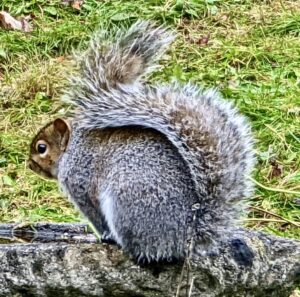
Researchers at the Animal and Plant Health Authority (APHA) has been working of an oral contraceptive that will hopefully offer a way to reduce grey squirrel populations in a humane and effective manner. The contraceptive targets a mammalian hormone known as GnRH [Gonadotropic Releasing Hormone]. This hormone stimulates squirrels to ovulate or produce testosterone. The contraceptive stimulates the production of antibodies against the GnRH so that the animals are rendered sterile. However, there are problems with the contraceptive.
- It affects other species, such voles, wood mice, and dormice if they feed in the ‘traps’.
- Ensuring its effective means of delivery to grey squirrels alone.
To address these issues, APHA has be experimenting with different designs of baited ‘traps / feeders’ to deliver the contraceptive so that only grey squirrels can enter. The bait for these ‘traps / feeders’ is hazelnut butter mixed with rhodamine B. The rhodamine B is added as it causes the fur of grey animals that have taken the bait to fluoresce under UV light, it may also colour the fur of the squirrel to PINK. Red squirrels cannot reach the bait as they are not heavy enough to trigger the internal mechanism of the trap / feeder. A recent test of the mechanism revealed 19,000 visits by grey squirrels but only 9 by mice, so it does effectively distinguish between different woodland species. There is now a plan to test the traps / feeders on a much larger scale in Cumbria, Northumberland, South Scotland and Lancashire. Perhaps technology may be used to follow the behaviour of the animals at the 'traps' - e.g. trail cameras / infra red photography.
Modelling by APHA of the contraceptive and modified traps suggests that grey populations might drop by half within six years. Other methods to reduce the grey squirrel numbers include: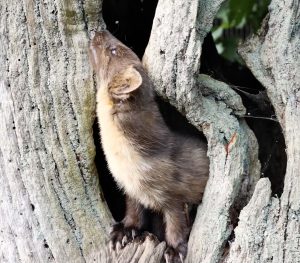
- The introduction of Pine Martens in suitable areas, which predate more successfully on grey squirrels, as the red ones are somewhat nimbler.
- Incentives for landowners to create more woodland.
Further information : https://aphascience.blog.gov.uk/2018/10/09/red-squirrel/
Comments are closed for this post.
Discussion
Thank you Charles. I have subscribed: Interesting articles, see how I go.
In the light of the comment by Cass, there is an interesting article here :
https://aeon.co/essays/ecologys-war-on-invasive-species-isnt-science
I’ve been rewilding for a few years and have visiting grey squirrels: I think, human beings have done enough over the years to disrupt and control species > Maybe if ‘we’ focused more on the human being species in terms of the damage ‘we’ do to ourselves, Flora and Fauna and the environment we may become a species that lives within the Earth rather than on top of it > I’m disheartened reading this article: I don’t think the current Human. Being species has learnt anything about the Natural World >
I agree with previous comment. Let them be. Absolutely awful that such an idea is being considered. What about all the other species that this will affect. Let nature be. Be grateful to have such wildlife and embrace it. Brings tears to my eyes.
I accidentally stumbled on this website woodlands.co.uk. I live in Las Vegas, Nevada. Do you people realize how fortunate you are. We have no green here, no squirrels, no nothing but dirt. Brown dirt that is what we have. Imagine driving around town an hour & during that entire time not seeing a patch of living greenery. Assembly Bill 356, passed in 2021 and effective through 2026, mandates the removal of “nonfunctional turf” (decorative, non-recreational grass) across Southern Nevada by January 1, 2027, to conserve water. You get paid to removal your grass. Public Infrastructure: Street medians and roundabouts are having grass replaced with metal artwork on rare occasion maybe a desert friendly plant.
Recreation Spots: A notable project is the removal of 88,000 square feet of turf at Mission Hills Park in Henderson. All we have is rocks & dirt. And fake grass. All this in the name of conserving water. Imagine what this is like. We worry about climate change but this has only added fuel to the fire. And in the long run , I wonder is this actually going to help with the water crisis we’re in. I read this article about too many squirrels and it just makes me cry. We have fake turf here and unfortunately that will not sustain life. The cemetery is the best chance you got at possibly seeing a squirrel here in Las Vegas. It used to be really exciting to see a wild burro in the dessert, a rare occasion it was. Despite how rare, they have been rounded up in the name of controlling the population and now I honestly can’t remember the last time I’ve seen one.
Sorry my comment is so long and a bit off topic. Embrace what you have including all them darn squirrels ♥️
Frances Timmermans
9 April, 2026