Carder bees – important pollinators.
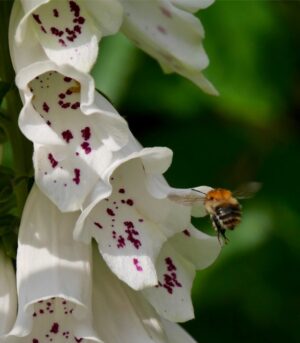
There are some 270 species of bee to be found in the UK. Most of these bees are solitary bees. Solitary bees do not form colonies like the honey bee, with a queen and workers. Twenty four are types of bumblebee, although two of these bumblebees may be extinct in the UK. Included in the bumblebee category are the carder bees. Their name relates to their ability to ‘knit’ together plant materials / fibres to form a nest*.
The six species of carder bees in the UK are listed below :
- The common carder bee
- The brown banded carder bee
- The moss carder bee
- The red shanked carder bee
- The ruderal carder bee
- The shrill carder bee
The common carder bee (Bombus pascuorum) is quite widespread and is found in gardens, the edges of woodland, and farmland throughout the country. It is a social insect, forming colonies with worker bees. Their yearly cycle is not dissimilar to that of bumblebees. In spring, queen carder bees emerge from hibernation and establish new colonies. These develop throughout the spring and summer, adding workers. By late summer, new queens and males are formed, and in autumn the old queen and workers die. The new queens overwinter and emerge in the following spring.
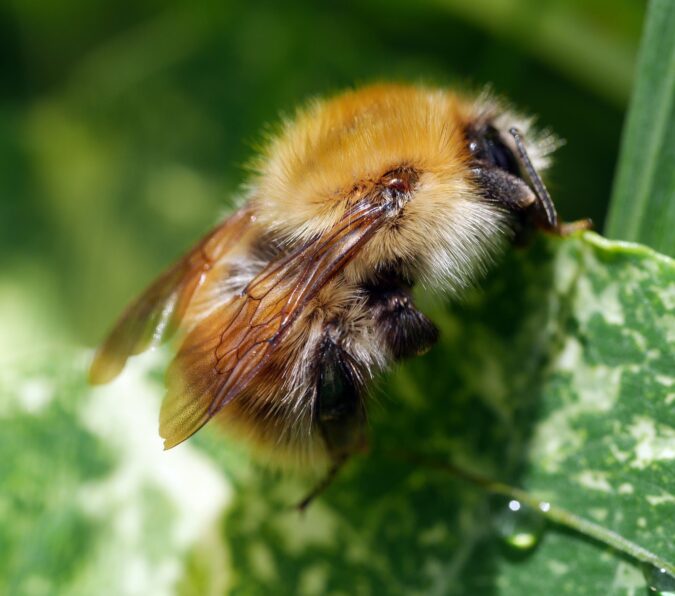
Common carder bee
Carder bees tend to build their nests on or near the soil surface, using moss, dried grass or similar plant material. The shrill carder bee favours flower-rich grassland areas to build its nest. As so many of these diverse grasslands have disappeared over the last century, it explains the rarity of this particular bee. Carder worker bees are a ginger / warm brown colour.
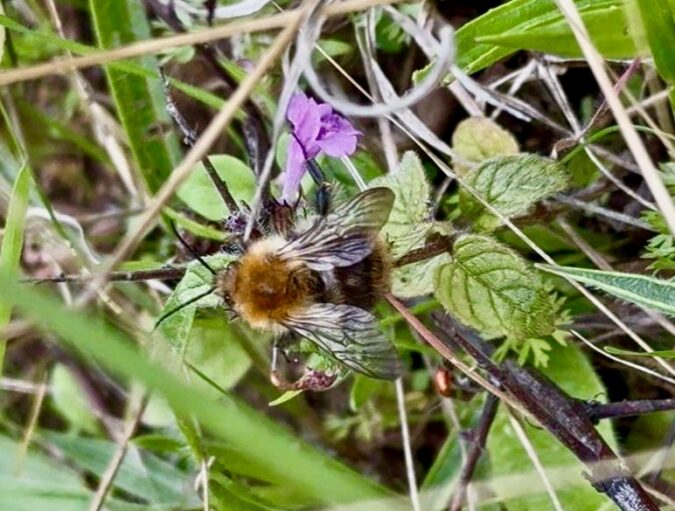
Carder bees are noted for their ‘long tongues’, i.e. their mouthparts have a long proboscis [feeding tube]. This allows them to reach the nectar inside flowers with a long, tubular shape (such as foxgloves, honeysuckle and clover). It also means that they are not in direct competition with ‘shorter tongued’ bees, who can only access open flowers. Whilst visiting flowers, they act as pollinators of both wild flowers and farmland crops. As pollinators, they help promote the transfer of pollen from plant to plant, promoting outbreeding which in turn helps maintain variation with a species.
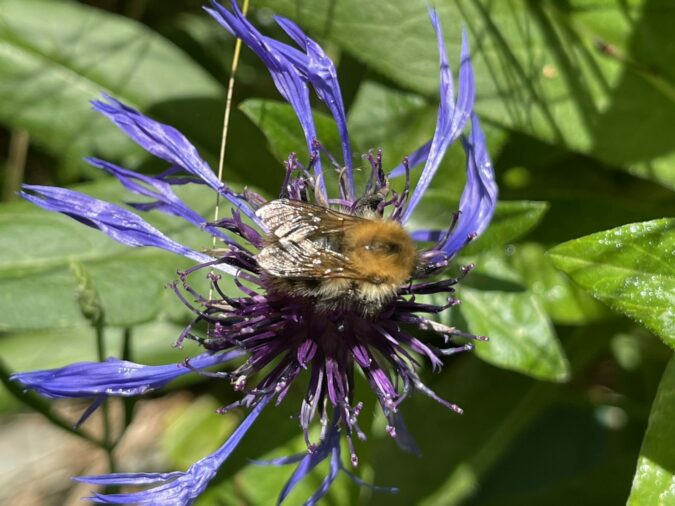
The bees actively forage from spring into autumn and can thrive in our extensively modified landscape, so they are key pollinators in both rural and urban areas.
* Originally, the term a carder referred to person who combs out and cleans fibres of wool / cotton before spinning.
Comments are closed for this post.