Living fossils – horsetails.
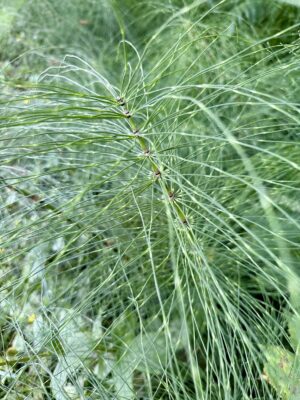
Like the monkey puzzle tree, the horsetails (Equisetum spp) are sometimes referred to as ‘living fossils’. Some of their ‘relatives’ date back to the late Devonian period - about 380 million years ago. Some were huge and tree like, reaching a height of some 30 metres, about 98 feet. These plants formed 'forests' and were abundant in the carboniferous period. These ancient species persisted for some 100 million years, with some contributing to the formation of coal deposits. Modern horsetails first appeared during the Jurassic period.
Present day forms are much smaller than those of the past.. Equisetum arvense is a species that is widespread across Northern Europe and parts of America. It is a nonflowering plant, multiplying through spores. It can absorb silicon from the soil, which is unusual. It also has the ability to take up and accumulate heavy metals such as copper, zinc, lead and cadmium. It grows and spreads by underground rhizomes. These rhizomes can form an extensive network, penetrating deep into the soil (sometimes to a depth of six feet). This means the plant can be very difficult to eradicate if it appears in your garden. Techniques for removing the plant can be found on the RHS site : here. Unchecked, Equisetum can spread extensively and smother / outcompete smaller plants.
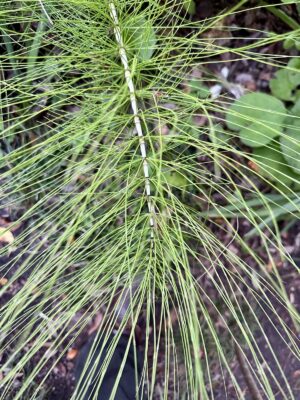 In Spring, the rhizomes produce pale, fertile shoots, topped with strobili. Strobili are cone shaped structures that release spores. Once the spores have been released, these shoots wither and die. Somewhat later, the non-reproductive shoots appear. These have fine branches that appear in whorls around the ‘segmented’ stems. The whorls form at various ‘nodes’ along the stem. These branches give the plant is characteristic form.
The name Equisetum comes from the latin Equus for horse, and setae for bristles, as the shoots have a vague resemblance to a horse’s tail. The word arvense is also derived from the Latin where "arvum", means “ploughed”. This references the growth of the plant in arable soil and disturbed areas. Horsetails commonly occur in damp and open woodlands, and may also been found near the edges of streams (which may have been their original habitat).
The plant has been used in herbal medicine to make a ‘tea’ or used in baths to treat skin complaints, chilblains and wounds.
Leave a comment