A Guide to Tree Identification
It is possible to identify many of our native trees by looking at their leaves. Strictly speaking, identification should involve examination of the flowers (petals, sepals, stamens etc), which are less variable than leaves. However, in most cases, it is possible to make an identification using just a few features of the leaves and twigs.
We are developing a series of guides to help you identify individual tree species on the right, or on mobile click on list of tree species. Then just click on the name of the tree that interests you. This part of the site is still under development, we hope to be able to add pictures of winter twigs etc ..... and other tree species.
If you are particularly interested in the nature of the timber from a particular species of tree then you may find this site helpful : http://www.timberpolis.co.uk/wood-species
Leaf
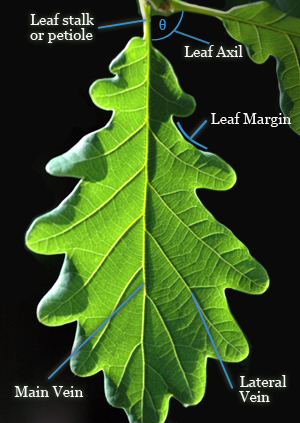
The leaf blade
Leaves are generally speaking broad, flat, and thin: these features allow them to intercept light for photosynthesis and allow gases to enter or leave the leaf easily. The flat surface of the leaf is termed the leaf blade or lamina, as seen to the left. The top surface (or adaxial surface) of the leaf is often very different from the lower (or abaxial) surface. For example the lower surface may be hairy, or a different colour, or the veins of the leaves may be more obvious. The leaf is usually joined to the stem of a plant by a stalk; this is called the petiole. The angle that the petiole makes with the stem of the plant is termed the leaf axil. The tip of the leaf is sometimes referred to as the apex of the leaf.
The leaf margin
The edge of the leaf is known as the leaf margin. Looking at the margin of the leaf can be an important in identifying the leaf. Leaf margins may be described as entire, toothed, or lobed. The oak leaf to the left is clearly lobed.
Leaves, simple or compound
A leaf is said to be simple if its lamina is undivided; that is, any ‘teeth’ or lobes do not reach down to the main vein of the leaf. A compound leaf consists of several leaflets, all of which join up with a single leaf stalk or petiole. It is important when looking at the leaves of a tree to look for the petiole - as a single leaflet of a compound leaf can look like a single, simple leaf.
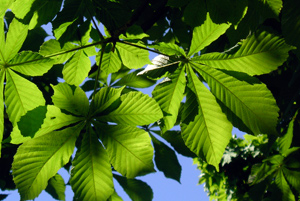
Palmate compound leaf
For this type of leaf, the leaflets join to a central point, like outstretched fingers joined to a central palm - like those seen on Horse Chestnut.
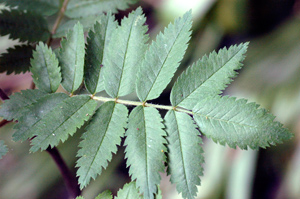
Pinnate compound leaf
The leaflets usually occur in pairs (opposite to, or slightly displaced from opposite each other) with a single leaflet at the top of the leaf - like those on Ash and Mountain Ash.
Leaf arrangement
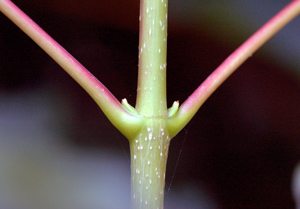
Leaf arrangement or phyllotaxis is another feature of leaves that may help in you in identifying a tree is how they are arranged on the shoots or twigs of the tree.
Look at a shoot (not too near the tip).
- How are the leaves arranged?
- Do they occur in pairs?
If pairs of buds are set at right angles to each other, then this arrangement is described as decussate (as seen in the Horse Chestnut).
Or are they arranged singly and alternately, as in Beech and Birch?
Bark, Buds & Stem
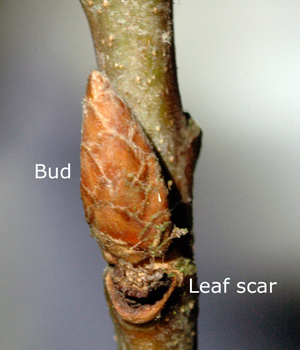
Buds
The buds are usually encased in modified leaves - scale leaves. These may be tough protective structures, they may be coloured or they may be sticky (as in the horse chestnut). When the scale leaves fall, they often leave distinctive scars on the twigs (see the photo to the left). The size, colour, position of the buds can often help identify a tree in winter, when the leaves have been shed.

Shoots and twigs
When examining shoots and twigs, it is sometimes useful to look for lenticels. Lenticels are small areas on the stem, where the cells are less densely packed so as to allow for the exchange of gases.
Depending on the species, they can be small, round ‘spots’ or minute ‘slits’ and the colour of them can also vary.
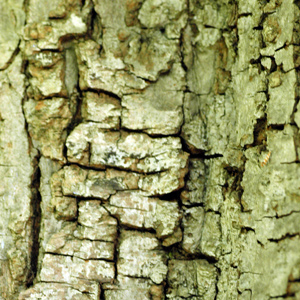
Bark
In more mature trees, another feature that can help in identification is the bark. The bark protects the underlying tissues from damage. The outermost part of the bark consists of dead cells and often has a characteristic colour and texture.
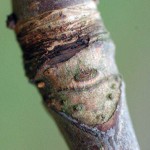
Winter Twigs
Examination of the arrangement of the buds (are they opposite or alternate?), the colour of the buds and their scale leaves, and the leaf scars can often provide enough information to identify a tree.